

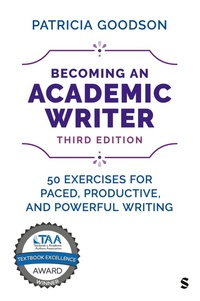
Becoming an Academic Writer
50 Exercises for Paced, Productive, and Powerful Writing
3rd Edition
Published on 17. October 2023
Book
Paperback/Softback
272 pages
978-1-5443-5615-0 (ISBN)
Description
With its friendly, step-by-step format, the Third Edition of Becoming an Academic Writer helps readers improve their writing by engaging in deep, deliberate, and daily practice. Author Patricia Goodson designed this book for anyone in an academic setting who must write to survive, from new graduate students to senior faculty. Featuring 50 exercises, this practical and flexible self-paced guide is organized so readers can either work through the exercises in order, or focus on the specific areas where they need additional practice. The Third Edition features an expanded unit on how to manage the reading required for any writing project - a strategy to help writers avoid getting bogged down in this crucial step. Updated material, alongside testimonials from students and readers, new appendices on topics such as processing reviewer feedback, and new "Research Shows" boxes help readers address important hurdles to developing a lower-stress, sustainable writing habit.
Reviews / Votes
"The major strength of this text are the exercises. The exercises are practical, doable, and relevant to the new, developing, andexperienced writer. They make the often overwhelming task of academic writing, palatable and approachable." -- C. Casey Ozaki "I like the way that it sets up students for success if they are patient enough to read carefully and work through the exercises." -- Anne Hardgrove "It has a lot of GREAT writing advice that helps students to break through writing blocks, helps them think through their ideas, and helps
them write about it in a powerful way." -- Holly Brewer, Burke Professor of American History "Students loved it and found it very useful. Everyone I've recommended it to has found it to be useful." -- Brenda C. Barnes, Ph.D. "[This text] encourages the development of identity as a writer and writing as a practice, provides several practical tips and guidance for practices that will develop strengths as a writer, [and] maintains an accessible tone. No one will feel that this book is too lofty for them to use it." -- Vanessa Dennen "The strength of this text is the practical exercises." -- Lize A.E. Booysen. Gradute School of Leadership and Change "The key advice is sound. The collection of other writers' advice is excellent. The author brings together a lot of good advice. I found
myself taking notes from chunks of the book for my lecture discussion." -- Joseph Graf "It is suitable for a flipped teaching approach, [and emphasizes] internalizing the writing process and developing an identity as a
writer." -- Charles Duquette "Practical, accessible, useful, empathic" -- Dr. Amanda O. Latz
More details
Edition
3rd Revised edition
Language
English
Place of publication
Thousand Oaks
United States
Target group
College/higher education
Edition type
Revised edition
Dimensions
Height: 229 mm
Width: 152 mm
Thickness: 18 mm
Weight
449 gr
ISBN-13
978-1-5443-5615-0 (9781544356150)
Copyright in bibliographic data and cover images is held by Nielsen Book Services Limited or by the publishers or by their respective licensors: all rights reserved.
Schweitzer Classification
Other editions
Previous edition
Patricia Goodson
Becoming an Academic Writer
50 Exercises for Paced, Productive, and Powerful Writing
Book
05/2016
2nd Edition
SAGE Publications Inc
€82.00
Article exhausted; check for reprint
Person
Patricia Goodson is professor of health education in the Department of Health & Kinesiology at Texas A&M University (TAMU). She obtained a bachelor's degree in Linguistics (from Universidade Estadual de Campinas) and a master's in Philosophy of Education (from Pontificia Universidade Catolica de Campinas) in Brazil; a master's in General Theological Studies (from Covenant Theological Seminary) and a PhD in Health Education (from the University of Texas at Austin) in the United States. At TAMU, she has taught mostly graduate-level courses such as Health Behavior Theory, Health Research Methods, Health Program Evaluation, Health Education Ethics, and Advanced Health Behavior Theory. In 2007, while acting as associate dean for Graduate Program Development, she created and implemented a college-wide writing support service for graduate students, based on the POWER model described in this book. Currently, as director of the College of Education and Human Development's Writing Initiative (POWER Services), she offers Basic and Advanced Writing Studios for graduate students in the college, on a regular basis, and occasionally teaches writing workshops for faculty at Texas A&M and other universities. Dr. Goodson has won several department-, college-, and university- level awards for her teaching and research. In 2012 she was awarded the title of Presidential Professor for Teaching Excellence at Texas A&M University-one of the highest teaching awards at that university. Also in 2012, she became the university's sole nominee for the Piper Professor Award, a state-level recognition for teaching. While she considers mentoring graduate students the most fulfilling part of her career, a couple of research interests vie for her attention. Her research focuses on topics such as sexual health of adults and adolescents, the history of the HIV/AIDS epidemic, and public health genomics. She has published extensively in high-impact journals, has reviewed for several prestigious publications, and has served as book review editor for The Journal of Sex Research. One of her intellectual passions is theory, and her "other" book presents a critique of health education's current use of theory in both research and practice.
Content
Chapter 1. Get Ready to Practice
The POWER Model
Practicing Academic Writing
Note to the Third Edition
Chapter 1-Main Points in One Page
Notes
Part I. Practice Becoming a Productive Academic Writer
Chapter 2. Establish and Maintain the "Write" Habit
Think About It...
Seeing Yourself as a Writer
Chapter 2-Main Points in One Page
Notes
Chapter 3. Practice Building Academic Vocabulary
Think About It...
Alternative
Online Sources
Chapter Three-Main Points in One Page
Chapter 4. Polish the Grammar
Think About It...
Online Sources
Chapter Four-Main Points in One Page
Chapter 5. Get Feedback
Think About It...
Online Sources
Chapter Five-Main Points in One Page
Chapter 6. Edit and Proofread
Think About It...
Online Sources
Chapter Six-Main Points in One Page
Note
Part II. Practice Writing Introductions, Methods, Results/Findings, and Discussions
Chapter 7. Exercises for Writing Introductions & Purpose Statements
Think About It...
Online Sources
Chapter Seven-Main Points in One Page
Notes
Chapter 8. Exercises for Writing the Methods Section
Think About It...
Online Sources
Chapter Eight-Main Points in One Page
Chapter 9. Exercises for Writing the Results/Findings Section
Think About It...
Online Sources
Chapter 9-Main Points in One Page
Chapter 10. Exercises for Writing the Discussion or Conclusion Section
Think About It...
Chapter Ten-Main Points in One Page
Notes
Chapter 11. Exercise for Writing Abstracts
Think About It...
Chapter 11-Main Points in One Page
Chapter 12. Reading-&-Writing: How to Stop Making the Literature Review an Excuse For Not Writing
Think About It...
Conversing With the Text
Systems for Reading and Organizing the Reviewed Literature
Read and Write Simultaneously: The Matrix Method
Identify the Purpose for Reading
Remember: Always Read with a Well-Defined Purpose
The Matrix and Your Writing
Reality Check
Chapter Twelve-Main Points in One Page
Note
The POWER Model
Practicing Academic Writing
Note to the Third Edition
Chapter 1-Main Points in One Page
Notes
Part I. Practice Becoming a Productive Academic Writer
Chapter 2. Establish and Maintain the "Write" Habit
Think About It...
Seeing Yourself as a Writer
Chapter 2-Main Points in One Page
Notes
Chapter 3. Practice Building Academic Vocabulary
Think About It...
Alternative
Online Sources
Chapter Three-Main Points in One Page
Chapter 4. Polish the Grammar
Think About It...
Online Sources
Chapter Four-Main Points in One Page
Chapter 5. Get Feedback
Think About It...
Online Sources
Chapter Five-Main Points in One Page
Chapter 6. Edit and Proofread
Think About It...
Online Sources
Chapter Six-Main Points in One Page
Note
Part II. Practice Writing Introductions, Methods, Results/Findings, and Discussions
Chapter 7. Exercises for Writing Introductions & Purpose Statements
Think About It...
Online Sources
Chapter Seven-Main Points in One Page
Notes
Chapter 8. Exercises for Writing the Methods Section
Think About It...
Online Sources
Chapter Eight-Main Points in One Page
Chapter 9. Exercises for Writing the Results/Findings Section
Think About It...
Online Sources
Chapter 9-Main Points in One Page
Chapter 10. Exercises for Writing the Discussion or Conclusion Section
Think About It...
Chapter Ten-Main Points in One Page
Notes
Chapter 11. Exercise for Writing Abstracts
Think About It...
Chapter 11-Main Points in One Page
Chapter 12. Reading-&-Writing: How to Stop Making the Literature Review an Excuse For Not Writing
Think About It...
Conversing With the Text
Systems for Reading and Organizing the Reviewed Literature
Read and Write Simultaneously: The Matrix Method
Identify the Purpose for Reading
Remember: Always Read with a Well-Defined Purpose
The Matrix and Your Writing
Reality Check
Chapter Twelve-Main Points in One Page
Note