

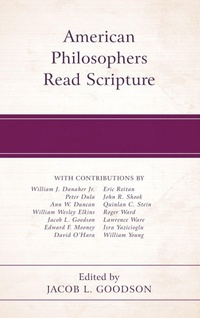
American Philosophers Read Scripture
Published on 13. December 2019
Book
Hardback
266 pages
978-1-4985-3795-7 (ISBN)
Description
This collection introduces readers to the philosophical interpretation of Scripture, specifically within American Philosophy. The purpose of the collection concerns starting a conversation about the practice and task of the philosophical interpretation of Scripture. Reflections on the philosophical interpretation of Scripture have been treated more as a "conversation-stopper" than a conversation-starter within the American academy. To start such a conversation, this collection offers substantive accounts of the role of Scripture in the philosophical thought of fifteen American philosophers: Jane Addams, Henry Bugbee, Stanley Cavell, John Dewey, Jonathan Edwards, Ralph Waldo Emerson, Margaret Fuller, William James, Martin Luther King, Jr., Charles Sanders Peirce, Josiah Royce, Richard Rorty, George Santayana, Henry David Thoreau, and Cornel West.
Reviews / Votes
This collection of explorations into the manner and purpose of American philosophers' reading of Scripture pushes back against trends in academic philosophy that seek to block this path of inquiry. The authors investigate the question with acuity, inventiveness, and care, such that the reader wants to learn more about the philosophers, previously known or unknown, whose use of Scripture has gone unnoticed or ignored. The book is a welcome invitation to a rich and longer conversation. -- Seth Vannatta, professor and chair, Department of Philosophy and Religious Studies, Morgan State University American Philosophers Read Scripture breaks down the old reason versus revelation debate surrounding scriptural interpretation by showing how American philosophers-regardless of theological tradition or religious orientation-used scripture as evidence for arguments or as inspirational starting-points of musement and action. It also highlights the critical role that reading plays in the life of those who write, be it Biblical texts or not. It also works at a meta-level, as astute philosophy and religion scholars read scripture along with those classic American scholars who read scripture. The book reminds us that the philosophical life extends into whatever text we read. -- Brad Elliott Stone, Loyola Marymount University Surprising-I am delighted but surprised by the subject of this book. I had agreed to blurb the book because I think so highly of its editor, but I confess I thought the topic to be "one off." But these are wonderful essays that not only through light on largely ignored American philosophers (Bugbee) but just as important we learn how scripture can be read in constructive manner. I cannot recommend this book highly enough because it turns out the subject is not only interesting but significant for how to go on philosophically. -- Stanley Hauerwas, Duke University Divinity SchoolMore details
Language
English
Place of publication
United States
Publishing group
Bloomsbury Publishing Plc
Target group
Professional and scholarly
Dimensions
Height: 235 mm
Width: 157 mm
Thickness: 20 mm
Weight
590 gr
ISBN-13
978-1-4985-3795-7 (9781498537957)
Copyright in bibliographic data and cover images is held by Nielsen Book Services Limited or by the publishers or by their respective licensors: all rights reserved.
Schweitzer Classification
Other editions
Additional editions
E-Book
12/2019
1st Edition
Lexington Books
€98.99
Available for download
Jacob L. Goodson
American Philosophers Read Scripture
E-Book
12/2019
1st Edition
Bloomsbury eBooks US
€98.99
Available for download
Persons
Content
Acknowledgments
Introduction
Section 1. Reading Genesis and Job with American Philosophers
1. Ann W. Duncan & Jacob L. Goodson, "Immortal Eve"? Genesis 1-3 in Margaret Fuller's Woman in the Nineteenth Century
2. Edward F. Mooney, "In Demonstration of the Spirit": Henry Bugbee's Meditations on the Book of Job
Section 2. Reading the Prophets with American Philosophers
3. William J. Danaher Jr., "Fire Enfolding Itself": Jonathan Edwards and the Merkabah
4. Willie Young, Gathering the Wild Fruits of Scripture: Henry David Thoreau's Philosophical Interpretations of Scripture
5. Lawrence Ware, The Black Prophetic Tradition: Cornel West, Abraham Heschel, and the Biblical Prophets
Section 3. Philosophical Interpretations of the Synoptic Gospels
6. Jacob L. Goodson, "Ye Shall Know Them By Their Fruits": Ralph Waldo Emerson's Interpretation of Jesus' Logical Rule
7. John R. Shook, Let the Philosophers Bury Their Own Dead: Matthew 8 and Luke 9 in John Dewey's Philosophy
Section 4.
Introduction
Section 1. Reading Genesis and Job with American Philosophers
1. Ann W. Duncan & Jacob L. Goodson, "Immortal Eve"? Genesis 1-3 in Margaret Fuller's Woman in the Nineteenth Century
2. Edward F. Mooney, "In Demonstration of the Spirit": Henry Bugbee's Meditations on the Book of Job
Section 2. Reading the Prophets with American Philosophers
3. William J. Danaher Jr., "Fire Enfolding Itself": Jonathan Edwards and the Merkabah
4. Willie Young, Gathering the Wild Fruits of Scripture: Henry David Thoreau's Philosophical Interpretations of Scripture
5. Lawrence Ware, The Black Prophetic Tradition: Cornel West, Abraham Heschel, and the Biblical Prophets
Section 3. Philosophical Interpretations of the Synoptic Gospels
6. Jacob L. Goodson, "Ye Shall Know Them By Their Fruits": Ralph Waldo Emerson's Interpretation of Jesus' Logical Rule
7. John R. Shook, Let the Philosophers Bury Their Own Dead: Matthew 8 and Luke 9 in John Dewey's Philosophy
Section 4.