

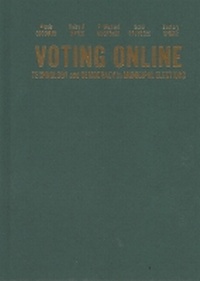
Voting Online
Technology and Democracy in Municipal Elections
Published on 4. June 2024
Book
Hardback
228 pages
978-0-2280-2124-7 (ISBN)
Description
In an attempt to reverse declining rates of voter participation, governments around the world are turning to electronic voting to improve the efficiency of vote counts, and increase the accessibility and equity of the voting process for electors who may face additional barriers. The Covid-19 pandemic has intensified this trend.
Voting Online focuses on Canada, where the technology has been widely embraced by municipal governments with one of the highest rates of use in the world. In the age of cyber elections, Canada is the only country where governments offer fully remote electronic elections and where traditional paper voting is eliminated for entire electorates. Municipalities are the laboratories of electoral modernization when it comes to digital voting reform. We know conspicuously little about the effects of these changes, particularly the elimination of paper ballots.
Relying on surveys of voters, non-voters, and candidates in twenty Ontario cities, and a survey of administrators across the province of Ontario, Voting Online provides a holistic view of electronic elections unavailable anywhere else.
Voting Online focuses on Canada, where the technology has been widely embraced by municipal governments with one of the highest rates of use in the world. In the age of cyber elections, Canada is the only country where governments offer fully remote electronic elections and where traditional paper voting is eliminated for entire electorates. Municipalities are the laboratories of electoral modernization when it comes to digital voting reform. We know conspicuously little about the effects of these changes, particularly the elimination of paper ballots.
Relying on surveys of voters, non-voters, and candidates in twenty Ontario cities, and a survey of administrators across the province of Ontario, Voting Online provides a holistic view of electronic elections unavailable anywhere else.
Reviews / Votes
"Voting Online will become an important reference point for practitioners and academics alike. Particularly novel are its findings on the effect of online voting on satisfaction levels with (local) democracy, which are likely to spark debate." Micha Germann, senior lecturer in Comparative Politics, University of Bath "I very much enjoyed reading Voting Online. The authors do an excellent job of profiling the importance of their subject, showing how their research findings inform comparative politics." Jean-Francois Daoust, Universite de Sherbrooke, and co-author of The Motivation to Vote "[Voting Online's] findings about voter satisfaction with online voting are unexpected and will likely lead to additional research. The authors have produced a work that will stimulate further research by scholars and practitioners considering whether digital elections can be extended to other levels of government." ChoiceMore details
Series
Language
English
Place of publication
Montreal
Canada
Target group
Professional and scholarly
Illustrations
15 diagrams, 22 tables
Dimensions
Height: 229 mm
Width: 152 mm
ISBN-13
978-0-2280-2124-7 (9780228021247)
Copyright in bibliographic data and cover images is held by Nielsen Book Services Limited or by the publishers or by their respective licensors: all rights reserved.
Schweitzer Classification
Other editions
Additional editions

Nicole Goodman | Helen A. Hayes | R. Michael McGregor
Voting Online
Technology and Democracy in Municipal Elections
E-Book
06/2024
1st Edition
McGill-Queen's University Press
€34.49
Available for download

Nicole Goodman | Helen A. Hayes | R. Michael McGregor
Voting Online
Technology and Democracy in Municipal Elections
E-Book
06/2024
1st Edition
McGill-Queen's University Press
€34.49
Available for download
Persons
Nicole Goodman is associate professor in the Department of Political Science at Brock University.
Helen A. Hayes is a PhD candidate in the Department of Art History and Communication Studies at McGill University.
R. Michael McGregor is associate professor in the Department of Politics and Public Administration at Toronto Metropolitan University.
Scott Pruysers is associate professor in the Department of Political Science at Dalhousie University.
Zachary Spicer is associate professor in the School of Public Policy and Administration at York University.
Helen A. Hayes is a PhD candidate in the Department of Art History and Communication Studies at McGill University.
R. Michael McGregor is associate professor in the Department of Politics and Public Administration at Toronto Metropolitan University.
Scott Pruysers is associate professor in the Department of Political Science at Dalhousie University.
Zachary Spicer is associate professor in the School of Public Policy and Administration at York University.