

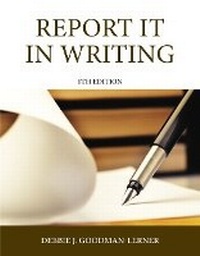
Report It in Writing
6th Edition
Will be published approx. on 13. August 2014
Book
Paperback/Softback
272 pages
978-0-13-348318-5 (ISBN)
Description
The most complete and up-to-date guide to writing in law enforcement: covers every aspect of effective writing, including report writing elements, basic writing skills, and interpersonal skills for ethically identifying the most effective information to include.
Report It In Writing, 6E is the most up-to-date and comprehensive guide to effective report writing for all law enforcement and public safety professionals. Organized in an easy-to-follow A to Z format, it covers both report writing elements and basic writing skills, as well as the interpersonal skills that are indispensable to effective information gathering. Throughout, integrated exercises focus on identifying basic facts and reinforcing basic rules of the English language. This edition contains many new exercises, as well as expanded 100-question pre- and post-tests, helping students more effectively review spelling, punctuation, grammar, proofreading, chronological order, and much more. Readers will find new or expanded coverage of many crucial topics, including ethical investigation and reporting; listening and rapport; observation, description, and other key topics.
Report It In Writing, 6E is the most up-to-date and comprehensive guide to effective report writing for all law enforcement and public safety professionals. Organized in an easy-to-follow A to Z format, it covers both report writing elements and basic writing skills, as well as the interpersonal skills that are indispensable to effective information gathering. Throughout, integrated exercises focus on identifying basic facts and reinforcing basic rules of the English language. This edition contains many new exercises, as well as expanded 100-question pre- and post-tests, helping students more effectively review spelling, punctuation, grammar, proofreading, chronological order, and much more. Readers will find new or expanded coverage of many crucial topics, including ethical investigation and reporting; listening and rapport; observation, description, and other key topics.
More details
Edition
6th edition
Language
English
Place of publication
United States
Publishing group
Pearson Education (US)
Target group
College/higher education
Professional and scholarly
Dimensions
Height: 280 mm
Width: 220 mm
Thickness: 10 mm
Weight
495 gr
ISBN-13
978-0-13-348318-5 (9780133483185)
Schweitzer Classification
Other editions
Previous edition
Debbie J. Goodman
Report It in Writing
Book
05/2010
5th Edition
Pearson
€54.55
Article exhausted; check for reprint
Content
Preface
Acknowledgments
Introduction
Top Twelve Reasons Why You Should Write Well
Pretest
I. THE A-Z'S OF REPORT WRITING
A. Report-Writing Rules
B. Ten Good Questions
C. Ethical Reporting
D. Chronological Order
E. Fact vs. Opinion
F. Vague vs. Specific Language
G. Common Abbreviations for Note Taking
H. Who vs. Whom
I. Proofreading
J. First- vs. Third-Person Reporting
K. Report-Writing "Shoulds"
L. Note Taking
M. Organizing the Report
N. Observation and Description
O. Your A-Z Guide at a Glance
P. Report-Writing Exercises for Police, Probation, and Corrections Officers
Q. Interviewing Skills and Investigative Reporting
R. Ten Steps for Becoming a Good Listener
S. CPR: Courtesy, Professionalism, and Respect
T. Establishing Rapport
U. Interpersonal Communication
V. Nonverbal Communication
W. When to Write a Report?
X. The Four C's
Y. Document, Document, Document
Z. Get a Writing Mentor
II. PARTS OF SPEECH
A. Nouns
B. Pronouns
C. Verbs
D. Adjectives
E. Adverbs
F. Prepositions
G. Conjunctions
H. Interjections
Final Note
III. HOMOPHONES
IV. THE SENTENCE
A. What Is a Sentence?
B. Changing Fragments to Sentences
C. Misplaced Phrases D. Run-on Sentence (Fused Sentence)
E. Subject Identification
F. Capitalization
V. ACTIVE VS. PASSIVE VOICE, SUBJECT AND VERB AGREEMENT, AND GRAMMAR
A. Active and Passive Voice
B. Subject and Verb Agreement
C. Pronoun Agreement
VI. SPELLING
VII. PUNCTUATION
A. The Comma
B. The Comma Splice
C. The Semicolon
D. The Colon
E. Quotation Marks
F. The Apostrophe
Posttest
Glossary of Writing, Grammar and Word Usage Rules
Recommended Reading
Index
Acknowledgments
Introduction
Top Twelve Reasons Why You Should Write Well
Pretest
I. THE A-Z'S OF REPORT WRITING
A. Report-Writing Rules
B. Ten Good Questions
C. Ethical Reporting
D. Chronological Order
E. Fact vs. Opinion
F. Vague vs. Specific Language
G. Common Abbreviations for Note Taking
H. Who vs. Whom
I. Proofreading
J. First- vs. Third-Person Reporting
K. Report-Writing "Shoulds"
L. Note Taking
M. Organizing the Report
N. Observation and Description
O. Your A-Z Guide at a Glance
P. Report-Writing Exercises for Police, Probation, and Corrections Officers
Q. Interviewing Skills and Investigative Reporting
R. Ten Steps for Becoming a Good Listener
S. CPR: Courtesy, Professionalism, and Respect
T. Establishing Rapport
U. Interpersonal Communication
V. Nonverbal Communication
W. When to Write a Report?
X. The Four C's
Y. Document, Document, Document
Z. Get a Writing Mentor
II. PARTS OF SPEECH
A. Nouns
B. Pronouns
C. Verbs
D. Adjectives
E. Adverbs
F. Prepositions
G. Conjunctions
H. Interjections
Final Note
III. HOMOPHONES
IV. THE SENTENCE
A. What Is a Sentence?
B. Changing Fragments to Sentences
C. Misplaced Phrases D. Run-on Sentence (Fused Sentence)
E. Subject Identification
F. Capitalization
V. ACTIVE VS. PASSIVE VOICE, SUBJECT AND VERB AGREEMENT, AND GRAMMAR
A. Active and Passive Voice
B. Subject and Verb Agreement
C. Pronoun Agreement
VI. SPELLING
VII. PUNCTUATION
A. The Comma
B. The Comma Splice
C. The Semicolon
D. The Colon
E. Quotation Marks
F. The Apostrophe
Posttest
Glossary of Writing, Grammar and Word Usage Rules
Recommended Reading
Index