

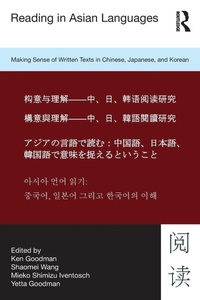
Reading in Asian Languages
Making Sense of Written Texts in Chinese, Japanese, and Korean
1st Edition
Published on 22. November 2011
Book
Paperback/Softback
296 pages
978-0-415-89477-7 (ISBN)
Description
Reading in Asian Languages is rich with information about how literacy works in the non-alphabetic writing systems (Chinese, Japanese, Korean) used by hundreds of millions of people and refutes the common Western belief that such systems are hard to learn or to use. The contributors share a comprehensive view of reading as construction of meaning which they show is fully applicable to character-based reading.
The book explains how and why non-alphabetic writing works well for its users; provides explanations for why it is no more difficult for children to learn than are alphabetic writing systems where they are used; and demonstrates in a number of ways that there is a single process of making sense of written language regardless of the orthography. Unique in its perspective and offering practical theory-based methodology for the teaching of literacy in Chinese, Japanese, and Korean to first and second language learners, it is a useful resource for teachers of increasingly popular courses in these languages in North America as well as for teachers and researchers in Asia. It will stimulate innovation in both research and instruction.
The book explains how and why non-alphabetic writing works well for its users; provides explanations for why it is no more difficult for children to learn than are alphabetic writing systems where they are used; and demonstrates in a number of ways that there is a single process of making sense of written language regardless of the orthography. Unique in its perspective and offering practical theory-based methodology for the teaching of literacy in Chinese, Japanese, and Korean to first and second language learners, it is a useful resource for teachers of increasingly popular courses in these languages in North America as well as for teachers and researchers in Asia. It will stimulate innovation in both research and instruction.
More details
Language
English
Place of publication
London
United Kingdom
Publishing group
Taylor & Francis Ltd
Target group
College/higher education
Illustrations
15 s/w Tabellen
15 Tables, black and white
Dimensions
Height: 229 mm
Width: 152 mm
Thickness: 16 mm
Weight
432 gr
ISBN-13
978-0-415-89477-7 (9780415894777)
Copyright in bibliographic data and cover images is held by Nielsen Book Services Limited or by the publishers or by their respective licensors: all rights reserved.
Schweitzer Classification
Other editions
Additional editions
Kenneth S. Goodman | Shaomei Wang | Mieko Iventosch
Reading in Asian Languages
Making Sense of Written Texts in Chinese, Japanese, and Korean
E-Book
04/2012
1st Edition
Routledge
€76.49
Available for download
Kenneth S. Goodman | Shaomei Wang | Mieko Iventosch
Reading in Asian Languages
Making Sense of Written Texts in Chinese, Japanese, and Korean
E-Book
04/2012
1st Edition
Routledge
€76.49
Available for download
Kenneth S. Goodman | Shaomei Wang | Mieko Iventosch
Reading in Asian Languages
Making Sense of Written Texts in Chinese, Japanese, and Korean
Book
11/2011
1st Edition
Routledge
€232.10
Shipment within 15-20 days
Persons
Ken Goodman is Professor Emeritus of the University of Arizona.
Shaomei Wang is a lecturer in German, Russian and Asian Languages and Literature at Tufts University.
Mieko Shimizu Iventosch teaches Japanese as a foreign language at Pima Community College and at the University of Arizona.
Yetta Goodman is Regents Professor Emerita of the University of Arizona.
Shaomei Wang is a lecturer in German, Russian and Asian Languages and Literature at Tufts University.
Mieko Shimizu Iventosch teaches Japanese as a foreign language at Pima Community College and at the University of Arizona.
Yetta Goodman is Regents Professor Emerita of the University of Arizona.
Content
Dedication. Acknowledgements. Foreword Jun Liu Part 1: Writing Systems in Chinese, Japanese, and Korean 1. The Process of Reading in Non-Alphabetic Languages: An Introduction Ken Goodman 2. How a Morphosyllabic Writing System Works in Chinese Yueh-Nu Hung 3. Similarities and Dissimilarities in Reading Chinese and English: Goodman's Reading Model Perspective Yueh-Nu Hung 4. Chinese Writing Reform: A Social-Cultural Perspective Shaomei Wang 5. Ideography and Borrowing in Chinese Ning Yu 6. Chinese Unconventional Characters:Characteristics, Controversial Arguments, and Pedagogical Implications Junlin Pan 7. A Successful Mixture of Alphabetic and Non-Alphabetic Writing: Chinese Characters in Korean Rodney E. Tyson 8. Orthography: Human Creativity and Adaptability Mieko Shimizu Iventosch Part 2: Studies of Reading in Chinese and Japanese 9. Making Sense in Reading Chinese: An Error Detection Study Jingguo Xu 10. Miscues and Eye Movements of Japanese Beginning Readers Daniel Ferguson, Yasuhiko Kato, and Mariko Nagahiro 11. How Readers Process Japanese Orthography with Two Different Texts Koomi Kim 12 . The Taxonomy of Chinese Reading Miscues Shaomei Wang Part 3: Implications and Applications for Instruction 13. Understanding and Facilitating Literacy Development among Chinese Speaking Young Children Lianju Lee 14. Teachers' Reflections on Chinese Miscue Analysis: A Graduate Course in Reading Wen-Yun Lin 15. Experiencing Korean Culture and Language Through Korean Children's Literature Yoo Kyung Sung 16. Teaching Japanese Written Language Mieko Shimizu Iventosch 17. Kamishibai Junko Sakoi. Contributors. Index