

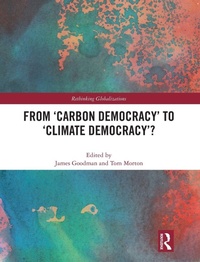
From 'Carbon Democracy' to 'Climate Democracy'?
1st Edition
Published on 11. October 2024
Book
Hardback
176 pages
978-1-032-76494-8 (ISBN)
Description
What are the democratic requirements for effective climate action? how can 'climate democracy' be conceptualised?
Liberal democracies emerged on the back of fossil fuels, creating what Tim Mitchell called 'carbon democracy'. Three decades of climate policy have affirmed the controlling influence of fossil fuel interests. Runaway climate change now threatens the very foundations of social life. Today we face a very clear democratic question, of whether the fossil fuel sector has the right to determine the planet's climate future. Achieving global energy transformation at the scope and scale needed requires a democratic transformation, to overcome the stranglehold. This book examines these requirements. It debates the political constituencies, agendas and institutions that are emerging from climate crisis, comparing evidence of emergent themes. New claims are emerging, for 'green deals', 'climate justice', 'energy justice', 'energy democracy' and 'de-growth', reflecting a new intensity of contestation as climate change impacts deepen.
This book will be of great relevance to students, researchers and policymakers with an interest in comparative politics, democracy studies, climate change and environmental policies. The chapters in this book were originally published as a special issue of Globalizations.
Liberal democracies emerged on the back of fossil fuels, creating what Tim Mitchell called 'carbon democracy'. Three decades of climate policy have affirmed the controlling influence of fossil fuel interests. Runaway climate change now threatens the very foundations of social life. Today we face a very clear democratic question, of whether the fossil fuel sector has the right to determine the planet's climate future. Achieving global energy transformation at the scope and scale needed requires a democratic transformation, to overcome the stranglehold. This book examines these requirements. It debates the political constituencies, agendas and institutions that are emerging from climate crisis, comparing evidence of emergent themes. New claims are emerging, for 'green deals', 'climate justice', 'energy justice', 'energy democracy' and 'de-growth', reflecting a new intensity of contestation as climate change impacts deepen.
This book will be of great relevance to students, researchers and policymakers with an interest in comparative politics, democracy studies, climate change and environmental policies. The chapters in this book were originally published as a special issue of Globalizations.
More details
Series
Language
English
Place of publication
London
United Kingdom
Publishing group
Taylor & Francis Ltd
Target group
College/higher education
Postgraduate, Undergraduate Advanced, and Undergraduate Core
Dimensions
Height: 260 mm
Width: 208 mm
Thickness: 15 mm
Weight
642 gr
ISBN-13
978-1-032-76494-8 (9781032764948)
Copyright in bibliographic data and cover images is held by Nielsen Book Services Limited or by the publishers or by their respective licensors: all rights reserved.
Schweitzer Classification
Other editions
Additional editions
James Goodman | Tom Morton
From 'Carbon Democracy' to 'Climate Democracy'?
Book
05/2026
1st Edition
Routledge
€57.50
Shipment within 10-20 days
James Goodman | Tom Morton
From 'Carbon Democracy' to 'Climate Democracy'?
E-Book
10/2024
1st Edition
Routledge
€73.99
Available for download
James Goodman | Tom Morton
From 'Carbon Democracy' to 'Climate Democracy'?
E-Book
10/2024
1st Edition
Routledge
€73.99
Available for download
Persons
James Goodman is Professor in Social and Political Sciences at the Faculty of Arts and Social Sciences at the University of Technology, Sydney where he researches climate change and energy transitions. He is the co-author of the book Beyond the Coal Rush and Decarbonising Electricity with Tom Morton.
Tom Morton is at Martin Luther University Halle-Wittenberg in Germany. He researches climate communication and is an award-winning documentary producer. He has co-authored the book, Beyond the Coal Rush and Decarbonising Electricity with James Goodman.
Tom Morton is at Martin Luther University Halle-Wittenberg in Germany. He researches climate communication and is an award-winning documentary producer. He has co-authored the book, Beyond the Coal Rush and Decarbonising Electricity with James Goodman.
Content
Introduction - 'Rage into action': from carbon democracy to climate democracy? 1. Reluctant transformers or reconsidering opposition to climate change mitigation? German think tanks between environmentalism and neoliberalism 2. Energy transition and dialectics: tracing discursive resistance to coal through discourse coalition in India 3. Democratizing global climate governance? The case of indigenous representation in the Intergovernmental Panel on Climate Change (IPCC) 4. Who wins and who loses from renewable energy transition? Large-scale solar, land, and livelihood in Karnataka, India 5. Legitimizing energy transitions through community participation: Germany and Australia at a crossroad 6. Comparing local energy conflicts in NSW Australia: moving to climate generosity 7. Climate camps and environmental movements: impacting the coal industry and practicing 'system change' 8. Climate movements in Germany, India, and Australia: dynamics of transition, transformation, and emergency 9. Climate, violence, resource extraction and ecological debt: global implications of an assassination on South Africa's coal mining belt