

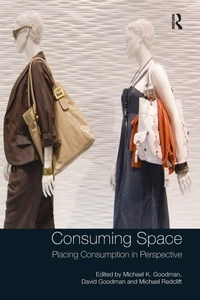
Consuming Space
Placing Consumption in Perspective
1st Edition
Published on 17. November 2016
Book
Paperback/Softback
296 pages
978-1-138-27945-2 (ISBN)
Description
An examination of the relationship between space, place and consumption offers important insights into some of the most powerful forces constructing contemporary societies. Space and place are made and remade through consumption. Yet how do cultures of consumption discover space, and how do they construct place? This book addresses these questions by exploring the implications of conceptualizing consumption as a spatial, increasingly global, yet intensely localized activity. The work develops integrative approaches that articulate the processes involved in the production and consumption of space and place. The result is a varied, engaging, and innovative study of consumption and its role in structuring contemporary capitalist political economies.
Reviews / Votes
'This is a book that quite literally maps the complex territory between consumption and production. Case studies of Chilean wine, chewing gum, chickens and more provide fascinating insight into the changing contours of what proves to be a fluid, contested and sometimes disturbing landscape.' Elizabeth Shove, Lancaster University, UK 'In a most interesting set of geographical analyses Consuming Space enriches our understanding of the diverse spatial and locational patterns and relations of consumption in modern society. An excellent and innovative volume, complementary to the existing literature on consumption.' Arthur P.J. Mol, Wageningen University, The Netherlands 'The wide range of material covered in Consuming Places did indeed 'place consumption in perspective' demonstrating successfully how production and consumption are intertwined in the construction and reconstruction of place and space. A pleasure to consume, the book has a permanent 'place' on my bookshelf!' Juliana Mansvelt, New Zealand Geographer '... an enduring accomplishment of this edited collection is its significant contribution to the current debate on sustainable consumption. Indeed, it adds to our knowledge of the broader disciplines of human geography and economics and specifically of the fields of spatial behaviour, colonialism, post-colonialism and human territoriality. In summary, this publication should be regarded as essential reading for students, from undergraduate level upwards, and for geographers, historians and economists alike.' Irish GeographyMore details
Language
English
Place of publication
London
United Kingdom
Publishing group
Taylor & Francis Ltd
Target group
College/higher education
Dimensions
Height: 234 mm
Width: 156 mm
Thickness: 16 mm
Weight
456 gr
ISBN-13
978-1-138-27945-2 (9781138279452)
Copyright in bibliographic data and cover images is held by Nielsen Book Services Limited or by the publishers or by their respective licensors: all rights reserved.
Schweitzer Classification
Other editions
Additional editions
E-Book
05/2016
Routledge
€72.49
Available for download
E-Book
05/2016
Routledge
€72.49
Available for download
Book
03/2010
1st Edition
Routledge
€232.10
Shipment within 10-20 days
Persons
Dr Michael K. Goodman is Lecturer in Geography, King's College London, David Goodman is Professor of Environmental Studies, University of California, Santa Cruz, USA and Michael Redclift is Professor of International Environmental Policy at King's College London, UK
Content
Introduction; Chapter 1: Introduction; Chapter 2: Multiple Spaces of Consumption; Chapter 3: The Seduction of Space; Part I: The Consumption of Space and Place; Chapter 4: Frontier Spaces of Production and Consumption; Chapter 5: Recognition and Redistribution in the Renegotiation of Rural Space; Part II: Consumption in Space and Place; Chapter 6: Ethical Campaigning and Buyer-Driven Commodity Chains; Chapter 7: The Cultural Economy of the Boutique Hotel; Part III: Consumption as Connection/Disconnection/Reconnection; Chapter 8: Manufacturing Meaning along the Chicken Supply Chain; Chapter 9: Place and Space in Alternative Food Networks; Part IV: Consumption as Production and Production as Consumption; Chapter 10: Creating Palate Geographies; Chapter 11: Consuming Burmese Teak; Chapter 12: Space for Change or Changing Spaces