

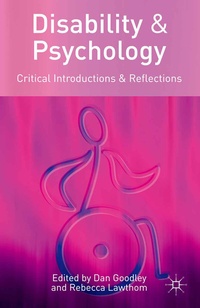
Disability and Psychology
Critical Introductions and Reflections
Published on 31. October 2005
Book
Paperback/Softback
248 pages
978-1-4039-3601-1 (ISBN)
Description
Disability is not just the physical, sensory or intellectual impairments a person has, but the exclusion from society they face as a result. Organisations for disabled people are a growing voice in challenging this exclusion and Anti-Discrimination legislation is helping to change the structures in society that have contributed to it.
This book examines the discipline of psychology in this regard. It argues that psychology has tended to ignore the socio-cultural aspects of disability and treat disabled people as objects rather than arbiters of psychological intervention. Bringing together disabled and non-disabled researchers and psychologists, this book proposes ideas for an enabling psychological theory and practice, and addresses questions such as:
" How can we support the inclusion of disabled children?
" Can therapy enable rather than pathologise?
" What can be learnt from the experience of disabled psychologists?
" How can psychology contribute to social models of disability?
In examining these issues, this volume challenges the reader to reconsider the relationship between disability studies and psychology and to do so in ways that contribute to the emancipation - rather than the exclusion - of disabled people.
A key text for students on relevant courses within Disability Studies and Psychology degrees, this book is also an important resource for those who study or work in the areas of healthcare studies, nursing, sociology and social work.
Dan Goodley is a Reader in Disability Studies, University of Sheffield, with research interests in disability theory, activism and methodology.
Rebecca Lawthom is Principal Lecturer in Psychology, Manchester Metropolitan University and a member of the Research Institute for Health and Social Change. Her research interests are in disability, community and feminist psychology.
This book examines the discipline of psychology in this regard. It argues that psychology has tended to ignore the socio-cultural aspects of disability and treat disabled people as objects rather than arbiters of psychological intervention. Bringing together disabled and non-disabled researchers and psychologists, this book proposes ideas for an enabling psychological theory and practice, and addresses questions such as:
" How can we support the inclusion of disabled children?
" Can therapy enable rather than pathologise?
" What can be learnt from the experience of disabled psychologists?
" How can psychology contribute to social models of disability?
In examining these issues, this volume challenges the reader to reconsider the relationship between disability studies and psychology and to do so in ways that contribute to the emancipation - rather than the exclusion - of disabled people.
A key text for students on relevant courses within Disability Studies and Psychology degrees, this book is also an important resource for those who study or work in the areas of healthcare studies, nursing, sociology and social work.
Dan Goodley is a Reader in Disability Studies, University of Sheffield, with research interests in disability theory, activism and methodology.
Rebecca Lawthom is Principal Lecturer in Psychology, Manchester Metropolitan University and a member of the Research Institute for Health and Social Change. Her research interests are in disability, community and feminist psychology.
More details
Edition
2005
Language
English
Place of publication
London
United Kingdom
Publishing group
Bloomsbury Publishing PLC
Target group
College/higher education
Professional and scholarly
Dimensions
Height: 216 mm
Width: 140 mm
Thickness: 14 mm
Weight
317 gr
ISBN-13
978-1-4039-3601-1 (9781403936011)
DOI
10.1007/978-1-137-12098-4
Schweitzer Classification
Other editions
Additional editions
E-Book
10/2005
1st Edition
Bloomsbury Academic
€49.99
Available for download
Persons
DAN GOODLEY is Professor of Psychology and Disability at the Department of Psychology and Social Change, Manchester Metropolitan University, UK.
REBECCA LAWTHOM is a Senior Lecturer in Psychology at Manchester Metropolitan University, UK and the Interpersonal and Organizational Development Research Group in the Department of Psychology and Speech Pathology.
REBECCA LAWTHOM is a Senior Lecturer in Psychology at Manchester Metropolitan University, UK and the Interpersonal and Organizational Development Research Group in the Department of Psychology and Speech Pathology.
Content
Preface; D.Goodley & R.Lawthom.- Disability and Psychology: New Allies; D.Goodley & R.Lawthom.- PART ONE: THE PSYCHOLOGY OF DISABILITY: FROM INFANCY TO ADULTHOOD.- Parents, Professionals and Disabled Babies Personal Reflections on Disabled Lives; C.Tregaskis.- Being in School: Disabled Children and the Denial of Psychological Reality; P.Murray.- The Disability Discrimination Act and Lifelong Learning? Disabled Students and Higher Education; D.Viney.- Disabled and Graduated: Barriers and Dilemmas for the Disabled Psychology Graduate; P.Stannett.- Disability and Old Age: Or Why it Isn't All in the Mind; M.Priestly.- Towards a Psychology of Disability: The Emotional Effects of Living in a Disabling Society; D. Reeve.- PART TWO: DISABILITY, PSYCHOLOGY AND PRACTICE: FROM A DISABLING TO AN ENABLING PSYCHOLOGY.- Against Stereotypes: Experiences of Disabled Psychologists; F.Levinson & S.Parritt.- Understanding Intellectually Disabled Clients in Clinical Psychology; J.Clegg.- Enabling Practice for Professionals: The Need for Practical Post-Structuralist Theory; L.Todd.- Counselling with the Social Model: Challenging Therapy's Pathologies; J.Swain, C.Griffiths & S.French.- Community Psychology with Disabled People; P.Duckett, C.Kagan, R.Lawthom & M.Burton.- Conclusions: Making Enabling Alliances between Disability and Psychology; D.Goodley & R.Lawthom.