

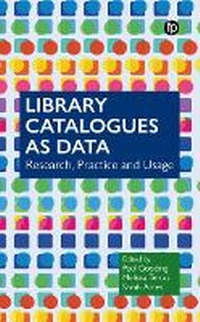
Library Catalogues as Data
Research, Practice and Usage
1st Edition
Will be published approx. on 26. June 2025
Book
Hardback
272 pages
978-1-78330-659-6 (ISBN)
Description
Through the web of library catalogues, library management systems and myriad digital resources, libraries have become repositories not only for physical and digital information resources but also for enormous amounts of data about the interactions between these resources and their users. Bringing together leading practitioners and academic voices, this book considers library catalogue data as a vital research resource.
Divided into four sections, each approaches library catalogues, collections and records from a different angle, from exploring methods for examining such data; to the politics of catalogues and library data; their interdisciplinary potential; and practical uses and applications of catalogues as data. Other topics the volume discusses include:
Practical routes to preparing library catalogue data for researchers
The ethics of library metadata privacy and reuse
Data-driven decision making
Data quality and collections bias
Preserving, resurrecting and restoring data
The uses and potential of historical library data
The intersection of catalogue data, AI and Large Language Models (LLMs)
This comprehensive book will be an essential read for practitioners in the GLAM sector, particularly those dealing with collections and catalogue data, and LIS academics and students.
Divided into four sections, each approaches library catalogues, collections and records from a different angle, from exploring methods for examining such data; to the politics of catalogues and library data; their interdisciplinary potential; and practical uses and applications of catalogues as data. Other topics the volume discusses include:
Practical routes to preparing library catalogue data for researchers
The ethics of library metadata privacy and reuse
Data-driven decision making
Data quality and collections bias
Preserving, resurrecting and restoring data
The uses and potential of historical library data
The intersection of catalogue data, AI and Large Language Models (LLMs)
This comprehensive book will be an essential read for practitioners in the GLAM sector, particularly those dealing with collections and catalogue data, and LIS academics and students.
More details
Language
English
Place of publication
London
United Kingdom
Target group
Professional and scholarly
Professional Reference
Dimensions
Height: 234 mm
Width: 156 mm
Thickness: 18 mm
ISBN-13
978-1-78330-659-6 (9781783306596)
Copyright in bibliographic data and cover images is held by Nielsen Book Services Limited or by the publishers or by their respective licensors: all rights reserved.
Schweitzer Classification
Other editions
Additional editions
Book
06/2025
1st Edition
Facet Publishing
€74.08
Shipment within 3-4 weeks
E-Book
06/2025
Facet Publishing
€70.49
Available for download
Persons
Paul Gooding is Professor of Library Studies and Digital Scholarship at the University of Glasgow. His research focuses on the relationship between digital library collections, communities of usage and practice and legal/institutional frameworks for collection development. He has a particular interest in the implications of emerging digital technologies on research and library practices.
Prof. Melissa Terras is the Professor of Digital Cultural Heritage at the University of Edinburgh's College of Arts, Humanities, and Social Sciences, leading digital aspects of CAHSS research as Director of the Edinburgh Centre for Data, Culture and Society, and is Director of Research in the Edinburgh Futures Institute. Gooding and Terras have collaborated on a previous edited volume, entitled Electronic Legal Deposit: Shaping the Library Collections of the Future.
Dr. Sarah Ames is Digital Scholarship Librarian at the National Library of Scotland, with responsibility for Digital Research, including the Library's open data platform, Data Foundry. She has collaborated on a wide range of research initiatives bringing together digital tools and methods to explore the national collections.
Prof. Melissa Terras is the Professor of Digital Cultural Heritage at the University of Edinburgh's College of Arts, Humanities, and Social Sciences, leading digital aspects of CAHSS research as Director of the Edinburgh Centre for Data, Culture and Society, and is Director of Research in the Edinburgh Futures Institute. Gooding and Terras have collaborated on a previous edited volume, entitled Electronic Legal Deposit: Shaping the Library Collections of the Future.
Dr. Sarah Ames is Digital Scholarship Librarian at the National Library of Scotland, with responsibility for Digital Research, including the Library's open data platform, Data Foundry. She has collaborated on a wide range of research initiatives bringing together digital tools and methods to explore the national collections.
Content
Foreword - Thomas Padilla
Introduction: The Library Catalogue Data Ecosystem - Paul Gooding, Melissa Terras and Sarah Ames
Chapter 1: Making the Conceptual Concrete: Defining, Describing and Visualising Collective Collections - Brian Lavoie
Chapter 2: Effects of Open Science and the Digital Transformation on the Bibliographical Data Landscape - Peter Kiraly, Tomasz Umerle, Vojtech Malinek, Elzbieta Herden, Beata Koper, Giovanni Colavizza, Rindert Jagersma, Leo Lahti, David Lindemann, Jakub Maciej Lubocki, Alexandra Milanova, Robert Peter, Nanette Rissler-Pipka, Dorota Siwecka, Matteo Romanello, Marcin Roszkowski, Mikko Tolonen and Ondrej Vimr
Chapter 3: Data Quality in Library Catalogues and its Impact on Access, Analysis, and Reuse - Gustavo Candela
Chapter 4: Data Bias and the Natural Language Processing of Metadata - Lucy Havens
Chapter 5: 'Contains Scenes of Mild Peril': Illuminating the Catalogues of Dark Archives - Martin Paul Eve
Chapter 6: Book Formats, Printing Practices and Reading Habits in Early Modern Europe - Mikko Tolonen
Chapter 7: '(S)hut not thy Heart, nor thy Library': Realising the Potential of Historical Library Borrowing Data - Katie Halsey and Matthew Sangster, with Brian Aitken, Karen Baston, Maxine Branagh-Miscampbell, Alex Deans, Jaqueline Kennard, Gerard McKeever and Joshua J. Smith
Chapter 8: ChatGPT for Bibliometrics: Potential Applications and Limitations - Daniel Torres-Salinas, Mike Thelwall and Wenceslao Arroyo-Machado
Chapter 9: Using Generative AI to Turn 19th Century Library Catalogues into Data: Applications and Limitations -Julia Bauder and Christopher Jones
Chapter 10: A Corpus Linguistic Analysis of Catalogue Data: Understanding Curatorial Practice Over Time - Rossitza Atanassova and James Baker
Introduction: The Library Catalogue Data Ecosystem - Paul Gooding, Melissa Terras and Sarah Ames
Chapter 1: Making the Conceptual Concrete: Defining, Describing and Visualising Collective Collections - Brian Lavoie
Chapter 2: Effects of Open Science and the Digital Transformation on the Bibliographical Data Landscape - Peter Kiraly, Tomasz Umerle, Vojtech Malinek, Elzbieta Herden, Beata Koper, Giovanni Colavizza, Rindert Jagersma, Leo Lahti, David Lindemann, Jakub Maciej Lubocki, Alexandra Milanova, Robert Peter, Nanette Rissler-Pipka, Dorota Siwecka, Matteo Romanello, Marcin Roszkowski, Mikko Tolonen and Ondrej Vimr
Chapter 3: Data Quality in Library Catalogues and its Impact on Access, Analysis, and Reuse - Gustavo Candela
Chapter 4: Data Bias and the Natural Language Processing of Metadata - Lucy Havens
Chapter 5: 'Contains Scenes of Mild Peril': Illuminating the Catalogues of Dark Archives - Martin Paul Eve
Chapter 6: Book Formats, Printing Practices and Reading Habits in Early Modern Europe - Mikko Tolonen
Chapter 7: '(S)hut not thy Heart, nor thy Library': Realising the Potential of Historical Library Borrowing Data - Katie Halsey and Matthew Sangster, with Brian Aitken, Karen Baston, Maxine Branagh-Miscampbell, Alex Deans, Jaqueline Kennard, Gerard McKeever and Joshua J. Smith
Chapter 8: ChatGPT for Bibliometrics: Potential Applications and Limitations - Daniel Torres-Salinas, Mike Thelwall and Wenceslao Arroyo-Machado
Chapter 9: Using Generative AI to Turn 19th Century Library Catalogues into Data: Applications and Limitations -Julia Bauder and Christopher Jones
Chapter 10: A Corpus Linguistic Analysis of Catalogue Data: Understanding Curatorial Practice Over Time - Rossitza Atanassova and James Baker