

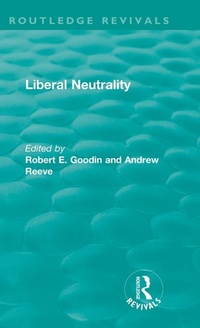
Liberal Neutrality
1st Edition
Published on 9. November 2018
Book
Hardback
224 pages
978-1-138-32403-9 (ISBN)
Description
Originally published in 1989 Liberal Neutrality approaches the recommendation of neutrality by confronting the abstract prescription (that we should be neutral) with the implications for particular people and institutions. This not only identifies what neutrality involves logically, but also exposes the practical difficulties that may be encountered in pursuing it. In some cases, such close examination shows that neutrality is not desirable, and in others that it is attainable only within certain limits. Although neutrality has become a fashionable term in political theory, this is the only volume to subject the idea to systematic scrutiny. It will be useful not only to specialists in diverse disciplines - political scientists, philosophers, sociologists, lawyers and educationalists.
More details
Series
Language
English
Place of publication
London
United Kingdom
Publishing group
Taylor & Francis Ltd
Target group
College/higher education
Professional and scholarly
Dimensions
Height: 222 mm
Width: 145 mm
Thickness: 16 mm
Weight
424 gr
ISBN-13
978-1-138-32403-9 (9781138324039)
Copyright in bibliographic data and cover images is held by Nielsen Book Services Limited or by the publishers or by their respective licensors: all rights reserved.
Schweitzer Classification
Other editions
Additional editions
Robert Goodin | Andrew Reeve
Liberal Neutrality
Book
02/2020
1st Edition
Routledge
€53.50
Shipment within 10-20 days
Robert Goodin | Andrew Reeve
Liberal Neutrality
E-Book
12/2018
1st Edition
Routledge
€47.49
Available for download
Robert Goodin | Andrew Reeve
Liberal Neutrality
E-Book
12/2018
1st Edition
Routledge
€47.49
Available for download
Persons
Robert Goodin, Andrew Reeve
Content
Acknowledgements 1. Liberalism and Neutrality 2. The Ideal of the Neutral State 3. The Neutrality of the Market 4. Legislation and Moral Neutrality 5. Neutrality and the Civil Service 6. Neutrality in Education 7. Neutrality and the Media 8. The Neutrality of Science and Technology 9. Do Neutral Institutions Add up to Neutral State About the Contributors Index