

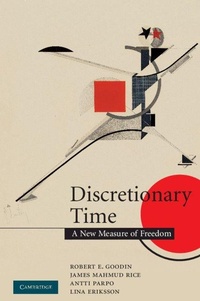
Discretionary Time
A New Measure of Freedom
Published on 21. February 2008
Book
Paperback/Softback
484 pages
978-0-521-70951-4 (ISBN)
Description
A healthy work-life balance has become increasingly important to people trying to cope with the pressures of contemporary society. This trend highlights the fallacy of assessing well-being in terms of finance alone; how much time we have matters just as much as how much money. The authors of this book have developed a novel way to measure 'discretionary time': time which is free to spend as one pleases. Exploring data from the US, Australia, Germany, France, Sweden and Finland, they show that temporal autonomy varies substantially across different countries and under different living conditions. By calibrating how much control people have over their time, and how much they could have under alternative welfare, gender or household arrangements, this book offers a new perspective for comparative cross-national enquiries into the temporal aspects of human welfare.
Reviews / Votes
'Only a group of scholars led by Bob Goodin could be sufficiently intellectually daring to replace money with leisure time as the metric of welfare achievement. In an era in which 'time to stand and stare' becomes ever scarcer, this is a book on the impacts of public policy which really matters.' Francis G. Castles, University of Edinburgh 'Confronting Marx's capitalist 'realm of necessity' head on, Goodin and his co-authors replace money with time as the measure of freedom and ask: 'how much control do citizens of OECD countries have over their allotments of time?' Don't be intimidated by the numbers and tables - the result is a fresh view of cross-national inequities, replete with new recipes for reform.' Stephan Leibfried, University of Bremen and Head of the Research Center for Transformations of the State 'The conclusion of Discretionary Time, an academic text based on a wealth of data from OECD countries, is that most of us have no one but ourselves to blame for our time-scarce predicament. Time pressure, they argue, suggests compulsion.' Financial Times 'The book articulates its argument over roughly 450 pages ... Its substantial length and technicalities go unnoticed, partly for the easily accessible language, partly for the neat and rational organization of the argument's frame ... case studies ... provide a wide and attractive empirical articulation for [the authors'] theoretical framework.' Journal of Economics and Philosophy 'Discretionary Time: A New Measure of Freedom is an interesting work of theory and policy ... a notable work.' Political Studies Review 'This is a carefully thought-out and crafted book ... with strong conceptual and methodological contributions indeed.' Feminist Economics 'This book makes fascinating reading and invites further questions.' Managing LeisureMore details
Language
English
Place of publication
Cambridge
United Kingdom
Target group
Professional and scholarly
Product notice
Paperback (trade)
Illustrations
41 Tables, unspecified; 41 Line drawings, unspecified
Dimensions
Height: 229 mm
Width: 152 mm
Thickness: 28 mm
Weight
776 gr
ISBN-13
978-0-521-70951-4 (9780521709514)
Copyright in bibliographic data and cover images is held by Nielsen Book Services Limited or by the publishers or by their respective licensors: all rights reserved.
Schweitzer Classification
Other editions
Additional editions

E-Book
04/2008
1st Edition
Cambridge University Press
€29.49
Available for download
Book
02/2008
Cambridge University Press
€128.90
Shipment within 15-20 days
Persons
Robert E. Goodin is Distinguished Professor of Philosophy and Social & Political Theory in the Research School of Social Sciences at Australian National University. James Mahmud Rice is an ARC Research Associate in the Research School of Social Sciences at Australian National University. Antti Parpo is Administrator of Somero Social & Health Services, Finland. Lina Eriksson is an ARC Research Associate in the Research School of Social Sciences at Australian National University.
Content
Part I. Introduction: 1. Time and money; 2. Discretionary time; 3. The distribution of discretionary time; Part II. Time Pressure: 4. Time pressure: a new problem?; 5. Time pressure: a new measure; 6. Is it really an illusion?; Part III. Welfare Regimes Matter: 7. How welfare regimes differ; 8. A temporal perspective on welfare regimes; 9. Welfare regimes and temporal autonomy; Part IV. Gender Regimes Matter: 10. How gender regimes differ; 11. A temporal perspective on gender regimes; 12. Gender regimes and temporal autonomy; Part V. Household Regimes Matter: 13. How household regimes differ; 14. The difference that household rules make; 15. The difference that states make; 16. Alternative household rules and temporal autonomy; Part VI. Conclusions: 17. Conclusions; Appendix 1. Methodology; Appendix 2. Data.