

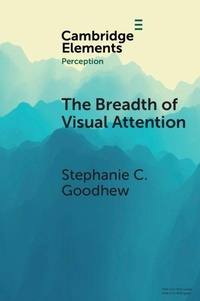
The Breadth of Visual Attention
Published on 18. June 2020
Book
Paperback/Softback
84 pages
978-1-108-79621-7 (ISBN)
Description
Humans can focus their attention narrowly (e.g., to read this text) or broadly (e.g., to determine which way a large crowd of people are moving). This Element comprehensively considers attentional breadth. Section 1 introduces the concept of attentional breadth, while Section 2 considers measures of attentional breadth. In particular, this section provides a critical discussion of the types of psychometric evidence which should be sought to establish the validity of measures of attentional breadth and reviews the available evidence through this lens. Section 3 considers the visual task performance consequences of attentional breadth, including prescribing several key methodological criteria that studies that manipulate attentional breadth need to meet, as well as a discussion of relevant theories and avenues for future theoretical development. Section 4 discusses the utility of the exogenous-endogenous distinction from covert shifts of attention for understanding the performance consequences of attentional breadth. Finally, Section 5 provides concluding remarks.
More details
Series
Language
English
Place of publication
Cambridge
United Kingdom
Target group
Professional and scholarly
Product notice
Paperback (trade)
Illustrations
Worked examples or Exercises
Dimensions
Height: 229 mm
Width: 152 mm
Thickness: 4 mm
Weight
122 gr
ISBN-13
978-1-108-79621-7 (9781108796217)
Copyright in bibliographic data and cover images is held by Nielsen Book Services Limited or by the publishers or by their respective licensors: all rights reserved.
Schweitzer Classification
Other editions
Additional editions
Stephanie C. Goodhew
The Breadth of Visual Attention
E-Book
06/2020
Cambridge University Press
€15.49
Available for download
Person
Content
1. Introduction to attentional breadth; 2. Measuring attentional breadth; 3. Manipulating attentional breadth and understanding its impact on performance; 4. Exogenous versus endogenous attention and how it relates to attentional breadth; 5. Conclusions.