

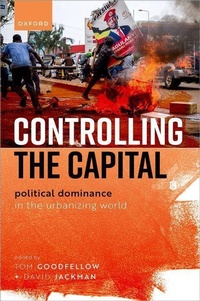
Controlling the Capital
Political Dominance in the Urbanizing World
Published on 28. September 2023
Book
Hardback
288 pages
978-0-19-286832-9 (ISBN)
Description
This is an open access title available under the terms of a CC BY-NC-ND 4.0 international license. It is free to read on Oxford Academic and offered as a free PDF download from OUP and selected open access locations.
Authoritarianism is on the rise globally, with more than twice as many countries experiencing democratic decline as democratic enhancement in recent years. This has been occurring simultaneously with unprecedented rates of urbanization in many parts of the world, raising questions about the role of cities - often considered the focal points of democratic deepening - in this authoritarian turn. While most literature considers authoritarianism on the national scale, the chapters in this book train their gaze on capital cities, which as 'containers' of both capital and sovereignty are spaces in which authoritarian dominance is increasingly built, contested, maintained, and undone. Focusing on some of the world's fastest urbanizing regions - Sub-Saharan Africa and South Asia - the book explores the multiple ways in which authoritarian regimes have been attempting to build and sustain long-term dominance in capital cities in order to meet the challenge of urban political resistance.
The diverse selection of case studies presented here spans governing regimes that have recently tried to build urban dominance and spectacularly failed, as well as those that have managed to hold onto power by constantly evolving strategies for dominance that limit the potential for urban opposition to tip into regime overthrow. With chapters on Addis Ababa, Colombo, Dhaka, Harare, Kampala, and Lusaka, Controlling the Capital offers the first cross-regional comparative study of the relationship between cities and political dominance. It contributes to debates on authoritarianism and authoritarian durability, urbanization, political contestation and resistance, the politics of development, and the prospects for democracy.
Authoritarianism is on the rise globally, with more than twice as many countries experiencing democratic decline as democratic enhancement in recent years. This has been occurring simultaneously with unprecedented rates of urbanization in many parts of the world, raising questions about the role of cities - often considered the focal points of democratic deepening - in this authoritarian turn. While most literature considers authoritarianism on the national scale, the chapters in this book train their gaze on capital cities, which as 'containers' of both capital and sovereignty are spaces in which authoritarian dominance is increasingly built, contested, maintained, and undone. Focusing on some of the world's fastest urbanizing regions - Sub-Saharan Africa and South Asia - the book explores the multiple ways in which authoritarian regimes have been attempting to build and sustain long-term dominance in capital cities in order to meet the challenge of urban political resistance.
The diverse selection of case studies presented here spans governing regimes that have recently tried to build urban dominance and spectacularly failed, as well as those that have managed to hold onto power by constantly evolving strategies for dominance that limit the potential for urban opposition to tip into regime overthrow. With chapters on Addis Ababa, Colombo, Dhaka, Harare, Kampala, and Lusaka, Controlling the Capital offers the first cross-regional comparative study of the relationship between cities and political dominance. It contributes to debates on authoritarianism and authoritarian durability, urbanization, political contestation and resistance, the politics of development, and the prospects for democracy.
Reviews / Votes
Cities have long been viewed as a problem for authoritarian regimes. This fascinating edited volume provides a picture of the strategies used by authoritarian regimes to alternately woo and repress potentially restive urban populations. Goodfellow and Jackman lay out in a clear and cogent way how coercive and more positive 'generative' strategies coexist in urban settings, yielding more or less stable patterns of government control. This is an important book not just for urban scholars but for those more broadly interested in democratization and authoritarian durability. * Professor Adrienne LeBas, Department of Government, American University, Washington D. C. * The capital city has always been the foremost site of protracted struggles over power, prosperity, and livelihoods. This empirically rich and theoretically rigorous collection aptly positions the analytical lens on the capital to shed light on the contours of power contestations, compromises, and ultimately the political economy of change and transformation in Africa and South Asia. Timely and a vital contribution. * Moses Khisa, Associate Professor of Political Science and Africana Studies, North Carolina State University * The battle for political control over capital cities is critical to the efforts of governments to contain the threat posed by dynamic opposition parties - and will only become more important as the continent becomes evermore urbanized. This is the best book yet on the subject, offering powerful insights into a wide range of important cases. * Professor Nic Cheeseman, Director of the Centre for Elections, Democracy, Accountability and Representation (CEDAR), University of Birmingham * A timely book to understand processes of urban control in the rapidly urbanizing developing world. Taking six capital cities as key spaces of political action, the book provides a trenchant analysis of how authoritarian regimes enmesh urban citizens, repress/prevent dissent among others by co-opting key actors and sections of society, to ensure political domination and authoritarian durability. * Professor Fana Gebresenbet, Director of the Institute for Peace and Security Studies, Addis Ababa University *More details
Language
English
Place of publication
Oxford
United Kingdom
Target group
Professional and scholarly
Product notice
sewn/stitched
Cloth over boards
Dimensions
Height: 147 mm
Width: 58 mm
Thickness: 20 mm
Weight
522 gr
ISBN-13
978-0-19-286832-9 (9780192868329)
Copyright in bibliographic data and cover images is held by Nielsen Book Services Limited or by the publishers or by their respective licensors: all rights reserved.
Schweitzer Classification
Other editions
Additional editions
E-Book
09/2023
1st Edition
OUP eBook
€91.49
Available for download
E-Book
09/2023
1st Edition
OUP eBook
€81.99
Available for download
Persons
Tom Goodfellow is a Professor of Urban Studies and International Development at the University of Sheffield. His research focuses on the comparative political economy of urban development in Africa, particularly the politics of urban land and transportation, conflicts around infrastructure and housing, migration, and urban institutional change. He is author of Politics and the Urban Frontier: Transformation and Divergence in Late Urbanizing East Africa (OUP, 2022) and co-author of Cities and Development (Routledge 2016).
David Jackman is a Leverhulme Early Career Research Fellow at the University of Oxford. His research interests lie in the political economy of crime and violence in South Asia, with a focus on Bangladesh, where he has worked since 2010. His work on gangsterism, labour politics, party-police relations, and beggar bosses have been published in journals such as Development and Change, Modern Asian Studies, and Journal of Contemporary Asia. His current project examines the pirates of the Sundarbans in Bangladesh and West Bengal.
David Jackman is a Leverhulme Early Career Research Fellow at the University of Oxford. His research interests lie in the political economy of crime and violence in South Asia, with a focus on Bangladesh, where he has worked since 2010. His work on gangsterism, labour politics, party-police relations, and beggar bosses have been published in journals such as Development and Change, Modern Asian Studies, and Journal of Contemporary Asia. His current project examines the pirates of the Sundarbans in Bangladesh and West Bengal.
Editor
Professor of Urban Studies and International DevelopmentProfessor of Urban Studies and International Development, University of SheffieldProfessor of Urban Studies and International Development, University of Sheffield
Leverhulme Early Career FellowLeverhulme Early Career Fellow, University of OxfordLeverhulme Early Career Fellow, University of Oxford
Content
1: Tom Goodfellow and David Jackman: Introduction: Political dominance in an urbanizing world
2: Tom Goodfellow and David Jackman: Generativity and repression: Strategies for urban control
3: Nansozi K. Muwanga, Paul I. Mukwaya, and Tom Goodfellow: Carrot, stick, and statute: Elite strategies and contested dominance in Kampala
4: Eyob Gebremariam: The politics of dominating Addis Ababa, 2005-2018
5: David Jackman: Dominating Dhaka
6: Marja Hinfelaar, Danielle Resnick, and Sishuwa Sishuwa: Fragile dominance? The rise and fall of urban strategies for political settlement maintenance and change in Zambia
7: JoAnn McGregor and Kudzai Chatiza: Geographies of urban dominance: The politics of Harare's periphery
8: Iromi Perera and Jonathan Spencer: Beautification, governance, and spectacle in post-war Colombo
9: Tom Goodfellow and David Jackman: Conclusions: Within and beyond urban dominance
2: Tom Goodfellow and David Jackman: Generativity and repression: Strategies for urban control
3: Nansozi K. Muwanga, Paul I. Mukwaya, and Tom Goodfellow: Carrot, stick, and statute: Elite strategies and contested dominance in Kampala
4: Eyob Gebremariam: The politics of dominating Addis Ababa, 2005-2018
5: David Jackman: Dominating Dhaka
6: Marja Hinfelaar, Danielle Resnick, and Sishuwa Sishuwa: Fragile dominance? The rise and fall of urban strategies for political settlement maintenance and change in Zambia
7: JoAnn McGregor and Kudzai Chatiza: Geographies of urban dominance: The politics of Harare's periphery
8: Iromi Perera and Jonathan Spencer: Beautification, governance, and spectacle in post-war Colombo
9: Tom Goodfellow and David Jackman: Conclusions: Within and beyond urban dominance