

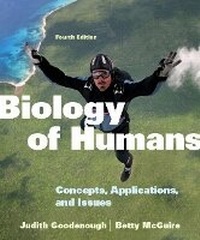
Biology of Humans
Concepts, Applications, and Issues: United States Edition
4th Edition
Published on 7. February 2011
Book
Paperback/Softback
624 pages
978-0-321-70702-4 (ISBN)
Description
With a new open, student-friendly layout and more media integration, the Fourth Edition of Biology of Humans: Concepts, Applications, and Issues continues to personalize the study of human biology. Its conversational writing style, stunning art, abundant applications, and learning tools develop your critical-thinking skills. The authors provide a conceptual framework to help you understand how our bodies work, and to deal with issues relevant to human health in today's world. You'll gain an appreciation for the intricacy of the human body and the place of humans in the ecosphere.
More details
Edition
4th edition
Language
English
Place of publication
United States
Publishing group
Pearson Education (US)
Target group
College/higher education
Dimensions
Height: 227 mm
Width: 273 mm
Thickness: 19 mm
Weight
1250 gr
ISBN-13
978-0-321-70702-4 (9780321707024)
Copyright in bibliographic data is held by Nielsen Book Services Limited or its licensors: all rights reserved.
Schweitzer Classification
Other editions
New editions
Judith Goodenough | Betty A. McGuire
Biology of Humans
Concepts, Applications, and Issues: United States Edition
Book
02/2013
5th Edition
Pearson
€154.74
Article exhausted; check for reprint
Previous edition
Judith Goodenough | Betty A. McGuire | Robert A. Wallace
Biology of Humans
Concepts, Applications, and Issues: United States Edition
Book
02/2009
3rd Edition
Pearson
€84.17
Article exhausted; check for reprint
Persons
Judy Goodenough
Judy received her B.S. from Wagner College (Staten Island, NY), and her doctorate from New York University. She has 30 years of teaching experience at the University of Massachusetts, Amherst, specializing in introductory level courses. The insights into student concerns and problems-gained from more than 25 years of teaching Human Biology and 20 years of team-teaching The Biology of Social Issues-have helped shape this book. In 1986, Judy was honored with a "Distinguished Teaching Award." In addition to teaching, she has written articles in peer-reviewed journals, contributed chapters to several introductory biology texts, and written numerous laboratory manuals. With the author team of McGuire and Jakob, she is preparing Perspectives on Animal Behavior.
Betty McGuire
Betty received her B.S. in Biology from Pennsylvania State University, where she also played varsity basketball. She went on to receive an M.S. and Ph.D. in Zoology from the University of Massachusetts, Amherst, and then spent two years as a postdoctoral researcher at the University of Illinois, Champaign-Urbana. Her field and laboratory research emphasize the social behavior and reproduction of small mammals. She has published numerous research papers, co-authored the text Perspectives on Animal Behavior as well as several introductory biology study guides, and served as an Associate Editor for Mammalian Species, a publication of the American Society of Mammalogists. Betty taught Human Biology, Introductory Biology, Vertebrate Biology, and Animal Behavior at Smith College. She now teaches Mammalogy and The Vertebrates: Structure, Function, and Evolution at Cornell University.
Judy received her B.S. from Wagner College (Staten Island, NY), and her doctorate from New York University. She has 30 years of teaching experience at the University of Massachusetts, Amherst, specializing in introductory level courses. The insights into student concerns and problems-gained from more than 25 years of teaching Human Biology and 20 years of team-teaching The Biology of Social Issues-have helped shape this book. In 1986, Judy was honored with a "Distinguished Teaching Award." In addition to teaching, she has written articles in peer-reviewed journals, contributed chapters to several introductory biology texts, and written numerous laboratory manuals. With the author team of McGuire and Jakob, she is preparing Perspectives on Animal Behavior.
Betty McGuire
Betty received her B.S. in Biology from Pennsylvania State University, where she also played varsity basketball. She went on to receive an M.S. and Ph.D. in Zoology from the University of Massachusetts, Amherst, and then spent two years as a postdoctoral researcher at the University of Illinois, Champaign-Urbana. Her field and laboratory research emphasize the social behavior and reproduction of small mammals. She has published numerous research papers, co-authored the text Perspectives on Animal Behavior as well as several introductory biology study guides, and served as an Associate Editor for Mammalian Species, a publication of the American Society of Mammalogists. Betty taught Human Biology, Introductory Biology, Vertebrate Biology, and Animal Behavior at Smith College. She now teaches Mammalogy and The Vertebrates: Structure, Function, and Evolution at Cornell University.
Content
1. Humans in the World of Biology
2. Chemistry Comes to Life
2a. Special Topic: Food Safety and Defense
3. The Cell
4. Body Organization and Homeostasis
5. The Skeletal System
6. The Muscular System
7. Neurons: The Matter of the Mind
8. The Nervous System
8a. Special Topic: Drugs and the Mind
9. Sensory Systems
10. The Endocrine System
10a. Special Topic: Diabetes Mellitus
11. Blood
12. The Cardiovascular and Lymphatic System
12a. Special Topic: Cardiovascular Disease
13. Body Defense Mechanisms
13a. Special Topic: Infectious Disease
14. The Respiratory System
15. The Digestive System
15a. Special Topic: Nutrition and Weight Control
16. The Urinary System
17. Reproductive Systems
17a. Special Topic: Sexually Transmitted Diseases and AIDS
18. Development Through Life
18a. Special Topic: Autism Spectrum Disorders
19. Chromosomes and Cell Division
19a. Special Topic: Stem Cells-A Repair Kit for the Body
20. Genetics and Human Inheritance
21. DNA and Biotechnology
21a. Special Topic: Cancer
22. Evolution and Our Heritage
23. Ecology, The Environment, and Us
24. Human Populations, Limited Resources, and Pollution
2. Chemistry Comes to Life
2a. Special Topic: Food Safety and Defense
3. The Cell
4. Body Organization and Homeostasis
5. The Skeletal System
6. The Muscular System
7. Neurons: The Matter of the Mind
8. The Nervous System
8a. Special Topic: Drugs and the Mind
9. Sensory Systems
10. The Endocrine System
10a. Special Topic: Diabetes Mellitus
11. Blood
12. The Cardiovascular and Lymphatic System
12a. Special Topic: Cardiovascular Disease
13. Body Defense Mechanisms
13a. Special Topic: Infectious Disease
14. The Respiratory System
15. The Digestive System
15a. Special Topic: Nutrition and Weight Control
16. The Urinary System
17. Reproductive Systems
17a. Special Topic: Sexually Transmitted Diseases and AIDS
18. Development Through Life
18a. Special Topic: Autism Spectrum Disorders
19. Chromosomes and Cell Division
19a. Special Topic: Stem Cells-A Repair Kit for the Body
20. Genetics and Human Inheritance
21. DNA and Biotechnology
21a. Special Topic: Cancer
22. Evolution and Our Heritage
23. Ecology, The Environment, and Us
24. Human Populations, Limited Resources, and Pollution