

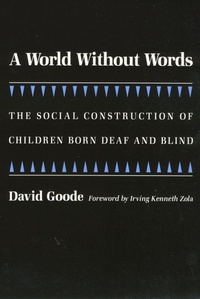
A World Without Words
The Social Construction of Children Born Deaf and Blind
Published on 29. June 1994
Book
Paperback/Softback
277 pages
978-1-56639-216-7 (ISBN)
Description
During the Rubella Syndrome epidemic of the 1960s, many children were born deaf, blind, and mentally disabled. David Goode has devoted his life and career to understanding such people's world, a world without words, but not, the author confirms, one without communication. This book is the result of his studies of two children with congenital deaf-blindness and mental retardation.
Goode spent countless hours observing, teaching, and playing with Christina, who had been institutionalized since age six, and Bianca, who remained in the care of her parents. He also observed the girls' parents, school, and medical environments, exploring the unique communication practices-sometimes so subtle they are imperceptible to outsiders-that family and health care workers create to facilitate innumerable every day situations. A World Without Words presents moving and convincing evidence that human beings both with and without formal language can understand and communicate with each other in many ways.
Through various experiments in such unconventional forms of communication as playing guitar, mimicking, and body movements like jumping, swinging, and rocking, Goode established an understanding of these children on their own terms. He discovered a spectrum of non-formal language through which these children create their own set of symbols within their own reality, and accommodate and maximize the sensory resources they do have. Ultimately, he suggests, it is impractical to attempt to interpret these children's behaviors using ideas about normal behavior of the hearing and seeing world.
Goode spent countless hours observing, teaching, and playing with Christina, who had been institutionalized since age six, and Bianca, who remained in the care of her parents. He also observed the girls' parents, school, and medical environments, exploring the unique communication practices-sometimes so subtle they are imperceptible to outsiders-that family and health care workers create to facilitate innumerable every day situations. A World Without Words presents moving and convincing evidence that human beings both with and without formal language can understand and communicate with each other in many ways.
Through various experiments in such unconventional forms of communication as playing guitar, mimicking, and body movements like jumping, swinging, and rocking, Goode established an understanding of these children on their own terms. He discovered a spectrum of non-formal language through which these children create their own set of symbols within their own reality, and accommodate and maximize the sensory resources they do have. Ultimately, he suggests, it is impractical to attempt to interpret these children's behaviors using ideas about normal behavior of the hearing and seeing world.
Reviews / Votes
"David Goode's work is unique and his thinking original and deep. It is some of the best in the sociology of disability." --Robert Bogdan, Syracuse UniversityMore details
Series
Edition
New
Language
English
Place of publication
Philadelphia PA
United States
Target group
Professional and scholarly
Product notice
Paperback (trade)
Dimensions
Height: 208 mm
Width: 140 mm
Thickness: 19 mm
Weight
331 gr
ISBN-13
978-1-56639-216-7 (9781566392167)
Copyright in bibliographic data and cover images is held by Nielsen Book Services Limited or by the publishers or by their respective licensors: all rights reserved.
Schweitzer Classification
Person
David Goode is the Coordinator of the Program in Developmental Disabilities and teaches sociology at the College of Staten Island, City University of New York.
Content
Contents Foreword - Irving Kenneth Zola
Acknowledgments
1. Introduction
2. A World Without Words
3. On Understanding Without Words
4. Reflections on the Possibility of Understanding Without Formal Language
5. Construction and Use of Data in Social Science Research
6. Kids, Culture, and Innocents
7. Conclusions
Appendix: Ascertaining Choice with Alingual, Deaf-Blind, and Retarded Clients
Notes
References
Index
Acknowledgments
1. Introduction
2. A World Without Words
3. On Understanding Without Words
4. Reflections on the Possibility of Understanding Without Formal Language
5. Construction and Use of Data in Social Science Research
6. Kids, Culture, and Innocents
7. Conclusions
Appendix: Ascertaining Choice with Alingual, Deaf-Blind, and Retarded Clients
Notes
References
Index