

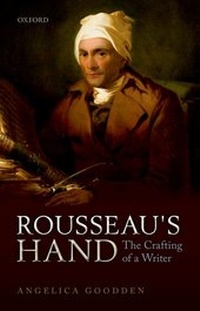
Rousseau's Hand
The Crafting of a Writer
Published on 31. October 2013
Book
Hardback
248 pages
978-0-19-968383-3 (ISBN)
Description
For all the fame he won as a writer during a brief but astonishingly fertile period in the 1750s and early 1760s, Rousseau thought the making of books essentially foreign to his nature; what mattered most to him was making things. Descended as he was from a long line of watchmakers, and raised in the artisanal heart of Geneva, he helped the promotion of craft associated with his one-time friend Diderot, whose Encyclopedie proclaimed the varied virtues of manual activity.
Taking as its point of departure the moral and monetary economy of craftsmanship in eighteenth-century Switzerland, this elegant and original study shows how family tradition and his own unfinished apprenticeship to an engraver led Rousseau to a radical questioning of central issues of the day, particularly in light of the moral utilitarianism of his age. Rousseau's Hand highlights the vital place of handwork in the artistic and social writings of his middle years -- from novels and plays to treatises and other forms of discourse -- illuminating many matters traditionally seen as inconsistencies in his ?uvre as a whole.
Abandoning creative writing for music copying in middle life, Rousseau celebrated homo faber's integrity along with the practicality and usefulness of handwork in the face of depersonalizing technological advance; yet the writings in which he extolled these virtues won him persecution as well as European celebrity. The paradox of craft's material essence in what he thought a world of abhorrent materialism and the problematic mechanization of ordinary existence exercised him throughout his life. Rousseau's Hand explores these preoccuptions.
Taking as its point of departure the moral and monetary economy of craftsmanship in eighteenth-century Switzerland, this elegant and original study shows how family tradition and his own unfinished apprenticeship to an engraver led Rousseau to a radical questioning of central issues of the day, particularly in light of the moral utilitarianism of his age. Rousseau's Hand highlights the vital place of handwork in the artistic and social writings of his middle years -- from novels and plays to treatises and other forms of discourse -- illuminating many matters traditionally seen as inconsistencies in his ?uvre as a whole.
Abandoning creative writing for music copying in middle life, Rousseau celebrated homo faber's integrity along with the practicality and usefulness of handwork in the face of depersonalizing technological advance; yet the writings in which he extolled these virtues won him persecution as well as European celebrity. The paradox of craft's material essence in what he thought a world of abhorrent materialism and the problematic mechanization of ordinary existence exercised him throughout his life. Rousseau's Hand explores these preoccuptions.
Reviews / Votes
Goodden recognizes more clearly, and explores further than other commentators, that aspect of Rousseaus oeuvre that engages the deepest concerns of his readers: the question concerning technology. * Dorina Verli, SHARP News * readers will be grateful for a study whose great intelligence and good nature plumb the work of the philosopher who thought with his hands. * Robert Zaretsky, Times Literary Supplement *More details
Language
English
Place of publication
Oxford
United Kingdom
Target group
College/higher education
Professional and scholarly
Dimensions
Height: 221 mm
Width: 147 mm
Thickness: 22 mm
Weight
434 gr
ISBN-13
978-0-19-968383-3 (9780199683833)
Copyright in bibliographic data and cover images is held by Nielsen Book Services Limited or by the publishers or by their respective licensors: all rights reserved.
Schweitzer Classification
Other editions
Additional editions
E-Book
10/2013
1st Edition
OUP eBook
€43.99
Available for download
Person
Angelica Goodden, a Fellow of St Hilda's College, Oxford, has written several books on aspects of 18th- and 19th-century culture in France along with biographies of the artists Louise Vigee Le Brun and Angelica Kauffman.
Content
Introduction ; 1. The Business of Making ; 2. Writing (Down) Music ; 3. Art or Craft? ; 4. Drama and Life ; 5. Emile, Wealth, and Wellbeing ; 6. Crafting a Self ; 7. The Order of Insight ; Conclusion ; Bibliography