

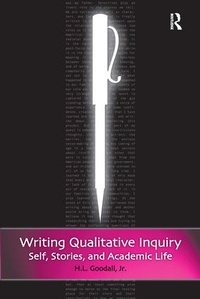
Writing Qualitative Inquiry
Self, Stories, and Academic Life
1st Edition
Published on 15. April 2009
Book
Paperback/Softback
256 pages
978-1-59874-324-1 (ISBN)
Description
Responding to the rapid growth of personal narrative as a method of inquiry among qualitative scholars, Bud Goodall offers a concise volume of practical advice for scholars and students seeking to work in this tradition. He provides writing tips and strategies from a well-published, successful author of creative nonfiction and concrete guidance on finding appropriate outlets for your work. For readers, he offers a set of criteria to assess the quality of creative nonfiction writing. Goodall suggests paths to success within the academy-still rife with political sinkholes for the narrative ethnographer-and ways of building a career as a public scholar. Goodall's work serves as both a writing manual and career guide for those in qualitative inquiry.
More details
Series
Language
English
Place of publication
Walnut Creek
United States
Target group
College/higher education
Illustrations
10 illus.
Dimensions
Height: 229 mm
Width: 152 mm
Weight
385 gr
ISBN-13
978-1-59874-324-1 (9781598743241)
Copyright in bibliographic data and cover images is held by Nielsen Book Services Limited or by the publishers or by their respective licensors: all rights reserved.
Schweitzer Classification
Other editions
Additional editions
E-Book
09/2016
Routledge
€54.99
Available for download
E-Book
09/2016
Routledge
€55.49
Available for download
Book
05/2008
1st Edition
Left Coast Press Inc
€230.27
Article not available at the moment
Person
H. L. (Bud) Goodall, Jr. is professor of communication and director of the Hugh Downs School of Human Communication at Arizona State University. He is the author or coauthor of twenty books, including A Need to Know: The Clandestine History of a CIA Family (Left Coast Press, 2006), which won the "Best Book of 2007" award from the Ethnography Division of the National Communication Association, as well as over 150 articles, chapters, and papers.A pioneer in the field of narrative ethnography, he introduced the "detective" metaphor to study high technology organizations and cultures in Casing a Promised Land: The Autobiography of an Organizational Detective as Cultural Ethnographer (Southern Illinois University Press, 1989); toured and played rhythm guitar in the Whitedog band to investigate rock and roll as a social theory of everyday working life in Living in the Rock'n Roll Mystery: Reading Context, Self, and Others as Clues (Southern Illinois University Press, 1991); and went "undercover" to explore alternative forms of religion and spirituality in the southern region of the United States in Divine Signs: Connecting Spirit to Community (Southern Illinois University Press, 1996). With Eric Eisenberg and Angela Trethewey, he is the coauthor of the award-winning best textbook, Organizational Communication: Balancing Creativity and Constraint (Bedford/St. Martin's, 2007), now in its fifth edition, and he authored the highly acclaimed Writing the New Ethnography (AltaMira Press, 2000). In 2003, he was awarded the Gerald M. Phillips Award for Distinguished Applied Communication Scholarship, an honor bestowed to scholars for their work over a 20-year span of time.His most recent public scholarship applies theories of communication and narratives to the challenge of countering ideological support for terrorism. In that role, he has served as a U.S. Department of State international speaker.He is married to the histori
Content
Chapter 1 The 5 Rs of Narrative Writing; Chapter 2 Fingers on the Keyboard ...; Chapter 3 Submitting Narrative Work to Academic Journals and Academic Presses; Chapter 4 Reading and Evaluating Narrative Scholarship; Chapter 5 Success in the Academy; Chapter 6 Success beyond the Academy;