

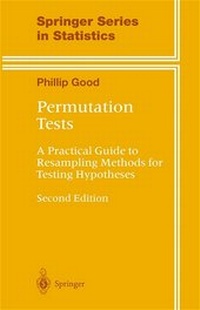
Permutation Tests
A Practical Guide to Resampling Methods for Testing Hypotheses
2nd Edition
Published on 1. January 2000
Book
Hardback
XVI, 271 pages
978-0-387-98898-6 (ISBN)
Description
A step-by-step manual on the application of permutation tests in biology, business, medicine, science, and engineering. Its intuitive and informal style make it ideal for students and researchers, whether experienced or coming to these resampling methods for the first time. The real-world problems of missing and censored data, multiple comparisons, nonresponders, after-the-fact covariates, and outliers are all dealt with at length. This new edition has more than 100 additional pages, and includes streamlined statistics for the k-sample comparison and analysis of variance plus expanded sections on computational techniques, multiple comparisons, multiple regression, comparing variances, and testing interactions in balanced designs. The comprehensive author and subject indexes, plus an expert-system guide to methods, provide for further ease of use, while the exercises at the end of every chapter have been supplemented with drills and a number of graduate-level thesis problems.
More details
Series
Edition
2nd ed.
Language
English
Place of publication
NY
United States
Target group
College/higher education
Professional and scholarly
Edition type
Revised edition
Illustrations
29 s/w Tabellen, 8 s/w Abbildungen
14 illus, indexes, bibliography
Dimensions
Height: 230 mm
Weight
560 gr
ISBN-13
978-0-387-98898-6 (9780387988986)
DOI
10.1007/978-1-4757-3235-1
Schweitzer Classification
Other editions
New editions
Phillip I. Good
Permutation, Parametric, and Bootstrap Tests of Hypotheses
Book
12/2004
3rd Edition
Springer
€213.99
Shipment within 5-7 days
Previous edition

Book
01/1994
Springer
€71.71
Article exhausted; check for reprint
Content
1. A Wide Range of Applications.- 2. A Simple Test.- 3. Testing Hypotheses.- 4. Experimental Designs.- 5. Multivariate Analysis.- 6. Categorical Data.- 7. Dependence.- 8. Clustering in Time and Space.- 9. Coping with Disaster.- 10. Which Statistic? Solving the Insolvable.- 11. Which Test Should You Usez.- 12. Publishing Your Results.- 13. Increasing Computational Efficiency.- 14. Theory of Permutation Tests.- B.1. Permutation Test Articles.- B.2. Computational Methods.- B.3. Seminal Articles.- Author Index.