

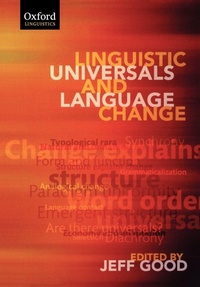
Linguistic Universals and Language Change
Published on 24. January 2008
Book
Paperback/Softback
360 pages
978-0-19-922899-7 (ISBN)
Description
This book looks at the relationship between linguistic universals and language change. Reflecting the resurgence of work in both fields over the last two decades, it addresses two related issues of central importance in linguistics: the balance between synchronic and diachronic factors in accounting for universals of linguistic structure, and the means of distinguishing genuine aspects of a universal human cognitive capacity for language from regularities that may be traced to extraneous origins.
The volume brings together specially commissioned work by leading scholars, including prominent representatives of generative and functional linguistics. It examines rival explanations for linguistic universals and assesses the effectiveness of competing models of language change. The authors investigate patterns and processes of grammatical and lexical change across a wide range of languages; they consider the degree to which common characteristics condition processes of change in related languages; and examine how far differences in linguistic outcomes may be explained by cultural or external factors.
This book will interest the wide range of scholars in linguistics and related fields concerned with language change, historical linguistics, linguistic typology and universals, and the nature of the human language faculty
The volume brings together specially commissioned work by leading scholars, including prominent representatives of generative and functional linguistics. It examines rival explanations for linguistic universals and assesses the effectiveness of competing models of language change. The authors investigate patterns and processes of grammatical and lexical change across a wide range of languages; they consider the degree to which common characteristics condition processes of change in related languages; and examine how far differences in linguistic outcomes may be explained by cultural or external factors.
This book will interest the wide range of scholars in linguistics and related fields concerned with language change, historical linguistics, linguistic typology and universals, and the nature of the human language faculty
Reviews / Votes
...rich insightful theoretical interpretation, along with extensive examination of data and sophisticated statistical analysis. It is also cleverly organized and rigorously edited... Linguistic Universals and Language Change is undoubtedly required reading for anyone interested in linguistic typology and universals, language change and historical linguistics. * Susan Lixia Cheng, Linguistics * an excellent addition to the literature on universals and language change. * B. Richard Page, Zeitschrift fuer Dialektologie und Linguistik *More details
Language
English
Place of publication
Oxford
United Kingdom
Target group
College/higher education
Dimensions
Height: 244 mm
Width: 170 mm
Thickness: 19 mm
Weight
615 gr
ISBN-13
978-0-19-922899-7 (9780199228997)
Copyright in bibliographic data and cover images is held by Nielsen Book Services Limited or by the publishers or by their respective licensors: all rights reserved.
Schweitzer Classification
Other editions
Additional editions
Book
01/2008
Oxford University Press
€82.94
Shipment within 15-20 days
Person
Jeff Good is Assistant Professor in the Department of Linguistics at the University at Buffalo. He was previously a senior research fellow at the Max Planck Institute for Evolutionary Anthropology in Leipzig. He has examined the relationship between grammatical patterns and language change in diverse languages, including Chechen, Saramaccan, Turkish, and languages of the Bantu family. His published work includes articles in Diachronica, Studies in Language, Lingua, and the Yearbook of Morphology.
Content
PART I UNIVERSALS AND CHANGE: GENERAL PERSPECTIVES; PART II PHONOLOGICAL UNIVERSALS: VARIATION, CHANGE, AND STRUCTURE; PART III MORPHOLOGICAL RELATIONSHIPS: THE SHAPE OF PARADIGMS; PART IV MORPHOSYNTACTIC PATTERNS: THE FORM OF GRAMMATICAL MARKERS; PART V PHRASE STRUCTURE: MODELLING THE DEVELOPMENT OF SYNTACTIC CONSTRUCTIONS; PART VI CONCLUSION