

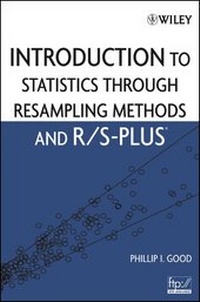
Introduction to Statistics Through Resampling Methods and R/S-PLUS
1st Edition
Published on 1. July 2005
Book
Paperback/Softback
248 pages
978-0-471-71575-7 (ISBN)
Description
Introduction to Statistics Through Resampling Methods and R/S-PLUS(r) aspires to introduce statistical methodology to a wide audience, simply, intuitively, and efficiently, through resampling from data at hand and by way of the computer programs R and S-PLUS. The objective of the book is to use quantitative methods to characterize, review, report on, test, estimate, and classify findings.
Features include:
* The R and S-PLUS¨ programming are used to illustrate the concepts and to aid the reader in completing the exercises. R may be downloaded, without charge, for use under Windows, UNIX, or the Macintosh.
* One hundred or more exercises included in each chapter plus dozens of thought-provoking questions serve the needs of both classroom and self-study. The discovery method is utilized as often as possible, thereby forcing the conscientious reader to think her or his way to a solution rather than copy the answer or apply a formula straight out of the text
* Chatty, informal, sometimes humorous writing style allows greater access to a variety of reader backgrounds and interests
* Covers unusual topics such as tests and estimation procedures for one, two, and many samples; correlation; multivariable analysis; and complex experimental designs
* Provides a web site free of charge to all end-users that includes all data sets and programs in the text
Features include:
* The R and S-PLUS¨ programming are used to illustrate the concepts and to aid the reader in completing the exercises. R may be downloaded, without charge, for use under Windows, UNIX, or the Macintosh.
* One hundred or more exercises included in each chapter plus dozens of thought-provoking questions serve the needs of both classroom and self-study. The discovery method is utilized as often as possible, thereby forcing the conscientious reader to think her or his way to a solution rather than copy the answer or apply a formula straight out of the text
* Chatty, informal, sometimes humorous writing style allows greater access to a variety of reader backgrounds and interests
* Covers unusual topics such as tests and estimation procedures for one, two, and many samples; correlation; multivariable analysis; and complex experimental designs
* Provides a web site free of charge to all end-users that includes all data sets and programs in the text
Reviews / Votes
"...easy to read and provides many interesting examples." (The American Statistician, November 2006) "This is certainly one of the most impressive little paperback 200-page introductory statistics books that I will ever see...it would make a good nightstand book for every statistician." (Technometrics, May 2006) "Good, a well-published statistical expert, is adept at introducing new ideas with well-structured scenarios, nicely illustrating his points, and presenting them in an effective, conversational tone." (CHOICE, January 2006) "I would recommend this book to readers new to statistics, practitioners who lack the basics of statistical estimation and hypothesis, and students who need a side reference..." (MAA Reviews, January 3, 2006) " ... clearly written and ha(s) a very informal style that is pleasant to read, making the text accessible to the many." (Significance: Vol. 3, 2) "...the books have plenty of wise advice for the application of statistics..." (Bulletin of Mathematical Biology ,2007) '...a very good introduction to statistics and focuses on the variety of problems which will be of interest to students.' (Statistical Papers,48, 2007)More details
Edition
1., Auflage
Language
English
Place of publication
New York
United States
Publishing group
John Wiley and Sons Ltd
Target group
Professional and scholarly
Illustrations
Illustrations
Dimensions
Height: 23.4 cm
Width: 15.3 cm
Thickness: 17 mm
Weight
397 gr
ISBN-13
978-0-471-71575-7 (9780471715757)
Schweitzer Classification
Other editions
New editions
Phillip I. Good
Introduction to Statistics Through Resampling Methods and R
Book
03/2013
2nd Edition
Wiley
€66.00
Shipment within 15-20 days
Person
PHILLIP I. GOOD, PHD, is Operations Manager of Information Research, a consulting firm specializing in statistical solutions for private and public organizations. He has published more than thirty scholarly works, more than 600 articles, and fourteen books, including Common Errors in Statistics (and How to Avoid Them) and A Manager's Guide to the Design and Conduct of Clinical Trials, both from Wiley.
Content
Preface.
1. Variation.
1.1 Variation.
1.2. Collecting Data.
1.3. Summarizing Your Data.
1.4. Types of Data.
1.5. Reporting Your Results.
1.6. Measures of Location.
1.7. Samples and Populations.
1.8. Variation-- Within and Between.
1.9. Summary and Review.
2. Probability.
2.1. Probability.
2.2. Binomial.
2.3. Condition Probability.
2.4. Independence.
2.5. Applications to Genetics.
2.6. Summary and Review.
3. Distributions.
3.1. Distribution of Values.
3.2. Discrete Distributions.
3.3. Continuous Distributions.
3.4. Properties of Independence Observations.
3.5. Testing A Hypothesis.
3.6. Estimating Effect Size.
3.7 Summary and Review.
4. Testing Hypotheses.
4.1. One-Sample Problems.
4.2. Comparing Two Samples.
4.3. Which Test Should e Use?
4.4. Summary and Review.
5. Designing an Experiment or Survey.
5.1. The Hawthorne Effect.
5.2. Designing an Experiment or Survey.
5.3. How Large a Sample.
5.4. Meta-Analysis.
5.5. Summary and Review.
6. Analyzing Complex Experiments.
6.1. Changes Measured in Percentages.
6.2. Comparing More Than Two Samples.
6.3. Equalizing Variances.
6.4. Categorical Data.
6.5. Multivariate Analysis.
6.6. Summary and Review.
7. Developing Models.
7.1. Models.
7.2. Regression.
7.3. Fitting a Regression Equation.
7.4. Problems with Regression.
7.5 Quantile Regression.
7.6. Validation.
7.7 Classification and Regression Trees.
7.8 Summary and Review.
8. Reporting Your Findings.
8.1. What to Report.
8.2. Text, Tables, of Graph?
8.3. Summarizing Your Results.
8.4 Reporting Analysis Results.
8.5 Exceptions are the Real Story.
9. Problem Solving.
9.1. Real Life Problems.
9.2. Problem Sets.
9.3. Solutions.
Appendix: S-PLUS.
Answers to Selected Exercises.
Subject Index.
Index to R Functions.
1. Variation.
1.1 Variation.
1.2. Collecting Data.
1.3. Summarizing Your Data.
1.4. Types of Data.
1.5. Reporting Your Results.
1.6. Measures of Location.
1.7. Samples and Populations.
1.8. Variation-- Within and Between.
1.9. Summary and Review.
2. Probability.
2.1. Probability.
2.2. Binomial.
2.3. Condition Probability.
2.4. Independence.
2.5. Applications to Genetics.
2.6. Summary and Review.
3. Distributions.
3.1. Distribution of Values.
3.2. Discrete Distributions.
3.3. Continuous Distributions.
3.4. Properties of Independence Observations.
3.5. Testing A Hypothesis.
3.6. Estimating Effect Size.
3.7 Summary and Review.
4. Testing Hypotheses.
4.1. One-Sample Problems.
4.2. Comparing Two Samples.
4.3. Which Test Should e Use?
4.4. Summary and Review.
5. Designing an Experiment or Survey.
5.1. The Hawthorne Effect.
5.2. Designing an Experiment or Survey.
5.3. How Large a Sample.
5.4. Meta-Analysis.
5.5. Summary and Review.
6. Analyzing Complex Experiments.
6.1. Changes Measured in Percentages.
6.2. Comparing More Than Two Samples.
6.3. Equalizing Variances.
6.4. Categorical Data.
6.5. Multivariate Analysis.
6.6. Summary and Review.
7. Developing Models.
7.1. Models.
7.2. Regression.
7.3. Fitting a Regression Equation.
7.4. Problems with Regression.
7.5 Quantile Regression.
7.6. Validation.
7.7 Classification and Regression Trees.
7.8 Summary and Review.
8. Reporting Your Findings.
8.1. What to Report.
8.2. Text, Tables, of Graph?
8.3. Summarizing Your Results.
8.4 Reporting Analysis Results.
8.5 Exceptions are the Real Story.
9. Problem Solving.
9.1. Real Life Problems.
9.2. Problem Sets.
9.3. Solutions.
Appendix: S-PLUS.
Answers to Selected Exercises.
Subject Index.
Index to R Functions.