

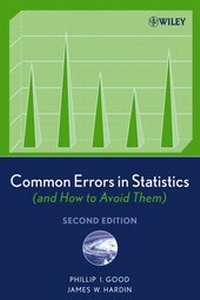
Common Errors in Statistics (and How to Avoid Them)
2nd Edition
Published on 1. April 2006
Book
Paperback/Softback
272 pages
978-0-471-79431-8 (ISBN)
Description
Common Errors is consistently coherent and provides a consistent level throughout. The Second Edition elaborates on a few key topics such as testing hypotheses (two-way designs) and multivariate regression (nonuniqueness and indicator variables).
Reviews / Votes
"A very engaging and valuable book for all who use statistics in any settings." (CHOICE, October 2006) "...a concise guide to the basics of statistics, replete with examples, explaining in common language...a valuable reference for more advanced statisticians as well..." (MAA Reviews, June 22, 2006) "All statistics students and teachers will find in this book a friendly and intelligent guide to...applied statistics in practice." (Journal Of Applied Statistics, April 2007)More details
Edition
2., Auflage
Language
English
Place of publication
New York
United States
Publishing group
John Wiley and Sons Ltd
Target group
Professional and scholarly
Edition type
Revised edition
Illustrations
Illustrations
Dimensions
Height: 22.9 cm
Width: 15.2 cm
Weight
435 gr
ISBN-13
978-0-471-79431-8 (9780471794318)
Schweitzer Classification
Other editions
New editions
Phillip I. Good | James W. Hardin
Common Errors in Statistics (and How to Avoid Them)
Book
07/2009
3rd Edition
Wiley
€53.90
Article exhausted; check for reprint
Additional editions
Phillip I. Good | James W. Hardin
Common Errors in Statistics (and How to Avoid Them)
E-Book
07/2006
2nd Edition
Wiley
€63.99
Available for download
Previous edition
Book
07/2003
1st Edition
Wiley
€54.90
Article exhausted; check for reprint
Persons
PHILLIP I. GOOD, PhD, is Operations Manager of Information Research, a consulting firm specializing in statistical solutions for private and public organizations and has published eighteen books.
JAMES W. HARDIN, PhD, is Associate Research Professor in the Department of Epidemiology and Biostatistics at the University of South Carolina.
JAMES W. HARDIN, PhD, is Associate Research Professor in the Department of Epidemiology and Biostatistics at the University of South Carolina.
Content
Preface.
PART I FOUNDATIONS.
1. Sources of Error.
Prescription.
Fundamental Concepts.
Ad Hoc, Post Hoc Hypotheses.
2. Hypotheses: The Why of Your Research.
Prescription.
What Is a Hypothesis?
How precise must a hypothesis be?
Found Data.
Null hypothesis.
Neyman-Pearson Theory.
Deduction and Induction.
Losses.
Decisions.
To Learn More.
3. Collecting Data.
Preparation.
Measuring Devices.
Determining Sample Size.
Fundamental Assumptions.
Experimental Design.
Four Guidelines.
Are Experiments Really Necessary?
To Learn More.
PART II HYPOTHESIS TESTING AND ESTIMATION.
4. Estimation.
Prevention.
Desirable and Not-So-Desirable Estimators.
Interval Estimates.
Improved Results.
Summary.
To Learn More.
5. Testing Hypotheses: Choosing a Test Statistic.
Comparing Means of Two Populations.
Comparing Variances.
Comparing the Means of K Samples.
Higher-Order Experimental Designs.
Contingency Tables.
Inferior Tests.
Multiple Tests.
Before You Draw Conclusions.
Summary.
To Learn More.
6. Strengths and Limitations of Some Miscellaneous Statistical Procedures.
Bootstrap.
Bayesian Methodology.
Meta-Analysis.
Permutation Tests.
To Learn More.
7. Reporting Your Results.
Fundamentals.
Tables.
Standard Error.
p-Values.
Confidence Intervals.
Recognizing and Reporting Biases.
Reporting Power.
Drawing Conclusions.
Summary.
To Learn More.
8. Interpreting Reports.
With A Grain of Salt.
Rates and Percentages.
Interpreting Computer Printouts.
9. Graphics.
The Soccer Data.
Five Rules for Avoiding Bad Graphics.
One Rule for Correct Usage of Three-Dimensional Graphics.
The Misunderstood Pie Chart.
Two Rules for Effective Display of Subgroup Information.
Two Rules for Text Elements in Graphics.
Multidimensional Displays.
Choosing Graphical Displays.
Summary.
To Learn More.
PART III BUILDING A MODEL.
10. Univariate Regression.
Model Selection.
Estimating Coefficients.
Further Considerations.
Summary.
To Learn More.
11. Alternate Methods of Regression.
Linear vs. Nonlinear Regression.
Least Absolute Deviation Regression.
Errors-in-Variables Regression.
Quantile Regression.
The Ecological Fallacy.
Nonsense Regression.
Summary.
To Learn More.
12. Multivariable Regression.
Caveats.
Factor Analysis.
General Linearized Models.
Reporting Your Results.
A Conjecture.
Decision Trees.
Building a Successful Model.
To Learn More.
13. Validation.
Methods of Validation.
Measures of Predictive Success.
Long-Term Stability.
To Learn More.
Appendix A.
Appendix B.
Glossary, Grouped by Related but Distinct Terms.
Bibliography.
Author Index.
Subject Index.
PART I FOUNDATIONS.
1. Sources of Error.
Prescription.
Fundamental Concepts.
Ad Hoc, Post Hoc Hypotheses.
2. Hypotheses: The Why of Your Research.
Prescription.
What Is a Hypothesis?
How precise must a hypothesis be?
Found Data.
Null hypothesis.
Neyman-Pearson Theory.
Deduction and Induction.
Losses.
Decisions.
To Learn More.
3. Collecting Data.
Preparation.
Measuring Devices.
Determining Sample Size.
Fundamental Assumptions.
Experimental Design.
Four Guidelines.
Are Experiments Really Necessary?
To Learn More.
PART II HYPOTHESIS TESTING AND ESTIMATION.
4. Estimation.
Prevention.
Desirable and Not-So-Desirable Estimators.
Interval Estimates.
Improved Results.
Summary.
To Learn More.
5. Testing Hypotheses: Choosing a Test Statistic.
Comparing Means of Two Populations.
Comparing Variances.
Comparing the Means of K Samples.
Higher-Order Experimental Designs.
Contingency Tables.
Inferior Tests.
Multiple Tests.
Before You Draw Conclusions.
Summary.
To Learn More.
6. Strengths and Limitations of Some Miscellaneous Statistical Procedures.
Bootstrap.
Bayesian Methodology.
Meta-Analysis.
Permutation Tests.
To Learn More.
7. Reporting Your Results.
Fundamentals.
Tables.
Standard Error.
p-Values.
Confidence Intervals.
Recognizing and Reporting Biases.
Reporting Power.
Drawing Conclusions.
Summary.
To Learn More.
8. Interpreting Reports.
With A Grain of Salt.
Rates and Percentages.
Interpreting Computer Printouts.
9. Graphics.
The Soccer Data.
Five Rules for Avoiding Bad Graphics.
One Rule for Correct Usage of Three-Dimensional Graphics.
The Misunderstood Pie Chart.
Two Rules for Effective Display of Subgroup Information.
Two Rules for Text Elements in Graphics.
Multidimensional Displays.
Choosing Graphical Displays.
Summary.
To Learn More.
PART III BUILDING A MODEL.
10. Univariate Regression.
Model Selection.
Estimating Coefficients.
Further Considerations.
Summary.
To Learn More.
11. Alternate Methods of Regression.
Linear vs. Nonlinear Regression.
Least Absolute Deviation Regression.
Errors-in-Variables Regression.
Quantile Regression.
The Ecological Fallacy.
Nonsense Regression.
Summary.
To Learn More.
12. Multivariable Regression.
Caveats.
Factor Analysis.
General Linearized Models.
Reporting Your Results.
A Conjecture.
Decision Trees.
Building a Successful Model.
To Learn More.
13. Validation.
Methods of Validation.
Measures of Predictive Success.
Long-Term Stability.
To Learn More.
Appendix A.
Appendix B.
Glossary, Grouped by Related but Distinct Terms.
Bibliography.
Author Index.
Subject Index.