

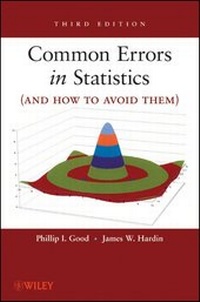
Common Errors in Statistics (and How to Avoid Them)
3rd Edition
Published on 17. July 2009
Book
Paperback/Softback
288 pages
978-0-470-45798-6 (ISBN)
Description
Praise for the Second Edition:
"All statistics students and teachers will find in this book a friendly and intelligentguide to. applied statistics in practice." -Journal of Applied Statistics
". a very engaging and valuable book for all who use statistics in any setting." -CHOICE
". a concise guide to the basics of statistics, replete with examples. a valuablereference for more advanced statisticians as well." -MAA Reviews
Now in its Third Edition, the highly readable Common Errors in Statistics (and How to Avoid Them) continues to serve as a thorough and straightforward discussion of basic statistical methods, presentations, approaches, and modeling techniques. Further enriched with new examples and counterexamples from the latest research as well as added coverage of relevant topics, this new edition of the benchmark book addresses popular mistakes often made in data collection and provides an indispensable guide to accurate statistical analysis and reporting. The authors' emphasis on careful practice, combined with a focus on the development of solutions, reveals the true value of statistics when applied correctly in any area of research.
The Third Edition has been considerably expanded and revised to include:
* A new chapter on data quality assessment
* A new chapter on correlated data
* An expanded chapter on data analysis covering categorical and ordinal data, continuous measurements, and time-to-event data, including sections on factorial and crossover designs
* Revamped exercises with a stronger emphasis on solutions
* An extended chapter on report preparation
* New sections on factor analysis as well as Poisson and negative binomial regression
Providing valuable, up-to-date information in the same user-friendly format as its predecessor, Common Errors in Statistics (and How to Avoid Them), Third Edition is an excellent book for students and professionals in industry, government, medicine, and the social sciences.
"All statistics students and teachers will find in this book a friendly and intelligentguide to. applied statistics in practice." -Journal of Applied Statistics
". a very engaging and valuable book for all who use statistics in any setting." -CHOICE
". a concise guide to the basics of statistics, replete with examples. a valuablereference for more advanced statisticians as well." -MAA Reviews
Now in its Third Edition, the highly readable Common Errors in Statistics (and How to Avoid Them) continues to serve as a thorough and straightforward discussion of basic statistical methods, presentations, approaches, and modeling techniques. Further enriched with new examples and counterexamples from the latest research as well as added coverage of relevant topics, this new edition of the benchmark book addresses popular mistakes often made in data collection and provides an indispensable guide to accurate statistical analysis and reporting. The authors' emphasis on careful practice, combined with a focus on the development of solutions, reveals the true value of statistics when applied correctly in any area of research.
The Third Edition has been considerably expanded and revised to include:
* A new chapter on data quality assessment
* A new chapter on correlated data
* An expanded chapter on data analysis covering categorical and ordinal data, continuous measurements, and time-to-event data, including sections on factorial and crossover designs
* Revamped exercises with a stronger emphasis on solutions
* An extended chapter on report preparation
* New sections on factor analysis as well as Poisson and negative binomial regression
Providing valuable, up-to-date information in the same user-friendly format as its predecessor, Common Errors in Statistics (and How to Avoid Them), Third Edition is an excellent book for students and professionals in industry, government, medicine, and the social sciences.
Reviews / Votes
"The new edition incorporates more graphics and examples using more recent data. ... Good's advice is usually wise, and always worth considering. Recommended as stimulating reading for the statistical sophisticate." (Journal of Biopharmaceutical Statistics, January 2010)More details
Edition
3., Auflage
Language
English
Place of publication
Hoboken
United Kingdom
Publishing group
John Wiley and Sons Ltd
Target group
College/higher education
Professional and scholarly
Edition type
Revised edition
Illustrations
Illustrations
Dimensions
Height: 23.8 cm
Width: 16.2 cm
Thickness: 13 mm
Weight
394 gr
ISBN-13
978-0-470-45798-6 (9780470457986)
Schweitzer Classification
Other editions
New editions
Phillip I. Good | James W. Hardin
Common Errors in Statistics (and How to Avoid Them)
Book
07/2012
4th Edition
Wiley
€66.00
Shipment within 15-20 days
Additional editions
Phillip I. Good | James W. Hardin
Common Errors in Statistics (and How to Avoid Them)
E-Book
09/2011
3rd Edition
Wiley
€45.99
Available for download
Phillip I. Good | James W. Hardin
Common Errors in Statistics (and How to Avoid Them)
E-Book
11/2009
3rd Edition
Wiley
€45.99
Available for download
Previous edition
Phillip I. Good | James W. Hardin
Common Errors in Statistics (and How to Avoid Them)
Book
04/2006
2nd Edition
Wiley
€72.90
Article exhausted; check for reprint
Persons
PHILLIP I. GOOD, PhD, is Operations Manager of Statcourse.com, a consulting firm specializing in statistical solutions for industry. He has published more than thirty scholarly works, more than six hundred popular articles, and twenty-one books, including Introduction to Statistics Through Resampling Methods and R/S-PLUS(r) and Introduction to Statistics Through Resampling Methods and Microsoft Office Excel(r), both published by Wiley. JAMES W. HARDIN, PhD, is Research Associate Professor and Director of the Biostatistics Collaborative Unit at the University of South Carolina.
Content
Preface.
PART I: FOUNDATIONS.
1. Sources of Error.
1. Prescription.
2. Fundamental Concepts.
3. Ad-hoc, post-hoc hypotheses.
2. Hypotheses: The Why of Your Research.
1. Prescription.
2. What is a hypothesis?
3. How precise must a hypothesis be?
4. Found data.
5. Null hypothesis.
6. Neyman-Pearson theory.
7. Deduction and Induction.
8. Losses.
9. Decisions.
10. To Learn More.
3. Collecting Data.
1. Preparation.
2. Response Variables.
3. Determining Sample Size.
4. Fundamental Assumptions.
5. Experimental Design.
6. Four Guidelines.
7. Are Experiments Really Necessary?
8. To Learn More.
PART II: STATISTICAL ANALYSIS.
4. Data Quality Assessment.
1. GIGO.
2. Objectives.
3. Design Review.
4. Data Review.
5. Estimation.
1. Prevention.
2. Desirable and Not-so-desirable estimators.
3. Interval Estimates.
4. Improved Results.
5. Summary.
6. To Learn More.
6. Testing Hypotheses: Choosing a Test Statistic.
1. First Steps.
2. Test Assumptions.
3. Binomial Trials.
4. Categorical Data.
5. Time to Event Data (survival analysis).
6. Comparing Means of Two Sets of Measurements.
a. Multivariate comparisons.
b. Options.
c. Testing equivalence.
d. Unequal variances.
e. Dependent observations.
7. Comparing Variances.
8. Comparing the Means of K Samples.
9. Subjective Data.
10. Independence vs. Correlation.
11. Higher Order Experimental Designs.
f. Errors in interpretation.
g. Multi-factor designs.
h. Cross-over designs.
i. Factorial designs.
j. Unbalanced designs.
12. Inferior Tests.
13. Multiple Tests.
14. Summary.
15. To Learn More.
7. Miscellaneous Statistical Procedures.
1. Bootstrap.
2. Bayesian Methodology.
3. Meta-Analysis.
4. Permutation Tests.
5. To Learn More.
PART III: REPORTS.
8. Reporting Results.
1. Fundamentals.
a. Treatment Allocation.
b. Adequacy of Blinding.
c. Missing Data.
2. Descriptive Statistics.
d. Binomial trials.
e. Categorical data.
f. Rare events.
g. Measurements.
h. Which mean?
i. Ordinal data.
j. Tables.
k. Dispersion, precision, and accuracy.
3. Standard Error.
4. p-values.
5. Confidence Intervals.
6. Recognizing and Reporting Biases.
7. Reporting Power.
8. Drawing Conclusions.
9. Summary.
10. To Learn More.
9. Interpreting Reports.
1. With A Grain of Salt.
2. Rates and Percentages.
3. Interpreting Computer Printouts.
10. Graphics.
1. Five Rules for Avoiding Bad Graphics.
2. Displaying the 3rd Dimension.
3. The Misunderstood Pie Chart.
4. Effective Display of Subgroup Information.
5. Two Rules for Text Elements.
6. Choosing The Right Display.
7. To Learn More.
PART IV: BUILDING A MODEL.
11. Univariate Regression.
1. Model Selection.
a. Scope.
b. Ambiguous relationships.
c. Confounding variables.
2. Estimating Coefficients.
3. Further Considerations.
a. Bad data.
b. Practical v. statistical significance.
c. Goodness-of-fit v. prediction.
d. Indicator variables.
e. Transformations.
f. When a straight line won't do.
g. Curve fitting and Magic Beans.
4. Summary.
5. Checklist.
6. To Learn More.
12. Alternate Modeling Methods.
1. LAD Regression.
2. Demming or EIV Regression.
3. Quantile Regression.
4. The Ecological Fallacy.
5. Poisson and Negative Binomial Regression.
6. Nonsense Regression.
7. Summary.
8. To Learn More.
13. Multivariate Regression.
1. Caveats.
2. Correcting for Confounding Variables.
3. Keep it Simple.
4. Dynamic Models.
5. Factor Analysis.
6. Reporting Your Results.
7. A Conjecture.
8. Decision Trees.
9. Building a Successful Model.
10. To Learn More.
14. Modeling Correlated Data.
2. Common Sources of Error.
3. Panel Data.
4. Fixed and Random Effects Models.
5. GEE's.
a. Subject-specific or population averaged?
b. Variance estimation.
6. Quick Reference for Popular Panel Estimators.
7. To Learn More.
15. Validation.
1. Objectives.
2. Methods of Validation.
a. Independent verification.
b. Split sample.
c. Resampling.
3. Measures of Predictive Success.
4. Long Term Stability.
5. To Learn More.
Appendix A.
Appendix B.
Appendix C.
Glossary.
Bibliography.
Author Index.
Subject Index.
PART I: FOUNDATIONS.
1. Sources of Error.
1. Prescription.
2. Fundamental Concepts.
3. Ad-hoc, post-hoc hypotheses.
2. Hypotheses: The Why of Your Research.
1. Prescription.
2. What is a hypothesis?
3. How precise must a hypothesis be?
4. Found data.
5. Null hypothesis.
6. Neyman-Pearson theory.
7. Deduction and Induction.
8. Losses.
9. Decisions.
10. To Learn More.
3. Collecting Data.
1. Preparation.
2. Response Variables.
3. Determining Sample Size.
4. Fundamental Assumptions.
5. Experimental Design.
6. Four Guidelines.
7. Are Experiments Really Necessary?
8. To Learn More.
PART II: STATISTICAL ANALYSIS.
4. Data Quality Assessment.
1. GIGO.
2. Objectives.
3. Design Review.
4. Data Review.
5. Estimation.
1. Prevention.
2. Desirable and Not-so-desirable estimators.
3. Interval Estimates.
4. Improved Results.
5. Summary.
6. To Learn More.
6. Testing Hypotheses: Choosing a Test Statistic.
1. First Steps.
2. Test Assumptions.
3. Binomial Trials.
4. Categorical Data.
5. Time to Event Data (survival analysis).
6. Comparing Means of Two Sets of Measurements.
a. Multivariate comparisons.
b. Options.
c. Testing equivalence.
d. Unequal variances.
e. Dependent observations.
7. Comparing Variances.
8. Comparing the Means of K Samples.
9. Subjective Data.
10. Independence vs. Correlation.
11. Higher Order Experimental Designs.
f. Errors in interpretation.
g. Multi-factor designs.
h. Cross-over designs.
i. Factorial designs.
j. Unbalanced designs.
12. Inferior Tests.
13. Multiple Tests.
14. Summary.
15. To Learn More.
7. Miscellaneous Statistical Procedures.
1. Bootstrap.
2. Bayesian Methodology.
3. Meta-Analysis.
4. Permutation Tests.
5. To Learn More.
PART III: REPORTS.
8. Reporting Results.
1. Fundamentals.
a. Treatment Allocation.
b. Adequacy of Blinding.
c. Missing Data.
2. Descriptive Statistics.
d. Binomial trials.
e. Categorical data.
f. Rare events.
g. Measurements.
h. Which mean?
i. Ordinal data.
j. Tables.
k. Dispersion, precision, and accuracy.
3. Standard Error.
4. p-values.
5. Confidence Intervals.
6. Recognizing and Reporting Biases.
7. Reporting Power.
8. Drawing Conclusions.
9. Summary.
10. To Learn More.
9. Interpreting Reports.
1. With A Grain of Salt.
2. Rates and Percentages.
3. Interpreting Computer Printouts.
10. Graphics.
1. Five Rules for Avoiding Bad Graphics.
2. Displaying the 3rd Dimension.
3. The Misunderstood Pie Chart.
4. Effective Display of Subgroup Information.
5. Two Rules for Text Elements.
6. Choosing The Right Display.
7. To Learn More.
PART IV: BUILDING A MODEL.
11. Univariate Regression.
1. Model Selection.
a. Scope.
b. Ambiguous relationships.
c. Confounding variables.
2. Estimating Coefficients.
3. Further Considerations.
a. Bad data.
b. Practical v. statistical significance.
c. Goodness-of-fit v. prediction.
d. Indicator variables.
e. Transformations.
f. When a straight line won't do.
g. Curve fitting and Magic Beans.
4. Summary.
5. Checklist.
6. To Learn More.
12. Alternate Modeling Methods.
1. LAD Regression.
2. Demming or EIV Regression.
3. Quantile Regression.
4. The Ecological Fallacy.
5. Poisson and Negative Binomial Regression.
6. Nonsense Regression.
7. Summary.
8. To Learn More.
13. Multivariate Regression.
1. Caveats.
2. Correcting for Confounding Variables.
3. Keep it Simple.
4. Dynamic Models.
5. Factor Analysis.
6. Reporting Your Results.
7. A Conjecture.
8. Decision Trees.
9. Building a Successful Model.
10. To Learn More.
14. Modeling Correlated Data.
2. Common Sources of Error.
3. Panel Data.
4. Fixed and Random Effects Models.
5. GEE's.
a. Subject-specific or population averaged?
b. Variance estimation.
6. Quick Reference for Popular Panel Estimators.
7. To Learn More.
15. Validation.
1. Objectives.
2. Methods of Validation.
a. Independent verification.
b. Split sample.
c. Resampling.
3. Measures of Predictive Success.
4. Long Term Stability.
5. To Learn More.
Appendix A.
Appendix B.
Appendix C.
Glossary.
Bibliography.
Author Index.
Subject Index.