

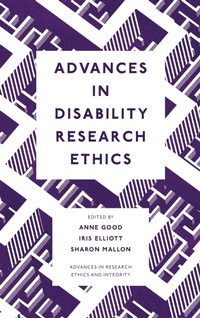
Advances in Disability Research Ethics
Published on 2. September 2024
Book
Hardback
192 pages
978-1-78769-312-8 (ISBN)
Description
There are currently over 1.3 billion people globally who experience exclusion and inequality rooted in persistent and deep ableism. Quality research with and about disabled people is vital to changing this situation. Such research presents ethical challenges and complexities which have not been given the attention they deserve if we are to advance disability rights as promised by the UNCRPD and other equality and human rights commitments.
Considering important aspects of general ethical principles, including respect, consent, privacy and confidentiality, this volume of Advances in Research Ethics and Integrity fills that gap. It does so while also recognising the broad scope, diversity and significant size of the disabled population.
Experienced researchers from the field examine processes of disablement and the specificities which arise when researching the lives of people with physical, mental, intellectual or sensory impairments. Authors also incorporate social factors such as gender, ethnicity and age and how they interact with disability. Building from the context set by the UNCRPD and other ethical guidance, chapters explore topics such as ensuring quality in data, the importance of defining terms, ethical inclusion, use and misuse of the term vulnerability, the intersection of race and ethnicity, the role of ethics committees and other approval processes and maximising research impact.
Considering important aspects of general ethical principles, including respect, consent, privacy and confidentiality, this volume of Advances in Research Ethics and Integrity fills that gap. It does so while also recognising the broad scope, diversity and significant size of the disabled population.
Experienced researchers from the field examine processes of disablement and the specificities which arise when researching the lives of people with physical, mental, intellectual or sensory impairments. Authors also incorporate social factors such as gender, ethnicity and age and how they interact with disability. Building from the context set by the UNCRPD and other ethical guidance, chapters explore topics such as ensuring quality in data, the importance of defining terms, ethical inclusion, use and misuse of the term vulnerability, the intersection of race and ethnicity, the role of ethics committees and other approval processes and maximising research impact.
More details
Series
Language
English
Place of publication
Bingley
United Kingdom
Target group
Professional and scholarly
Product notice
sewn/stitched
Cloth over boards
Dimensions
Height: 235 mm
Width: 153 mm
Thickness: 16 mm
Weight
400 gr
ISBN-13
978-1-78769-312-8 (9781787693128)
Copyright in bibliographic data and cover images is held by Nielsen Book Services Limited or by the publishers or by their respective licensors: all rights reserved.
Schweitzer Classification
Other editions
Additional editions
Anne Good | Iris Elliott | Sharon Mallon
Advances in Disability Research Ethics
E-Book
09/2024
1st Edition
Emerald Publishing Limited
€178.99
Available for download
Persons
Anne Good has now retired from public service after decades engaged with disability research, including its ethical dimension nationally and internationally. Good is now an independent Sociologist, Researcher and Writer who maintains a keen interest in social justice and equality.
Iris Elliott leads the Policy and Research Department in Ireland's National Human Rights and Equality Institution. She is a Fellow of the Royal Society of Arts in recognition of her outstanding contribution and commitment to mental health.
Sharon Mallon is Senior Mental Health Lecturer at the University of Staffordshire. She has a strong interest in the ethical impact of researching sensitive subjects.
Iris Elliott leads the Policy and Research Department in Ireland's National Human Rights and Equality Institution. She is a Fellow of the Royal Society of Arts in recognition of her outstanding contribution and commitment to mental health.
Sharon Mallon is Senior Mental Health Lecturer at the University of Staffordshire. She has a strong interest in the ethical impact of researching sensitive subjects.
Content
Introduction; Sharon Mallon, Anne Good and Iris Elliott
Chapter 1. Systemic Change in Research Ethics for the UNCRPD Knowledge Base: Mapping a Way Forward; Anne Good and Gary Allen
Chapter 2. Ethical and Legal Issues in the Collection, Use, and Dissemination of Data on Disability; Daniel Mont
Chapter 3. The Importance of Definition of Terms in Disability Research; Jennifer Madans
Chapter 4. Ethical Inclusion and Participation of People with Disability in Research: Problematising Vulnerability; Damian Mellifont, Annmaree Watharow, Sheelagh Daniels-Mayes, Jennifer Smith-Merry and Mary-Ann O'Donovan
Chapter 5. On Surviving Race with Allies: Disability, Race / Ethnicity and Human Rights; Celia Brown, Clarencetine (Teena) Brooks, Jonathan P. Edwards, Chyrell D. Bellamy and Kathleen O'Hara.
Chapter 6. The Role of an Ethics Committee in Co-produced Research: The Experience of the Disability Research on Independent Living and Learning (DRILL) Project; Alison Koslowski, Bronagh Byrne, Jackie Gulland and Peter Scott
Chapter 7. Communicating Evidence for Impact; Iris Elliott
Chapter 8. Conclusions; Iris Elliott, Sharon Mallon and Anne Good
Chapter 1. Systemic Change in Research Ethics for the UNCRPD Knowledge Base: Mapping a Way Forward; Anne Good and Gary Allen
Chapter 2. Ethical and Legal Issues in the Collection, Use, and Dissemination of Data on Disability; Daniel Mont
Chapter 3. The Importance of Definition of Terms in Disability Research; Jennifer Madans
Chapter 4. Ethical Inclusion and Participation of People with Disability in Research: Problematising Vulnerability; Damian Mellifont, Annmaree Watharow, Sheelagh Daniels-Mayes, Jennifer Smith-Merry and Mary-Ann O'Donovan
Chapter 5. On Surviving Race with Allies: Disability, Race / Ethnicity and Human Rights; Celia Brown, Clarencetine (Teena) Brooks, Jonathan P. Edwards, Chyrell D. Bellamy and Kathleen O'Hara.
Chapter 6. The Role of an Ethics Committee in Co-produced Research: The Experience of the Disability Research on Independent Living and Learning (DRILL) Project; Alison Koslowski, Bronagh Byrne, Jackie Gulland and Peter Scott
Chapter 7. Communicating Evidence for Impact; Iris Elliott
Chapter 8. Conclusions; Iris Elliott, Sharon Mallon and Anne Good