

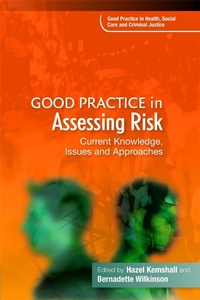
Good Practice in Assessing Risk
Current Knowledge, Issues and Approaches
Jessica Kingsley Publishers
Published on 15. January 2011
Book
Paperback/Softback
224 pages
978-1-84905-059-3 (ISBN)
Description
Maintaining a balance between managing and assessing risk and upholding the required high standards of practice in health and social care can be demanding, particularly in the current climate of increased preoccupation with the difficult tensions between rights, protection and risk-taking.
Good Practice in Assessing Risk is a comprehensive guide to good practice for those working with risk, covering a wide variety of health, social care and criminal justice settings including child protection, mental health, work with sex offenders and work with victims of domestic violence. The contributors discuss a range of key issues relating to risk including positive risk-taking, collaborating with victims and practitioners in the design of assessment tools, resilience to risk, and defensibility. The book also explores the role of bureaucracy in hindering high quality professional practice, complex decision-making in situations of stress or potential blame, and involving service users in assessment.
This book reflects the latest policy and practice within health, social care and criminal justice and will be an invaluable volume to all professionals working in these fields.
Good Practice in Assessing Risk is a comprehensive guide to good practice for those working with risk, covering a wide variety of health, social care and criminal justice settings including child protection, mental health, work with sex offenders and work with victims of domestic violence. The contributors discuss a range of key issues relating to risk including positive risk-taking, collaborating with victims and practitioners in the design of assessment tools, resilience to risk, and defensibility. The book also explores the role of bureaucracy in hindering high quality professional practice, complex decision-making in situations of stress or potential blame, and involving service users in assessment.
This book reflects the latest policy and practice within health, social care and criminal justice and will be an invaluable volume to all professionals working in these fields.
Reviews / Votes
Despite my quibbles about the move to assessing risk rather than needed, this book is well worth reading and digesting. -- PSW As a clinician, academic, and someone who works closely with high-risk offenders with complex needs, I would recommend this text for mental health nurses, and I think it provides a good discussion point for staff who want to improve risk assessment and violence prediction within their teams. The book helps the reader to identify areas that could be enhanced in their practice, risk assessment and management plans, and also their organisational policies and support mechanisms.I would certainly read this book again, keep it as useful reference material and recommend to mental health students or qualified practitioners. -- Mental Health Nursing This book is well laid out and readable, enabling the practitioner or manager to quickly assimilate salient facts and approaches which can be applied readily. As a manager and practice teacher, I see many uses for it in both day to day decision making and in helping students develop and awareness of the multifarious nature of risk, risk assessment and risk management processes. Overall, it is a very useful resource for social workers across the spectrum of practice. -- Rostrum
More details
Series
Language
English
Place of publication
London
United Kingdom
Target group
College/higher education
Professional and scholarly
Product notice
Paperback (UK-trade)
Illustrations
5 figures, 8 tables
Dimensions
Height: 226 mm
Width: 150 mm
Thickness: 18 mm
Weight
340 gr
ISBN-13
978-1-84905-059-3 (9781849050593)
Copyright in bibliographic data and cover images is held by Nielsen Book Services Limited or by the publishers or by their respective licensors: all rights reserved.
Schweitzer Classification
Other editions
Additional editions
Good Practice in Assessing Risk
Current Knowledge, Issues and Approaches
E-Book
01/2011
Jessica Kingsley Publishers
€33.99
Available for download
Persons
Martin C. Calder is Director of Calder Training and Consultancy Limited, which he established in 2005, having managed the child protection and domestic violence services for Salford. Martin trains extensively on frontline assessment issues and also where the practical becomes political. He continues to be driven to develop and deliver a range of evidence-based assessment tools for frontline staff. He is now involved in addressing issues facing frontline managers dealing with ever increasingly complex cases. Further details on his work and remit are available at www.caldertrainingandconsultancy.co.uk. Mike Titterton is a social work trainer and consultant based in Edinburgh, and has worked with the topic of risk as a developmental consultant in health promotion in the UK and internationally. Formerly a lecturer in social work at the University of Glasgow, he has published widely on health and social care.
Content
Introduction. Hazel Kemshall, De Montfort University, UK and Bernadette Wilkinson, KWP Training and Consultancy, UK. 1. Professional Risk Taking and Defensible Decisions. Kerry Baker, University of Oxford, UK and Bernadette Wilkinson. 2. Positive Risk Taking with People at Risk of Harm. Mike Titterton, Director, HALE (Health and Life for Everyone), UK. 3. The Role of Social Capital and Resources in Resilience to Risk. Thilo Boeck and Jennie Fleming, De Montfort University, UK. 4. Risk Assessment and Young People. Kerry Baker and Gill Kelly, KWP Training and Consultancy, UK. 5. The Fallacy of Formalisation: Practice Makes Process in the Assessment of Risks to Children. Sue Peckover, University of Huddersfield, UK, Karen Broadhurst, Lancaster University, UK, Sue White, Lancaster University, UK, David Wastell, University of Nottingham, UK, Chris Hall, University of Huddersfield, UK, and Andrew Pithouse, Cardiff University, UK. 6. Mental Health Risk. Tony Maden, Imperial College London, UK. 7. Risk and Intimate Partner Violence. Amanda Robinson, Cardiff University, UK. 8. Good Lives and Risk Assessment: Collaborative Approaches to Risk Assessment with Sexual Offenders. Georgia D. Barnett and Ruth E. Mann, Interventions and Substance Misuse Group, National Offender and Management Service, UK. 9. Risk and Personalisation. Rosemary Littlechild and John Glasby, University of Birmingham, UK with Louise Niblett and Tina Cooper. 10. Public Health Approaches to Risk Assessment and Risk Management. Jason Wood, De Montfort University, UK. 11. Organisationally Dangerous Practice: Political Drivers, Practice Implications and Pathways to Resolution. Martin C. Calder, Calder Training and Consultancy, UK. The Contributors. Index.