

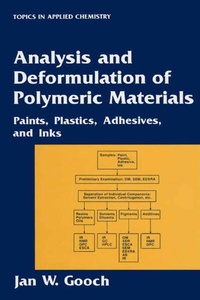
Analysis and Deformulation of Polymeric Materials
Paints, Plastics, Adhesives, and Inks
Published on 31. May 1997
Book
Hardback
XX, 332 pages
978-0-306-45541-4 (ISBN)
Description
This book is designed for the chemist, formulator, student, teacher, forensic scientist, or others who wish to investigate the composition of polymeric materials. Theinformationwithinthesepagesisintendedtoarmthereaderwiththenecessary workingknowledgetoanalyze,characterize, anddeformulatematerials. ThestructureoftheContentsisintendedtoassistthereaderinquicklylocating the subject of interest and proceed to it with a minimum of expended time and effort. The Contents provides an outline of major topics and relevant materials char- terizedforthereader'sconvenience. Anintroductiontoanalysisanddeformulation is provided in Chapter 1 to acquaint the reader with analytical methods and their applications. Extensive references are provided as additional sources ofinfor- tion. All tables arelocatedin theAppendix, beginning onp. 235. GUIDE FOR USE This is a practical book structured to efficiently use the reader's time with a minimum effort of searching for entries and information by following these brief instructions: 1. Searchthe Contents and/orIndex fora subject withinthe text. 2.
Analysis/deformulation principles are discussed at the outset to familiarize the reader with analysis methods and instruments; followed by formu- tions, materials, and analysis ofpaint, plastics, adhesives, and inks; and finally reformulation methods to test the results of analysis. 3. Materials and a wide assortment of formulations are discussed within the text by chapter/section number. 4. Materials are referred toby various names (trivial, trade, and scientific), and these are listed in tables and cross-referenced to aid the reader.
Analysis/deformulation principles are discussed at the outset to familiarize the reader with analysis methods and instruments; followed by formu- tions, materials, and analysis ofpaint, plastics, adhesives, and inks; and finally reformulation methods to test the results of analysis. 3. Materials and a wide assortment of formulations are discussed within the text by chapter/section number. 4. Materials are referred toby various names (trivial, trade, and scientific), and these are listed in tables and cross-referenced to aid the reader.
Reviews / Votes
` ...In conclusion, this book will be a very useful source of reference for the polymer analyst working in academia or industry who has to characterise and deformulate a wide range of polymer products. 'Polymer Testing, 18:231-232 (1999)
More details
Series
Edition
1997 ed.
Language
English
Place of publication
New York
United States
Publishing group
Springer Science+Business Media
Target group
Professional and scholarly
Research
Illustrations
41 s/w Abbildungen
XX, 332 p. 41 illus.
Dimensions
Height: 235 mm
Width: 157 mm
Thickness: 25 mm
Weight
667 gr
ISBN-13
978-0-306-45541-4 (9780306455414)
DOI
10.1007/b118875
Schweitzer Classification
Other editions
Additional editions
Book
04/2013
Springer
€246.09
Shipment within 15-20 days
E-Book
11/2005
Kluwer Academic / Plenum Publishers
€234.33
Available for download
Content
Deformulation Principles.- Surface Analysis.- Bulk Analysis.- Paint Formulations.- Paint Materials.- Deformulation of Paint.- Plastics Formulations.- Plastics Materials.- Deformulation of Plastics.- Adhesives Formulations.- Adhesives Materials.- Deformulation of Adhesives.- Ink Formulations.- Ink Materials.- Deformulation of Inks.