

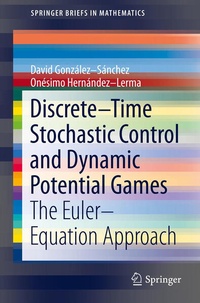
Discrete-Time Stochastic Control and Dynamic Potential Games
The Euler-Equation Approach
1st Edition
Published on 2. October 2013
Book
Paperback/Softback
XIV, 69 pages
978-3-319-01058-8 (ISBN)
Description
There are several techniques to study noncooperative dynamic games, such as dynamic programming and the maximum principle (also called the Lagrange method). It turns out, however, that one way to characterize dynamic potential games requires to analyze inverse optimal control problems, and it is here where the Euler equation approach comes in because it is particularly well-suited to solve inverse problems. Despite the importance of dynamic potential games, there is no systematic study about them. This monograph is the first attempt to provide a systematic, self-contained presentation of stochastic dynamic potential games.
More details
Series
Language
English
Place of publication
Cham
Switzerland
Publishing group
Springer International Publishing
Target group
Professional and scholarly
Research
Illustrations
XIV, 69 p.
Dimensions
Height: 235 mm
Width: 155 mm
Thickness: 5 mm
Weight
158 gr
ISBN-13
978-3-319-01058-8 (9783319010588)
DOI
10.1007/978-3-319-01059-5
Schweitzer Classification
Other editions
Additional editions
David González-Sánchez | Onésimo Hernández-Lerma
Discrete-Time Stochastic Control and Dynamic Potential Games
The Euler-Equation Approach
E-Book
09/2013
1st Edition
Springer
€52.99
Available for download
Persons
David Gonzalez-Sanchez is Assistant Professor at ITAM Mathematics Department,
Mexico City, Mexico.
Onesimo Hernandez-Lerma is Professor and Chair, CINVESTAV-IPN Mathematics
Department, Mexico City, Mexico.
Content
Introduction and summary.- Direct problem: the Euler equation approach.- The inverse optimal control problem.- Dynamic games.- Conclusion.- References.- Index