

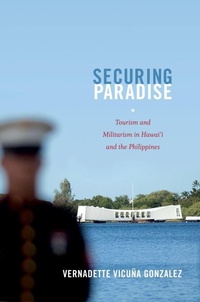
Securing Paradise
Tourism and Militarism in Hawai'i and the Philippines
Will be published approx. on 11. July 2013
Book
Paperback/Softback
296 pages
978-0-8223-5370-6 (ISBN)
Description
In Securing Paradise, Vernadette VicuNa Gonzalez shows how tourism and militarism have functioned together in Hawai`i and the Philippines, jointly empowering the United States to assert its geostrategic and economic interests in the Pacific. She does so by interpreting fiction, closely examining colonial and military construction projects, and delving into present-day tourist practices, spaces, and narratives. For instance, in both Hawai`i and the Philippines, U.S. military modes of mobility, control, and surveillance enable scenic tourist byways. Past and present U.S. military posts, such as the Clark and Subic Bases and the Pearl Harbor complex, have been reincarnated as destinations for tourists interested in World War II. The history of the U.S. military is foundational to tourist itineraries and imaginations in such sites. At the same time, U.S. military dominance is reinforced by the logics and practices of mobility and consumption underlying modern tourism. Working in tandem, militarism and tourism produce gendered structures of feeling and formations of knowledge. These become routinized into everyday life in Hawai`i and the Philippines, inculcating U.S. imperialism in the Pacific.
Reviews / Votes
"Securing Paradise will become a landmark work. It is the first systematic comparison of the Philippines and Hawai`i within the shared optic of U.S. imperial history and its military-tourism security complex. It will serve as a model for an emergent American postcolonial studies, paving the way for a more appropriately cosmopolitan critique of the already cosmopolitan workings of capitalism and empire."-Vicente L. Rafael, author of The Promise of the Foreign: Nationalism and the Technics of Translation in the Spanish Philippines "In Securing Paradise, Vernadette VicuNa Gonzalez's original research and fascinating case studies substantiate her argument that in both the Philippines and Hawai`i, militarization and tourism have worked hand-in-glove in the service of U.S. national security strategy in the Pacific. Gonzalez digs deep into the dynamic interplay between militarism and tourism in this timely, consciousness-raising analysis."-Cynthia Enloe, author of Globalization and Militarism: Feminists Make the Link "Highly recommended." - D. J. Timothy (Choice) "[A]n impressive scholarly contribution to transnational U.S. history and American Studies." - Christine Skwiot (Journal of American History) "[A] bold and creative argument for understanding the twinned projects of tourism and US militarism in the Pacific as grounded in multiple but always overlapping discourses of security. . . . Undoubtedly, Securing Paradise will become required reading in many fields, from Pacific Islands studies and Asian American studies to indigenous studies, women and gender studies, ethnic studies, and American studies." - Maile Arvin (Contemporary Pacific) "Securing Paradise compels readers with its unique and inventive approach to a ground-breaking subject. . . ." - Michael C. Hawkins (Journal of Southeast Asian Studies) "Securing Paradise is a significant contribution to the vibrant field of cultural studies of US imperialism. The book constantly reminds readers of the violence that tropical discourse, militarisation and the tourist industry exert on colonised peoples. Perhaps most importantly Gonzalez has written a history of a tenaciously imperial present, which in Hawai?i and the Philippines-as in many other places in the Pacific and the Caribbean-cannot be understood without thinking about the links between militarism and tourism." - Holger Droessler (Journal of Pacific History) "Gonzalez has written an important book that makes concrete the lingering affective and material consequences of the U.S. empire's projection of freedom with violence in the twentieth century. It has laid the groundwork for other scholars to examine similar processes of 'decolonization' as they unfolded elsewhere-in Guam, Samoa, Okinawa, for example-that will deepen our understanding of the pernicious effects and persistence of the American empire in the Pacific." - Simeon Man (Hawaiian Journal of History) "The text is to be applauded for its quality of analysis, and for its original contribution to tourism studies, military studies and American studies literatures..... Gonzalez presents an impressive and fascinating analysis of her selected case studies. She deftly overlaps mobile sexualities, re-colonization via militarism and tourism, and neoliberalism." - Claudia Bell (Journal of New Zealand and Pacific Studies)More details
Series
Language
English
Place of publication
North Carolina
United States
Target group
Professional and scholarly
Product notice
Paperback (trade)
Illustrations
15 photographs
Dimensions
Height: 235 mm
Width: 156 mm
Thickness: 16 mm
Weight
455 gr
ISBN-13
978-0-8223-5370-6 (9780822353706)
Copyright in bibliographic data and cover images is held by Nielsen Book Services Limited or by the publishers or by their respective licensors: all rights reserved.
Schweitzer Classification
Other editions
Additional editions
E-Book
07/2013
1st Edition
De Gruyter
€198.99
Available for download
Person
Vernadette VicuNa Gonzalez is Associate Professor of American Studies at the University of Hawai'i at Manoa.
Content
Acknowledgments vii
Introduction. Military-Tourism Partnerships in Hawai'i and the Philippines 1
1. Manifest Destinations and the Work of Tropical Fictions 21
2. Scenic Highways, Masculinity, Modernity, and Mobility 49
3. Neoliberalization and U.S.-Philippines Circuits of Sacrifice and Gratitude 83
4. Remembering Pearl Harbor, Reinforcing Vigilance 115
5. The Machine in the Garden: Helicopter Airmobilities, Aerial Fields of Vision, and Surrogate Tropics 147
6. Playing Soldier and Going Native in Subic Freeport's Jungle Tour 181
Conclusion. Insecurities, Tourism, and Terror 215
Notes 225
Bibliography 253
Index 271
Introduction. Military-Tourism Partnerships in Hawai'i and the Philippines 1
1. Manifest Destinations and the Work of Tropical Fictions 21
2. Scenic Highways, Masculinity, Modernity, and Mobility 49
3. Neoliberalization and U.S.-Philippines Circuits of Sacrifice and Gratitude 83
4. Remembering Pearl Harbor, Reinforcing Vigilance 115
5. The Machine in the Garden: Helicopter Airmobilities, Aerial Fields of Vision, and Surrogate Tropics 147
6. Playing Soldier and Going Native in Subic Freeport's Jungle Tour 181
Conclusion. Insecurities, Tourism, and Terror 215
Notes 225
Bibliography 253
Index 271