

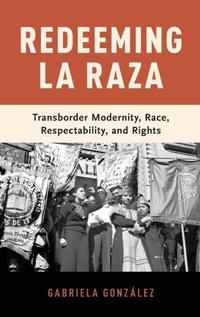
Redeeming La Raza
Transborder Modernity, Race, Respectability, and Rights
Published on 19. July 2018
Book
Hardback
280 pages
978-0-19-991414-2 (ISBN)
Description
The transborder modernization of Mexico and the American Southwest during the late nineteenth and early twentieth centuries transformed the lives of ethnic Mexicans across the political divide. While industrialization, urbanization, technology, privatization, and wealth concentration benefitted some, many more experienced dislocation, exploitative work relations, and discrimination based on race, gender, and class. The Mexican Revolution brought these issues to the fore within Mexican society, igniting a diaspora to el norte. Within the United States, similar economic and social power dynamics plagued Tejanos and awaited the war refugees. Political activism spearheaded by individuals and organizations such as the Idars, Leonor Villegas' de Magnon's White Cross, the Magonista movement, the Munguias, Emma Tenayuca, and LULAC emerged in the borderlands to address the needs of ethnic Mexicans whose lives were shaped by racism, patriarchy, and poverty.
As Gabriela Gonzalez shows in this book, economic modernization relied on social hierarchies that were used to justify economic inequities. Redeeming la raza was about saving ethnic Mexicans in Texas from a social hierarchy premised on false notions of white supremacy and Mexican inferiority. Activists used privileges of class, education, networks, and organizational skills to confront the many injustices that racism bred, but they used different strategies. Thus, the anarcho-syndicalist approach of Magonistas stands in contrast to the social and cultural redemption politics of the Idars who used the press to challenge a Jaime Crow world. Also, the family promoted the intellectual, material, and cultural uplift of la raza, working to combat negative stereotypes of ethnic Mexicans. Similar contrasts can be drawn between the labor activism of Emma Tenayuca and the Munguias, whose struggle for rights employed a politics of respectability that encouraged ethnic pride and unity. Finally, maternal feminist approaches and the politics of citizenship serve as reminders that gendered and nationalist rhetoric and practices foment hierarchies within civil and human rights organizations.
Redeeming La Raza examines efforts of activists to create a dignified place for ethnic Mexicans in American society by challenging white supremacy and the segregated world it spawned.
As Gabriela Gonzalez shows in this book, economic modernization relied on social hierarchies that were used to justify economic inequities. Redeeming la raza was about saving ethnic Mexicans in Texas from a social hierarchy premised on false notions of white supremacy and Mexican inferiority. Activists used privileges of class, education, networks, and organizational skills to confront the many injustices that racism bred, but they used different strategies. Thus, the anarcho-syndicalist approach of Magonistas stands in contrast to the social and cultural redemption politics of the Idars who used the press to challenge a Jaime Crow world. Also, the family promoted the intellectual, material, and cultural uplift of la raza, working to combat negative stereotypes of ethnic Mexicans. Similar contrasts can be drawn between the labor activism of Emma Tenayuca and the Munguias, whose struggle for rights employed a politics of respectability that encouraged ethnic pride and unity. Finally, maternal feminist approaches and the politics of citizenship serve as reminders that gendered and nationalist rhetoric and practices foment hierarchies within civil and human rights organizations.
Redeeming La Raza examines efforts of activists to create a dignified place for ethnic Mexicans in American society by challenging white supremacy and the segregated world it spawned.
Reviews / Votes
Provocative and original...This study breaks new ground in its deeply sympathetic treatment of middle-class and more elite women, most of whom have been overshadowed by their male counterparts, or too readily dismissed as naively assimilationist or even outright racist. The research base is impressive, primarily consisting of oral histories (some of her own creation), personal correspondence, newspapers, and organizational records and newsletters. * Benjamin H. Johnson, Pacific Historical Review * Gabriela Gonzalez offers a rich and luminous study of transborder activism during the early twentieth century to examine how racial, gendered, and classed forms of oppression were challenged in the border regions of Texas....A notable strength of this text is its robust engagement with emerging forms of feminism in the U.S.-Mexico borderlands....Reedeming la Raza is a salutary contribution to the fields of gender studies, Mexican American history, border studies, and ethnic studies. The text is written in a lucid and accessible manner, making it an excellent addition to graduate and advanced undergraduate syllabi. Lastly, scholars will find an excellent resource in this text for attending to la raza without employing essentialist discourse. * Ruben Ernesto Zecena, Journal of Arizona History * This important book explores the transborder history of Mexican-U.S. relations in the early twentieth century....Gonzalez offers a major revision of such stereotypes...of....Mexican Americans...as victims compelled by Anglo racism to live in poverty and relegated to low-paying jobs....She profiles the experiences of gente decente, middle-class families who actively opposed the Porfiriato (the regime of Porfirio Diaz, 1878-1911) and sided with the carrancistas in the 1910 revolution. ....Rich in detail and solidly grounded in American and Mexican primary sources, including oral history interviews..., this book should be required reading in Chicano studies courses and for any scholar seeking an excellent model of transnational history. * Abraham Hoffman, Journal of American History * This is an incredibly useful synthetic work, which, through well-researched vignettes, strings together the histories of many Mexico-Tejano activists. Gonzalez produces a truly intertwining, transnational study of this border zone (something which many works promise, but few actually deliver) and her analysis of women and gender is sharp and thoughtful....[Redeeming La Raza] is a love letter to the rich activist history of South Texas places and people. It illuminates a great deal about the histories of gender and respectability politics, intellectual production in the US-Mexico borderlands, and class chasms in Latino communities. It will also work well as a teaching tool. * Lori A. Flores, English Historical Review * Throughout the chapters, Gonzalez traces the evolution, transformation, and, at times, refusal of gente decente ideologies that animated transborder activism in the early twentieth century. She also gives critical attention to gender and its intersections with political development and involvement. Gonzalez weaves the biographies of men and women enveloped in struggles for rights....Redeeming La Raza is an excellent text that will be of great interest to borderlands and Mexican American historians. Those who research histories of civil rights, modernity, class, race, ethnicity, gender, and culture in a Mexico and/or U.S. context will also find it to be an invaluable addition to studies of the twentieth century. * Iliana Yamileth Rodriguez, Journal of Southern History * After reading this book, people should appreciate the broad overlaps in strategies connecting labor organizing with school advocacy, poll tax payments with cultural enrichment before World War II and the GI Bill generation. Redeeming la Raza leaves a vivid portrait of the cross-border organizing done by community-based activists in Texas during the hardening of Jim Crow and the U.S. Mexico border after World War I through the New Deal. In doing so, Gabriela Gonzalez demonstrates how difficult and important it is to redirect culture into politics in borderlands spaces such as Texas and the United States. * John Mckiernan-Gonzalez, Texas Books in Review * Redeeming La Raza is an excellent text * Iliana Yamileth Rodriguez, Journal of Southern History * In Redeeming La Raza ... Gabriela Gonzalez traces the multifaceted efforts of Mexican and Mexican American activists in the Texas-Mexico border region to confront structural and cultural obstacles to rights and progress for ethnic Mexicans throughout the first half of the twentieth century. Focusing in particular on a handful of individual biographical accounts, Gonzalez reveals the ambition and the breadth of multiple strands of activism that both sought progress and focused on transformation in a broadly transnational context. These varied activists sought to confront both race- and class-based exploitation using the tools open to them as individuals familiar with the gendered dynamics of their transborder lives ... It is a complicated and rewarding book that covers familiar subjects in interesting new ways. * John Weber, American Historical Review * This research significantly expands our knowledge of Mexican American, Texas, southwestern borderlands, and women's and gender history. Comprehensive, grounded on primary documents and essential secondary sources, and written in clear, jargon-free prose, Gonzalez's work is to be commended for the way in which it explains how gender ideologies shaped and informed locally grown ideas about women's place in society and in its connection to greater American historical processes. * Sonia Hernandez, Southwestern Historical Quarterly * Redeeming La Raza takes the political and cultural ideas debated by Texas Mexicans along the US borderline seriously as intellectual history. Always attentive to differences shaped by class and gender, Gabriela Gonzalez weaves a critical story of the impact of respectability politics, transnational modernism, and maternal feminism in the shaping and sustenance of a powerful transborder political culture."-George Sanchez, University of Southern California This book is the first to weave numerous biographies and political perspectives of Mexicans/Chicanos across decades using the lens of transnationalism. Gonzalez offers a most excellent treatment of transborder political culture showing how the Mexican immigrant middle class and Mexican American middle class sought to uplift working class Mexican immigrants from racism."-Cynthia E. Orozco, Eastern New Mexico University-Ruidoso Gabriela Gonzalez's erudite, deeply-researched, and far-reaching study of Mexicans in Texas should be read by students, scholars, activists, and others who care about the U.S.-Mexico border region, women's history, and civil rights. Capturing untold stories of women's leadership, international relations, and racial discrimination, Redeeming La Raza rewrites important chapters in twentieth-century American history. * Stephen Pitti, Yale University*
More details
Language
English
Place of publication
New York
United States
Illustrations
20 hts
Dimensions
Height: 240 mm
Width: 161 mm
Thickness: 20 mm
Weight
587 gr
ISBN-13
978-0-19-991414-2 (9780199914142)
Copyright in bibliographic data and cover images is held by Nielsen Book Services Limited or by the publishers or by their respective licensors: all rights reserved.
Schweitzer Classification
Other editions
Additional editions
Book
07/2018
Oxford University Press Inc
€59.20
Shipment within 15-20 days
E-Book
06/2018
1st Edition
OUP eBook
€24.99
Available for download
E-Book
06/2018
1st Edition
OUP eBook
€24.99
Available for download
Person
Gabriela Gonzalez is an associate professor of history at the University of Texas at San Antonio.
Content
- Note on Usage
- Acknowledgments
- Introduction: Redeeming la Raza in the World of Two Flags Entwined
- Part I: Modernizing Mexico, 1900-1929
- Chapter One: Social Change, Cultural Redemption, and Social Stability: The Political Strategies of Gente Decente Reform
- Chapter Two: Masons, Magonistas, and Maternalists: Liberal, Anarchist, and Maternalist Thought Within a Local/Global Nexus
- Chapter Three: Crossing Borders to Rebirth the Nation: Leonor Villegas de Magnón and the Mexican Revolution
- Part II: Borderlands Mexican Americans in Modern Texas, 1930-1950
- Chapter Four: All for Country and Home: The Transnational Lives and Work of Romúlo Munguía and Carolina Malpica de Munguía
- Chapter Five: La Pasionaria (The Passionate One): Emma Tenayuca and the Politics of Radical Reform
- Chapter Six: Struggling Against Jaime Crow: LULAC, Gente Decente Heir to a Transborder Political Strategy
- Conclusion "La Idea Mueve" (The Idea Moves Us): Why Cultural Redemption Matters
- Notes
- Bibliography
- Index