

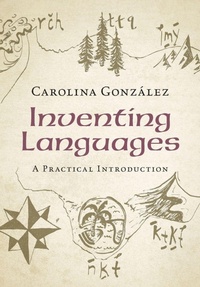
Inventing Languages
A Practical Introduction
Will be published approx. on 4. December 2025
Book
Paperback/Softback
402 pages
978-1-108-79941-6 (ISBN)
Description
How are invented languages created? Artificially constructed languages ('conlangs') shed light on how we can apply the universal principles of language to produce whole new languages. Grounded on world building and linguistic typology, this engaging book provides a step-by-step guide to language invention, introducing the basic blocks of language building (such as sounds, morphemes and sentence structure) and demonstrating their use in both natural languages from English to Swahili, and invented languages from Esperanto to Klingon. An original conlang is developed throughout the book to bring the theory to life, accompanied with scaffolded, creative exercises that allow the reader to explore different linguistic options before incorporating them in their own conlang. Making conlanging accessible to readers with little or no background in linguistics, this guide is ideal for linguistics students, creative writers, and readers interested in language and language invention.
More details
Language
English
Place of publication
Cambridge
United Kingdom
Product notice
Paperback (trade)
Illustrations
Worked examples or Exercises
Dimensions
Height: 244 mm
Width: 170 mm
Thickness: 22 mm
Weight
691 gr
ISBN-13
978-1-108-79941-6 (9781108799416)
Copyright in bibliographic data and cover images is held by Nielsen Book Services Limited or by the publishers or by their respective licensors: all rights reserved.
Schweitzer Classification
Other editions
Additional editions
Book
approx. 12/2025
Cambridge University Press
€138.90
Not yet published
Person
Carolina Gonzalez is Professor of Spanish and Linguistics at Florida State University.
Content
Abbreviations; Preface; Acknowledgements; 1. What are constructed languages?; 2. World building; 3. Designing vowel inventories; 4. Designing consonant inventories; 5. From sounds to syllables; 6. Stress and tone; 7. The lexicon; 8. The morphology of nouns; 9. The morphology of verbs; 10. Word order; 11. Statements, questions and commands; 12. Negation and evidentials; 13. Complex sentences; 14. Writing systems; 15. Semantics and pragmatics; 16. Variation in space and time; 17. Language channels and modalities; 18. Wrapping up and moving forward; Appendix A: natlangs mentioned; Appendix B: conlangs mentioned.