

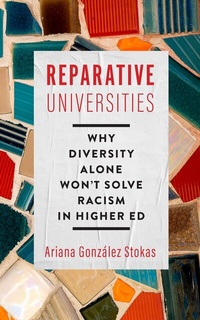
Reparative Universities
Why Diversity Alone Won't Solve Racism in Higher Ed
Published on 23. May 2023
Book
Hardback
288 pages
978-1-4214-4560-1 (ISBN)
Description
A timely investigation of why diversity alone is insufficient in higher education and how universities can use reparative actions to become anti-racist institutions.
As institutions increasingly reckon with histories entangled with slavery and Indigenous dispossession, diversity, equity, and inclusion (DEI) efforts occupy a central role in the strategy and resources of higher education. Yet reparation is rarely offered as a viable strategy for institutional transformation. In Reparative Universities, Ariana Gonzalez Stokas undertakes a critical and decolonial analysis of DEI work, linking contemporary practices of diversity to longer colonial histories. Gonzalez Stokas argues that diversity is an insufficient concept for efforts concerned with anti-oppression, anti-racism, equity, and decolonization. Given its historical ties to colonialism, can higher education foster reconciliation and healing?
Reparation is offered as a pathway toward untangling higher education from its colonial roots. Gonzalez Stokas develops the term "epistemic reparation" to describe a mode of social-historical accountability that can already be seen at work in historical examples, as well as current events in the United States, South Africa, and Canada. Recent legal decisions by Georgetown University and the Princeton Theological seminary to enact economic recompense for buying and selling human beings are evidence of attempts to redress higher education's violent histories and the colonial structures they reproduce every day on college campuses.
Engaging with a broad range of theories from decolonial philosophy to organizational psychology, Gonzalez Stokas offers a pathway-guided by reparative activities-for institutional workers frustrated by what often feels, as Sara Ahmed describes, like "banging one's head against a brick wall." Reparative Universities offers insight into why DEI efforts have been disconnected from past injustices and why unsettling diversity and engaging meaningful repair are critical for the future of higher education.
As institutions increasingly reckon with histories entangled with slavery and Indigenous dispossession, diversity, equity, and inclusion (DEI) efforts occupy a central role in the strategy and resources of higher education. Yet reparation is rarely offered as a viable strategy for institutional transformation. In Reparative Universities, Ariana Gonzalez Stokas undertakes a critical and decolonial analysis of DEI work, linking contemporary practices of diversity to longer colonial histories. Gonzalez Stokas argues that diversity is an insufficient concept for efforts concerned with anti-oppression, anti-racism, equity, and decolonization. Given its historical ties to colonialism, can higher education foster reconciliation and healing?
Reparation is offered as a pathway toward untangling higher education from its colonial roots. Gonzalez Stokas develops the term "epistemic reparation" to describe a mode of social-historical accountability that can already be seen at work in historical examples, as well as current events in the United States, South Africa, and Canada. Recent legal decisions by Georgetown University and the Princeton Theological seminary to enact economic recompense for buying and selling human beings are evidence of attempts to redress higher education's violent histories and the colonial structures they reproduce every day on college campuses.
Engaging with a broad range of theories from decolonial philosophy to organizational psychology, Gonzalez Stokas offers a pathway-guided by reparative activities-for institutional workers frustrated by what often feels, as Sara Ahmed describes, like "banging one's head against a brick wall." Reparative Universities offers insight into why DEI efforts have been disconnected from past injustices and why unsettling diversity and engaging meaningful repair are critical for the future of higher education.
More details
Series
Language
English
Place of publication
Baltimore, MD
United States
Target group
Professional and scholarly
Dimensions
Height: 203 mm
Width: 127 mm
Thickness: 24 mm
Weight
408 gr
ISBN-13
978-1-4214-4560-1 (9781421445601)
DOI
10.56021/9781421445618
Copyright in bibliographic data and cover images is held by Nielsen Book Services Limited or by the publishers or by their respective licensors: all rights reserved.
Schweitzer Classification
Other editions
Additional editions
E-Book
05/2023
Johns Hopkins University Press
€37.99
Available for download
Person
Ariana Gonzalez Stokas (TORONTO, ON) has spent the last two decades working in institutions as a faculty member and senior-level DEI administrator committed to co-inventing what is possible in learning environments.
Content
Prelude
Introduction
Part I: A Cabinet of Diversity
1. Object 1: Diversity Doesn't Work?
2. Object 2: Dominance
3. Object 3: From Wunderkammner to the Majors
4. Object 4: Patrol/Willy
5. Object 5: Accumulation/Difference that Makes No Difference
6. Object 6: Colorblindness/Federalist Paper no.6
7. Object 7: Partition/No. 76-811: A Grievance Not of Their Making
8. Object 8: The Morrill Acts: "The Land Grab University"
9. Afterthoughts
Part II: The Constellation of Reparation
10. Star 1: Attempted Remedies
11. Star 2: Outlines of Epistemic Reparation
12. Star 3: How is a University like a Light Switch?
13. Afterthoughts
Part III: Reparative Endeavors
14. Thread 1: Why Poetics?
15. Thread 2: Breath-Taking Landscapes: Place based interventions
16. Thread 3: Counter-space as the dramatization of a poetics of refusal
17. Thread 4: Gates/Gatekeeping
18. Thread 5: Unraveling Patrol
19. Thread 6: From Rank to Rhizome
20. Afterthoughts
Acknowledgements
Bibliography
Notes
Index
Introduction
Part I: A Cabinet of Diversity
1. Object 1: Diversity Doesn't Work?
2. Object 2: Dominance
3. Object 3: From Wunderkammner to the Majors
4. Object 4: Patrol/Willy
5. Object 5: Accumulation/Difference that Makes No Difference
6. Object 6: Colorblindness/Federalist Paper no.6
7. Object 7: Partition/No. 76-811: A Grievance Not of Their Making
8. Object 8: The Morrill Acts: "The Land Grab University"
9. Afterthoughts
Part II: The Constellation of Reparation
10. Star 1: Attempted Remedies
11. Star 2: Outlines of Epistemic Reparation
12. Star 3: How is a University like a Light Switch?
13. Afterthoughts
Part III: Reparative Endeavors
14. Thread 1: Why Poetics?
15. Thread 2: Breath-Taking Landscapes: Place based interventions
16. Thread 3: Counter-space as the dramatization of a poetics of refusal
17. Thread 4: Gates/Gatekeeping
18. Thread 5: Unraveling Patrol
19. Thread 6: From Rank to Rhizome
20. Afterthoughts
Acknowledgements
Bibliography
Notes
Index