

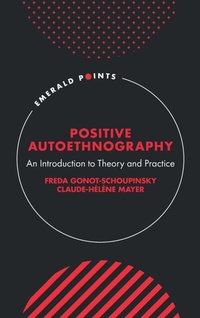
Positive Autoethnography
An Introduction to Theory and Practice
Will be published approx. on 21. October 2025
Book
Hardback
216 pages
978-1-80592-278-0 (ISBN)
Description
Positive Autoethnography (PosAE) combines personal narrative and positive psychology to offer a new approach to self-reflective research. This methodology focuses on personal growth, resilience, and well-being, addressing the growing need for a more constructive, positive approach in fields like psychology and sociology. By emphasizing positive reflexivity, PosAE creates space for insights that uplift both writers and readers.
In Positive Autoethnography: An Introduction to Theory and Practice, authors Dr. Freda Gonot-Schoupinsky and Prof. Dr. mult. Claude-Helene Mayer present the first comprehensive exploration of this methodology. Developed in consultation with Dr. Mark Weeks, and featuring the work of numerous scholars, this collection introduces the theoretical and practical underpinnings of PosAE. The authors reveal the close connection of PosAE to Pragmatic Autoethnography (PAE) and present its pragmatic usage across various applications. PosAE subtypes are showcased to highlight its therapeutic, intercultural, and collaborative potential, while addressing the unique needs PosAE fulfills within Positive Psychology (PP) and Autoethnography (AE). With practical examples and a broad interdisciplinary scope, this work underscores the adaptability of PosAE to a range of research contexts, making it accessible to scholars from diverse backgrounds.
Bringing a fresh perspective to qualitative research, Positive Autoethnography is a valuable resource for researchers, practitioners, and educators in PP, AE, psychology, social work, counseling, and beyond. Engaging in positive reflexivity, readers will find new ways to connect with autoethnographic practices that foster resilience, growth, and practical impact.
In Positive Autoethnography: An Introduction to Theory and Practice, authors Dr. Freda Gonot-Schoupinsky and Prof. Dr. mult. Claude-Helene Mayer present the first comprehensive exploration of this methodology. Developed in consultation with Dr. Mark Weeks, and featuring the work of numerous scholars, this collection introduces the theoretical and practical underpinnings of PosAE. The authors reveal the close connection of PosAE to Pragmatic Autoethnography (PAE) and present its pragmatic usage across various applications. PosAE subtypes are showcased to highlight its therapeutic, intercultural, and collaborative potential, while addressing the unique needs PosAE fulfills within Positive Psychology (PP) and Autoethnography (AE). With practical examples and a broad interdisciplinary scope, this work underscores the adaptability of PosAE to a range of research contexts, making it accessible to scholars from diverse backgrounds.
Bringing a fresh perspective to qualitative research, Positive Autoethnography is a valuable resource for researchers, practitioners, and educators in PP, AE, psychology, social work, counseling, and beyond. Engaging in positive reflexivity, readers will find new ways to connect with autoethnographic practices that foster resilience, growth, and practical impact.
Reviews / Votes
If the word "positive" in the book title drew you in, this is a good start. Stick with it and you will learn much about positive psychology, autoethnography, and positive autoethnography. This book reminds readers that all aspects of human experiences are worthy to be explored in autoethnography. Its theoretical and practical approach is accessible to all levels of autoethnographers. -- Heewon Chang, PhD, Professor and Chair, PhD in Organizational Leadership, Eastern University Freda and Claude's autoethnographies provide an intriguing background into the person behind the scholar. As scientists, we spend our lives trying to understand others and what makes them "tick". In this invaluable volume, the lens is turned toward the scientists so we come to understand what makes them "tick". I highly recommend this volume to all who are curious about the person behind the science. -- Corey Keyes, Emeritus Professor of Sociology and author of Languishing: How To Feel Alive Again In A World That Wears Us Down (2025, Crown Publishing) In Positive Autoethnography, contributors trace the development and evolution of autoethnography, explore the connections between positive psychology and autoethnographic inquiry, and showcase work that prioritizes well-being and transformation. This collection will be of interest to psychologists, especially those trained in positivism, who seek to integrate personal experience into therapeutic and research practice. -- Tony E. Adams, Bradley University My personal experience of writing this positive autoethnography is that it hit the trifecta of happiness for me - it was pleasurable, engaging, and deeply meaningful! I found myself having an urge to return to it and keep up with the writing. I experienced an array of personal insights - many of which I share in the article - as I connected past experiences from many parts of my life with present day. In this way, the writing and reflective experience was highly integrative and was a positive intervention in and of itself, boosting my well-being and inner peace. I am now thinking of ways to continue the journey! I can see this emerging approach as important for future qualitative research and a good new direction for positive psychology. -- Ryan M. Niemiec, PsyD, Chief Science & Education Officer, VIA Institute on Character, USA Perusing the contents of the richly variegated but conceptually coherent contents of Positive Autoethnography stirred a sense of curiosity in me that blossomed slowly into fascination. As a theorist, therapist and researcher who approaches life-altering loss and grief as a quest for meaning, I found myself resonating to the call for an honest yet disciplined practice of narrative self-reflection, directed by the intention to find in the rubble of even shattering experiences something of value. Paraphrasing Thoreau nearly 200 years ago, I admire the contributors' wish to live deliberately, to front only the essential facts of life, and see if they could not learn what it had to teach. I for one look forward to learning along with the practitioners of this emerging genre of life writing that Gonot-Schoupinsky and Mayer are thoughtfully cultivating. -- Robert A. Neimeyer, PhD, Director, Portland Institute for Loss & Transition and author, Living Beyond Loss: Questions & Answers about Grief and Bereavement This book offers an insightful introduction to Positive Autoethnography and a valuable guide for anyone with an interest in exploring the intersection of personal narrative, cultural context, and positive change. -- Richard G. Cowden, Ph.D., Research Scientist, Human Flourishing Program, Harvard UniversityMore details
Series
Language
English
Place of publication
Bingley
United Kingdom
Target group
Professional and scholarly
Dimensions
Height: 231 mm
Width: 153 mm
Thickness: 16 mm
Weight
424 gr
ISBN-13
978-1-80592-278-0 (9781805922780)
Copyright in bibliographic data and cover images is held by Nielsen Book Services Limited or by the publishers or by their respective licensors: all rights reserved.
Schweitzer Classification
Persons
Freda Gonot-Schoupinsky, MSc, MBA, PhD psychology is an independent consultant in Monaco and Visiting Research Fellow at the Faculty of Health and Wellbeing, University of Greater Manchester, UK.
Claude-Helene Mayer is a Professor of Industrial and Organisational Psychology at the University of Johannesburg, South Africa. Professor Claude-Helene Mayer, University of Johannesburg, South Africa, has been awarded the prestigious HERS-SA Higher Education Women Leaders Awards (HEWLA) 2025, recognising her scientific work in the category Humanities and Social Sciences.
Claude-Helene Mayer is a Professor of Industrial and Organisational Psychology at the University of Johannesburg, South Africa. Professor Claude-Helene Mayer, University of Johannesburg, South Africa, has been awarded the prestigious HERS-SA Higher Education Women Leaders Awards (HEWLA) 2025, recognising her scientific work in the category Humanities and Social Sciences.
Content
Foreword; Heewon Chang
Chapter 1. Introduction to Positive Autoethnography; Freda Gonot-Schoupinsky and Claude-Helene Mayer
Chapter 2. Roots: The Journey to Contemporary Autoethnography; Freda Gonot-Schoupinsky
Chapter 3. History of Positive Psychology, Contemporary and Future Directions; Claude-Helene Mayer
Chapter 4. The Theory of Positive Autoethnography and Some Insight into Pragmatic Autoethnography; Freda Gonot-Schoupinsky
Chapter 5. Intercultural Positive Autoethnography (IcPosAE); Claude-Helene Mayer
Chapter 6. Positive Autoethnographic Case Studies; Freda Gonot-Schoupinsky
Chapter 7. Therapeutic Positive Autoethnography (ThePosAE); Claude-Helene Mayer
Chapter 8. Rocked Me Like a Hurricane! A Positive Autoethnography by Bruce Friesen; Bruce Friesen, Claude-Helene Mayer, and Freda Gonot-Schoupinsky
Chapter 9. Supporting Earthquake Survivors with the Laughie: A Positive Collaborative Autoethnography from Tuerkiye; Guelcan Garip, Nilguen Kuru Alici, Besime Alpdogan, Claude-Helene Mayer, and Freda Gonot-Schoupinsky
Chapter 10. Reflections on the Art and Practice of Joy: A Positive Collaborative Autoethnography; Ros Ben-Moshe, Joe Hoare, Claude-Helene Mayer, and Freda Gonot-Schoupinsky
Chapter 11. A Promising Partnership: Positive Psychology and Positive Autoethnography; Grant Rich, Claude-Helene Mayer, and Freda Gonot-Schoupinsky
Chapter 12. Horizons: Observations on the Role and Future of Positive Autoethnography; Freda Gonot-Schoupinsky and Claude-Helene Mayer
Chapter 1. Introduction to Positive Autoethnography; Freda Gonot-Schoupinsky and Claude-Helene Mayer
Chapter 2. Roots: The Journey to Contemporary Autoethnography; Freda Gonot-Schoupinsky
Chapter 3. History of Positive Psychology, Contemporary and Future Directions; Claude-Helene Mayer
Chapter 4. The Theory of Positive Autoethnography and Some Insight into Pragmatic Autoethnography; Freda Gonot-Schoupinsky
Chapter 5. Intercultural Positive Autoethnography (IcPosAE); Claude-Helene Mayer
Chapter 6. Positive Autoethnographic Case Studies; Freda Gonot-Schoupinsky
Chapter 7. Therapeutic Positive Autoethnography (ThePosAE); Claude-Helene Mayer
Chapter 8. Rocked Me Like a Hurricane! A Positive Autoethnography by Bruce Friesen; Bruce Friesen, Claude-Helene Mayer, and Freda Gonot-Schoupinsky
Chapter 9. Supporting Earthquake Survivors with the Laughie: A Positive Collaborative Autoethnography from Tuerkiye; Guelcan Garip, Nilguen Kuru Alici, Besime Alpdogan, Claude-Helene Mayer, and Freda Gonot-Schoupinsky
Chapter 10. Reflections on the Art and Practice of Joy: A Positive Collaborative Autoethnography; Ros Ben-Moshe, Joe Hoare, Claude-Helene Mayer, and Freda Gonot-Schoupinsky
Chapter 11. A Promising Partnership: Positive Psychology and Positive Autoethnography; Grant Rich, Claude-Helene Mayer, and Freda Gonot-Schoupinsky
Chapter 12. Horizons: Observations on the Role and Future of Positive Autoethnography; Freda Gonot-Schoupinsky and Claude-Helene Mayer