

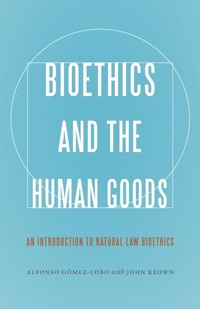
Bioethics and the Human Goods
An Introduction to Natural Law Bioethics
Published on 15. October 2015
Book
Paperback/Softback
144 pages
978-1-62616-163-4 (ISBN)
Description
Bioethics and the Human Goods offers students and general readers a brief introduction to bioethics from a "natural law" philosophical perspective. This perspective, which traces its origins to classical antiquity, has profoundly shaped Western ethics and law and is enjoying an exciting renaissance. While compatible with much in the ethical thought of the great religions, it is grounded in reason, not religion. In contrast to the currently dominant bioethical theories of utilitarianism and principlism, the natural law approach offers an understanding of human flourishing grounded in basic human goods, including life, health, friendship, and knowledge, and in the wrongness of intentionally turning against, or neglecting, these goods. The book is divided into two sections: Foundations and Issues. Foundations sketches a natural law understanding of the important ethical principles of autonomy, non-maleficence, beneficence, and justice and explores different understandings of "personhood" and whether human embryos are persons.
Issues applies a natural law perspective to some of the most controversial debates in contemporary bioethics at the beginning and end of life: research on human embryos, abortion, infanticide, euthanasia, the withdrawal of tube-feeding from patients in a "persistent vegetative state," and the definition of death. The text is completed by appendices featuring personal statements by Alfonso Gomez-Lobo on the status of the human embryo and on the definition and determination of death.
Issues applies a natural law perspective to some of the most controversial debates in contemporary bioethics at the beginning and end of life: research on human embryos, abortion, infanticide, euthanasia, the withdrawal of tube-feeding from patients in a "persistent vegetative state," and the definition of death. The text is completed by appendices featuring personal statements by Alfonso Gomez-Lobo on the status of the human embryo and on the definition and determination of death.
Reviews / Votes
An impressive and welcome book . . . This book [is] dialectically engaged with an important and influential strand of contemporary bioethics. * American Journal of Bioethics * This excellent book is an ideal read for the busy clinician. * Catholic Medical Quarterly * The book is well written and offers a different, much-needed voice in contemporary bioethics discussions. . . . [The authors] have largely accomplished the task they set for themselves [and] have presented a solid introduction to bioethics through the lens of natural law theory. * The National Catholic Bioethics Quarterly * The authors have strongly established credibility in the field and this specific topic. . . . This book meets its primary objective and can act as a great introductory resource for graduate students interested in bioethics because the philosophical arguments are assessable. When compared to other philosophical books in bioethics, this one is accessible to readers outside of mainstream philosophical bioethics and, therefore, an important contribution to the field. * Doody's Book Review *More details
Language
English
Place of publication
Washington, DC
United States
Target group
Professional and scholarly
US School Grade: College Graduate Student and over
Product notice
Paperback (trade)
Illustrations
Not illustrated
Dimensions
Height: 216 mm
Width: 140 mm
Weight
181 gr
ISBN-13
978-1-62616-163-4 (9781626161634)
Copyright in bibliographic data and cover images is held by Nielsen Book Services Limited or by the publishers or by their respective licensors: all rights reserved.
Schweitzer Classification
Other editions
Additional editions
E-Book
10/2015
Georgetown University Press
€31.99
Available for download
Persons
Alfonso Gomez-Lobo (d. 2011) held the Ryan Chair in Metaphysics and Moral Philosophy at Georgetown University. He was a leading authority on classical philosophy and on bioethics. He specialized in Greek philosophy and historiography, the history of ethics, contemporary natural law theory, and bioethics. He was the recipient of several awards, including a research fellowship from the Guggenheim Foundation, and was a member of the President's Council on Bioethics. His many publications include Morality and the Human Goods. John Keown holds the Rose F. Kennedy Chair in Christian Ethics in the Kennedy Institute of Ethics at Georgetown University. He previously taught the the law and ethics of medicine at Cambridge University. His research has been cited by distinguished bodies worldwide, including the US Supreme Court and the Law Lords. In 2015 Oxford University awarded him the degree of DCL, or Doctor of Civil Law, in recognition of his contribution to the field of law and bioethics.
Content
PrefaceIntroduction Part I: Foundations1. Bioethical Thinking2. Principles3. The Ethical Divide4. The Ontological Divide5. Potentiality and Genetics Part II: Issues6. Beginning-of-Life Issues7. End-of-Life Issues8. Issues in Transplantation 9. Epilogue Appendix A: The Status of the Human EmbryoPersonal statement of Professor Robert P. George, joined by Dr. Gomez-Lobo Appendix B: The Determination of DeathPersonal statement of Dr. Gomez-LoboSelected BibliographyIndex