

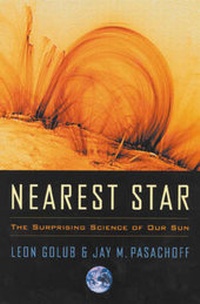
Nearest Star
The Surprising Science of Our Sun
Published on 11. May 2001
Book
Hardback
304 pages
978-0-674-00467-2 (ISBN)
Description
Unlike the myriad points of light we gaze at in the night sky, our nearest star allows us to study the wonders of stellar workings at blindingly close range - from a mere 93 million miles away. And what do we see? In this book, two of the world's leading solar scientists unfold all that history and science - from the first cursory observations to the measurements obtained by the latest state-of-the-instruments on the ground and in space - have revealed about the Sun. Following the path of science from the very centre of this 380,000,000,000,000,000,000-megawatt furnace to its explosive surface. This text invites readers into an open-ended narrative of discovery about what we know about the Sun and how we have learned it. How did the Sun evolve, and what will it become? What is the origin of its light and heat? How does solar activity affect the atmospheric conditions that make life on earth possible? These are the questions at the heart of solar physics, and at the centre of this book.
Having made optical solar observations with many solar telescopes and in the rockets and satellites, the authors bring their extensive personal experience to this story of how astronomers study the Sun, and what they have discovered about phenomena from eclipses to neutrinos, space weather, and global warming.
Having made optical solar observations with many solar telescopes and in the rockets and satellites, the authors bring their extensive personal experience to this story of how astronomers study the Sun, and what they have discovered about phenomena from eclipses to neutrinos, space weather, and global warming.
More details
Language
English
Place of publication
Cambridge, Mass
United States
Target group
College/higher education
Professional and scholarly
Illustrations
22 colour illustrations, 34 line illustrations, 3 tables
Dimensions
Height: 235 mm
Width: 156 mm
Weight
660 gr
ISBN-13
978-0-674-00467-2 (9780674004672)
Copyright in bibliographic data and cover images is held by Nielsen Book Services Limited or by the publishers or by their respective licensors: all rights reserved.
Schweitzer Classification
Persons
Leon Golub is an astrophysicist at the Harvard-Smithsonian Center for Astrophysics and is the head of one of the teams working with NASA's Transition Region and Coronal Explorer (TRACE) spacecraft. Jay M. Pasachoff is Field Memorial Professor of Astronomy at Williams College and, having viewed 30 solar eclipses, is Chair of the Working Group on Eclipses of the International Astronomical Union.