

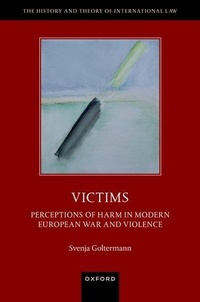
Victims
Perceptions of Harm in Modern European War and Violence
Published on 9. November 2023
Book
Hardback
224 pages
978-0-19-289772-5 (ISBN)
Description
Classifying people as 'victims' is a historical phenomenon with remarkable growth since the second half of the 20th century. The term victim is widely used to refer both to those who have died in wars and to people who have experienced some form of physical or psychological violence. Moreover, victimhood has become a shorthand for any injustice suffered. This can be seen in many contexts: in debates on social justice, when claims for compensation are made, human rights are defended, past crimes are publicly commemorated, or humanitarian intervention is called for. By adopting a history of knowledge approach, Victims takes a fresh look at the phenomenon of classifying people as victims. It goes beyond existing narratives to provide a new and comprehensive explanation of the complex genealogy of modern concepts of victimhood.
In order to reveal the fundamental shifts in perceptions and interpretations of harm, this book reconstructs the emergence of the figure of the victim from the late 18th century to the present. Focusing on Western Europe, it shows that neither the World Wars nor the Holocaust were the only reasons for this shift. Instead, changing power relations and new knowledge, especially in medicine and law, fundamentally altered perceptions and interpretations of death and suffering, of legitimate and illegitimate violence.
Today, the debate takes another turn with the widespread criticism of victim attribution and the increasing delegitimisation of the term. Svenja Goltermann tells this story with brilliant clarity - without subscribing to the new denigration of the victim.
In order to reveal the fundamental shifts in perceptions and interpretations of harm, this book reconstructs the emergence of the figure of the victim from the late 18th century to the present. Focusing on Western Europe, it shows that neither the World Wars nor the Holocaust were the only reasons for this shift. Instead, changing power relations and new knowledge, especially in medicine and law, fundamentally altered perceptions and interpretations of death and suffering, of legitimate and illegitimate violence.
Today, the debate takes another turn with the widespread criticism of victim attribution and the increasing delegitimisation of the term. Svenja Goltermann tells this story with brilliant clarity - without subscribing to the new denigration of the victim.
Reviews / Votes
In this careful historical analysis of the rise of victim-centered discourse in the 19th and 20th centuries, Svenja Goltermann offers a critical genealogy of the concept of 'war victim' as it evolved throughout modern Europe. * Kristin Foringer, International Review of Victimology * Her book sets an important precedent for future work to consider the rhetorical underpinnings of victimhood in whatever empirical context the research is situated. This kind of attentiveness will be increasingly important as victim identity is leveraged (and contested) in more diverse settings. * Kristin Foringer, International Review of Victimology *More details
Series
Language
English
Place of publication
Oxford
United Kingdom
Target group
College/higher education
Product notice
sewn/stitched
Cloth over boards
Dimensions
Height: 229 mm
Width: 163 mm
Thickness: 30 mm
Weight
522 gr
ISBN-13
978-0-19-289772-5 (9780192897725)
Copyright in bibliographic data and cover images is held by Nielsen Book Services Limited or by the publishers or by their respective licensors: all rights reserved.
Schweitzer Classification
Other editions
Additional editions
E-Book
01/2024
1st Edition
OUP eBook
€89.99
Available for download
E-Book
10/2023
1st Edition
OUP eBook
€89.99
Available for download
Person
Svenja Goltermann is Professor of Modern History at the Department of History at the University of Zurich. Her research focuses primarily on the history of violence, the history of changing conceptions of suffering, vulnerability, and trauma, the history of memory cultures, and the history of knowledge. She has published widely on these subjects, including the award-winning book The War in Their Minds: German Soldiers and Their Violent Pasts in West Germany (2017), first published in German in 2009. Her most recent monograph dealt with changing perception of victimhood (2017). She is currently working on a book-length project that explores the broadening of the understanding of violence in Western Europe since the 1960s to trace the genealogies of this recent phenomenon and to reveal its effects.
Content
1: Introduction
2: Recording, Documenting, Identifying (1800-1914)
3: Efforts in International Law: The Civilization of War (1864-1977)
4: Wounded Bodies and the Battle for Recognition (1914-1945)
5: Trauma and Morality (1945-2015)
6: Conclusion
2: Recording, Documenting, Identifying (1800-1914)
3: Efforts in International Law: The Civilization of War (1864-1977)
4: Wounded Bodies and the Battle for Recognition (1914-1945)
5: Trauma and Morality (1945-2015)
6: Conclusion