

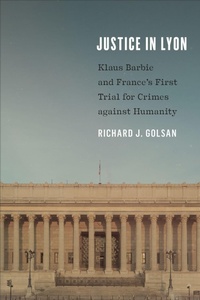
Justice in Lyon
Klaus Barbie and France's First Trial for Crimes Against Humanity
Published on 12. July 2022
Book
Paperback/Softback
330 pages
978-1-4875-4559-8 (ISBN)
Description
The trial of former SS lieutenant and Gestapo chief Klaus Barbie was France's first trial for crimes against humanity. Known as the "Butcher of Lyon" during the Nazi occupation of that city from 1942 to 1944, Barbie tortured, deported, and murdered thousands of Jews and Resistance fighters. Following a lengthy investigation and the overcoming of numerous legal and other obstacles, the trial began in 1987 and attracted global attention.
Justice in Lyon is the first comprehensive history of the Barbie trial, including the investigation leading up to it, the legal background to the case, and the hurdles the prosecution had to clear in order to bring Barbie to justice. Richard J. Golsan examines the strategies used by the defence, the prosecution, and the lawyers who represented Barbie's many victims at the trial. The book draws from press coverage, articles, and books about Barbie and the trial published at the time, as well as recently released archival sources and the personal archives of lawyers at the trial.
Making the case that, despite the views of its many critics, the Barbie trial was a success in legal, historical, and pedagogical terms, Justice in Lyon details how the trial has had a positive impact on French and international law governing crimes against humanity.
Justice in Lyon is the first comprehensive history of the Barbie trial, including the investigation leading up to it, the legal background to the case, and the hurdles the prosecution had to clear in order to bring Barbie to justice. Richard J. Golsan examines the strategies used by the defence, the prosecution, and the lawyers who represented Barbie's many victims at the trial. The book draws from press coverage, articles, and books about Barbie and the trial published at the time, as well as recently released archival sources and the personal archives of lawyers at the trial.
Making the case that, despite the views of its many critics, the Barbie trial was a success in legal, historical, and pedagogical terms, Justice in Lyon details how the trial has had a positive impact on French and international law governing crimes against humanity.
Reviews / Votes
"[Justice in Lyon] is a judicious, clearly written, and well-researched study which will now become the standard work on the subject." - Julian Jackson, Queen Mary University of London (H-France Review)More details
Language
English
Place of publication
Toronto
Canada
Target group
College/higher education
Professional and scholarly
Product notice
Paperback (trade)
Illustrations
10 b&w illustrations
Dimensions
Height: 231 mm
Width: 153 mm
Thickness: 25 mm
Weight
482 gr
ISBN-13
978-1-4875-4559-8 (9781487545598)
Copyright in bibliographic data and cover images is held by Nielsen Book Services Limited or by the publishers or by their respective licensors: all rights reserved.
Schweitzer Classification
Person
Richard J. Golsan is a University Distinguished Professor of French at Texas A&M University.
Content
Introduction
1. Klaus Barbie: Nazi "Idealist"
2. The Historical Judicial Backdrop: From Nuremberg to the 1980 Cologne Trial of Kurt Lischka, Herbert Hagen, and Ernst Heinrichson
3. The Investigation: War Crimes, Crimes against Humanity, and the Long Road to Compromise
4. The Barbie Trial Begins: Opening Rituals and the Departure of the Accused
5. The Witnesses
6. The Civil Parties and Prosecution Make Their Case
7. Barbie's Defence Takes Centre Stage
Conclusion
1. Klaus Barbie: Nazi "Idealist"
2. The Historical Judicial Backdrop: From Nuremberg to the 1980 Cologne Trial of Kurt Lischka, Herbert Hagen, and Ernst Heinrichson
3. The Investigation: War Crimes, Crimes against Humanity, and the Long Road to Compromise
4. The Barbie Trial Begins: Opening Rituals and the Departure of the Accused
5. The Witnesses
6. The Civil Parties and Prosecution Make Their Case
7. Barbie's Defence Takes Centre Stage
Conclusion