

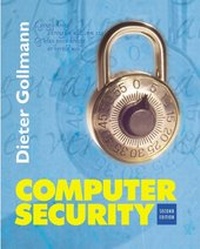
Computer Security
2nd Edition
Published on 25. November 2005
Book
Paperback/Softback
386 pages
978-0-470-86293-3 (ISBN)
Description
Today, security is no longer only a topic of interest for specialists, but a concern for all end users, systems administrators, and software developers.
The development of new kinds of IT applications means that unique security threats continue to emerge. These new challenges may require novel solutions, and traditional security solutions can actually exacerbate the problem rather than solve it.
Dieter Gollmann's popular text continues to offer a comprehensive yet concise overview of the subject that will help the reader think about security at every level. Beginning with basic definitions and concepts and going on to outline the mechanisms at the heart of the computer system, this book covers security issues in networks, operating systems and databases, and shows how to evaluate and tackle security problems.
Updated throughout, the second edition includes brand new chapters on software security, authentication in distributed systems, new paradigms in access control, and mobility. Also included are brief introductions to security management and cryptography.
Computer Security is essential reading for undergraduate and postgraduate students on a variety of introductory and advanced security courses in computer science, engineering and related disciplines. Technical and project managers will also find that this book offers a great starting point for dealing with complex security challenges.
Designed for use on courses or self study, additional resources such as lecture slides and suggested solutions to end of chapter exercises can be found at www.wiley.com/go/gollmann
Comments on the first edition
".a very useful book for those involved in the thorny issues of Computer Security. I recommend it to my students."
--Antonia Jones, Cardiff University
More comments on the first edition
".highly readable and contains clear explanations and examples. I found myself wishing I had had this book when I started working in this area."
--N. R. Mead, New York Review
".an excellent textbook either for higher education or for advanced training programmes on computer security."
--Jianying Zhou, Computer Communications
".the book I have been looking for for years."
--Viiveke Fak, Linkoping University
"Mandatory reading for aspiring system managers"
--Antonia Jones, Cardiff University
More details
Edition
2., Auflage
Language
English
Place of publication
Chichester
United Kingdom
Publishing group
John Wiley and Sons Ltd
Target group
College/higher education
Professional and scholarly
Edition type
New edition
Illustrations
Illustrations
Dimensions
Height: 23.5 cm
Width: 18.9 cm
Thickness: 20 mm
Weight
689 gr
ISBN-13
978-0-470-86293-3 (9780470862933)
Schweitzer Classification
Other editions
New editions
Previous edition
Person
Dieter Gollmann is Professor for Security in Distributed Applications at Hamburg University of Technology. He is also a visiting Professor at Royal Holloway, University of London and Adjunct Professor at the Technical University of Denmark. Previously he was a researcher in Information Security at Microsoft Research in Cambridge.
Content
1 Introduction.
1.1 Attacks and Attackers.
1.2 Security.
1.3 Security Management.
1.4 Risk and Threat Analysis.
1.5 Further Reading.
1.6 Exercises.
2 Foundations of Computer Security.
2.1 Definitions.
2.2 The Fundamental Dilemma of Computer Security.
2.3 Data vs Information.
2.4 Principles of Computer Security.
2.5 The Layer Below.
2.6 Further Reading.
2.7 Exercises.
3 Identification & Authentication.
3.1 Username and Password.
3.2 Managing Passwords.
3.3 Choosing Passwords.
3.4 Spoofing Attacks.
3.5 Protecting the Password File.
3.6 Single Sign-on.
3.7 Alternative Approaches.
3.8 Further Reading.
3.9 Exercises.
4 Access Control.
4.1 Background.
4.2 Authentication and Authorization.
4.3 Access Operations.
4.4 Ownership.
4.5 Access Control Structures.
4.6 Intermediate Controls.
4.7 Partial Orderings.
4.8 Further Reading.
4.9 Exercises.
5 Reference Monitors.
5.1 Introduction.
5.2 Operating System Integrity.
5.3 Hardware Security Features.
5.4 Protecting Memory.
5.5 Further Reading.
5.6 Exercises.
6 Unix Security.
6.1 Introduction.
6.2 Principals.
6.3 Subjects.
6.4 Objects.
6.5 Access Control.
6.6 Instances of General Security Principles.
6.7 Management Issues.
6.8 Further Reading.
6.9 Exercises.
7 Windows 2000 Security.
7.1 Introduction.
7.2 Access Control - Components.
7.3 Access Decisions.
7.4 Restricted Context.
7.5 Administration.
7.6 Further Reading.
7.7 Exercises.
8 Bell-LaPadula Model.
8.1 State Machine Models.
8.2 The Bell-LaPadula Model.
8.3 The Multics Interpretation of BLP.
8.4 Further Reading.
8.5 Exercises.
9 Security Models.
9.1 The Biba Model.
9.2 The Chinese Wall Model.
9.3 The Clark-Wilson Model.
9.4 The Harrison-Ruzzo-Ullman Model.
9.5 Information-Flow Models.
9.6 Execution Monitors.
9.7 Further Reading.
9.8 Exercises.
10 Security Evaluation.
10.1 Introduction.
10.2 The Orange Book.
10.3 The Rainbow Series.
10.4 Information Technology Security Evaluation Criteria.
10.5 The Federal Criteria.
10.6 The Common Criteria.
10.7 Quality Standards.
10.8 An E_ort Well Spent?.
10.9 Further Reading.
10.10Exercises.
11 Cryptography.
11.1 Introduction.
11.2 Modular Arithmetic.
11.3 Integrity Check Functions.
11.4 Digital Signatures.
11.5 Encryption.
11.6 Strength of Mechanisms.
11.7 Performance.
11.8 Further Reading.
11.9 Exercises.
12 Authentication in Distributed Systems.
12.1 Introduction.
12.2 Key Establishment and Authentication.
12.3 Key Establishment Protocols.
12.4 Kerberos.
12.5 Public Key Infrastructures.
12.6 Trusted Computing - Attestation.
12.7 Further Reading.
12.8 Exercises.
13 Network Security.
13.1 Introduction.
13.2 Protocol Design Principles.
13.3 IP Security.
13.4 SSL/TLS.
13.5 DNS.
13.6 Firewalls.
13.7 Intrusion Detection.
13.8 Further Reading.
13.9 Exercises.
14 Software Security.
14.1 Introduction.
14.2 Characters and Numbers.
14.3 Canonical Representations.
14.4 Memory Management.
14.5 Data and Code.
14.6 Race conditions.
14.7 Defences.
14.8 Further Reading.
14.9 Exercises.
15 New Access Control Paradigms.
15.1 Introduction.
15.2 Code-based Access Control.
15.3 Java Security.
15.4.NET Security Framework.
15.5 Cookies.
15.6 SPKI.
15.7 Trust Management.
15.8 Digital Rights Management.
15.9 Further Reading.
15.10Exercises.
16 Mobility.
16.1 Introduction.
16.2 GSM.
16.3 UMTS.
16.4 Mobile IPv6 Security.
16.5 WLAN.
16.6 Bluetooth.
16.7 Further Reading.
16.8 Exercises.
17 Database Security.
17.1 Introduction.
17.2 Relational Databases.
17.3 Access Control.
17.4 Statistical Database Security.
17.5 Integration with the Operating System.
17.6 Privacy.
17.7 Further Reading.
17.8 Exercises.