

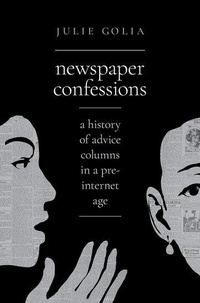
Newspaper Confessions
A History of Advice Columns in a Pre-Internet Age
Published on 14. October 2021
Book
Hardback
232 pages
978-0-19-752778-8 (ISBN)
Description
What can century-old advice columns tell us about the Internet today? This book reveals the little-known history of advice columns in American newspapers and the virtual communities they created among their readers.
Imagine a community of people who had never met writing into a media outlet, day after day, to reveal intimate details about their lives, anxieties, and hopes. The original "virtual communities" were born not on the Internet in chat rooms but a century earlier in one of America's most ubiquitous news features: the advice column.
Newspaper Confessions is the first history of the newspaper advice column, a genre that has shaped Americans' relationships with media, their experiences with popular therapy, and their virtual interactions across generations. Emerging in the 1890s, advice columns became unprecedented virtual forums where readers could debate the most resonant cultural crises of the day with strangers in an anonymous, yet strikingly public, forum. Early advice columns are essential-and overlooked-precursors to today's digital culture: forums, social media groups, chat rooms, and other online communities that define how present-day American communicate with each other.
By charting the economic and cultural motivations behind the rise of this influential genre, Julie Golia offers a nuanced analysis of the advice given by a diverse sample of columns across several decades, emphasizing the ways that advice columnists framed their counsel as modern, yet upheld the racial and gendered status quo of the day. She offers lively, surprising, and poignant case studies, demonstrating how columnists and everyday newspaper readers transformed advice columns into active and participatory virtual communities of confession, advice, debate, and empathy.
Imagine a community of people who had never met writing into a media outlet, day after day, to reveal intimate details about their lives, anxieties, and hopes. The original "virtual communities" were born not on the Internet in chat rooms but a century earlier in one of America's most ubiquitous news features: the advice column.
Newspaper Confessions is the first history of the newspaper advice column, a genre that has shaped Americans' relationships with media, their experiences with popular therapy, and their virtual interactions across generations. Emerging in the 1890s, advice columns became unprecedented virtual forums where readers could debate the most resonant cultural crises of the day with strangers in an anonymous, yet strikingly public, forum. Early advice columns are essential-and overlooked-precursors to today's digital culture: forums, social media groups, chat rooms, and other online communities that define how present-day American communicate with each other.
By charting the economic and cultural motivations behind the rise of this influential genre, Julie Golia offers a nuanced analysis of the advice given by a diverse sample of columns across several decades, emphasizing the ways that advice columnists framed their counsel as modern, yet upheld the racial and gendered status quo of the day. She offers lively, surprising, and poignant case studies, demonstrating how columnists and everyday newspaper readers transformed advice columns into active and participatory virtual communities of confession, advice, debate, and empathy.
Reviews / Votes
Golia...succeeds...[in] showing that advice columns deserve respect as a journalistic form and as a tool for community building in the modernizing United States....Golia's account offers a corrective for predominantly masculine narratives of journalism's professionalization. * John Nerone, Journal of American History * Nevertheless, the author presents a study that is extremely readable, which represents an enrichment for the postcolonial, gender and queer scientific perspective of media, culture and migration history and for further research on the intersectional contexts of readers of color , feminist and queer living environments in America in the first half of the 20th century. * Isabelle Haffter, Institute for Theater Studies, University of Bern, H-Soz-Kult von * American newspapers began targeting women readers in the 1890s as part of a transition from politically mobilizing readers to delivering consumers to advertisers....Newspapers soon offered a variety of columns on topics ranging from fashion and homemaking to relationships, helping readers navigate a changing society while upholding traditional gender norms. Syndicated columns ran in hundreds of newspapers across the country, and many metropolitan dailies established local columns that sought to create a sense of community among readers, inviting them to share their experiences and counsel. Advice column readers sought empathy, counsel, and a sense of community in an increasingly anonymous society. Golia concludes with a discussion of how social media and online communities have taken up this role today....Recommended. General readers through faculty; professionals. * Choice * This book would be useful in journalism and mass communication classes. * Kimberly Wilmot Voss, American Journalism * From Dorothy Dix to Princess Mysteria to Ann Landers, newspaper advice columnists have served as revenue drivers and cultural brokers, developing a democratic and interactive discourse in which women readers lay bare the practical as well as the existential challenges of modern life. In Julie Golia's fine book, these journalists craft self-identities that cloak their ambitions, exercise professional power, proffer advice that challenges as well as supports the status quo, and develop a genre that is as adaptable as it is therapeutic. * Jennifer Scanlon, Bowdoin College * Julie Golia's Newspaper Confessions is a terrific book. Full of interesting, at times eye-opening details and boasting a fascinating cast of characters, it sheds new light on a form of journalism that has been routinely disparaged, demonstrating its importance and revealing its influence on contemporary online communities. * Charles L. Ponce de Leon, author of Self-Exposure: Human-Interest Journalism and the Emergence of Celebrity in America * In this engaging study, Julie Golia illuminates how, when, and why Americans-especially women-began to seek advice for their most personal and intimate problems from total strangers writing in mass circulation newspapers. Newspaper Confessions not only traces the changing relationship between newspapers and their readers, but also uncovers the struggles confronting Americans of all backgrounds as they came to terms with modernity. * Elaine Tyler May, author of Homeward Bound: American Families in the Cold War Era * This book serves as an effective historical record of an area of journalism that may not be 'high status' in the way that the war reporter or undercover journalist might be considered, but through careful and detailed accounts of her evidence-base, Golia presents us with a wealth of testimony to the important role the advice column played in the twentieth century, providing insight into why it remains an enduring part of periodical journalism today. * Helena Goodwyn, Journal of European Periodical Studies *More details
Language
English
Place of publication
New York
United States
Product notice
sewn/stitched
Cloth over boards
Illustrations
20 black and white halftones
Dimensions
Height: 240 mm
Width: 160 mm
Thickness: 24 mm
Weight
466 gr
ISBN-13
978-0-19-752778-8 (9780197527788)
Copyright in bibliographic data and cover images is held by Nielsen Book Services Limited or by the publishers or by their respective licensors: all rights reserved.
Schweitzer Classification
Other editions
Additional editions
E-Book
04/2021
OUP eBook
€17.99
Available for download
E-Book
04/2021
OUP eBook
€17.99
Available for download
Person
Julie Golia is the Curator of History, Social Sciences, and Government Information at the New York Public Library. An active public historian, she tweets at @JuliethePH.
Content
Acknowledgments
Introduction
Ch. 1: Making Advice Modern: The Birth of the Newspaper Advice Column
Ch. 2: America's Confessional: Early Twentieth-Century Advice Columns and their Readers
Ch. 3: Queen of Heartaches: The Newspaper Advice Columnist as Icon and Journalist
Ch. 4: Advising the Race: Princess Mysteria and the Black Feminist Advice Tradition
Ch. 5: The Modern "Experience": Loneliness, Interactivity, and the Virtual Community
Conclusion
Notes
Bibliography
Index
Introduction
Ch. 1: Making Advice Modern: The Birth of the Newspaper Advice Column
Ch. 2: America's Confessional: Early Twentieth-Century Advice Columns and their Readers
Ch. 3: Queen of Heartaches: The Newspaper Advice Columnist as Icon and Journalist
Ch. 4: Advising the Race: Princess Mysteria and the Black Feminist Advice Tradition
Ch. 5: The Modern "Experience": Loneliness, Interactivity, and the Virtual Community
Conclusion
Notes
Bibliography
Index