

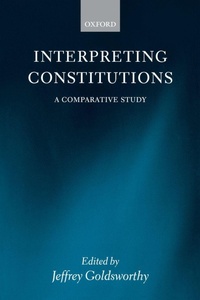
Interpreting Constitutions
A Comparative Study
Published on 7. June 2007
Book
Paperback/Softback
384 pages
978-0-19-922647-4 (ISBN)
Description
This book describes the constitutions of six major federations and how they have been interpreted by their highest courts, compares the interpretive methods and underlying principles that have guided the courts, and explores the reasons for major differences between these methods and principles.
Among the interpretive methods discussed are textualism, purposivism, structuralism and originalism. Each of the six federations is the subject of a separate chapter written by a leading authority in the field: Jeffrey Goldsworthy (Australia), Peter Hogg (Canada), Donald Kommers (Germany), S.P. Sathe (India), Heinz Klug (South Africa), and Mark Tushnet (United States). Each chapter describes not only the interpretive methodology currently used by the courts, but the evolution of that methodology since the constitution was first enacted. The book also includes a concluding chapter which compares these methodologies, and attempts to explain variations by reference to different social, historical, institutional and political circumstances.
Among the interpretive methods discussed are textualism, purposivism, structuralism and originalism. Each of the six federations is the subject of a separate chapter written by a leading authority in the field: Jeffrey Goldsworthy (Australia), Peter Hogg (Canada), Donald Kommers (Germany), S.P. Sathe (India), Heinz Klug (South Africa), and Mark Tushnet (United States). Each chapter describes not only the interpretive methodology currently used by the courts, but the evolution of that methodology since the constitution was first enacted. The book also includes a concluding chapter which compares these methodologies, and attempts to explain variations by reference to different social, historical, institutional and political circumstances.
Reviews / Votes
The book is a success. The essays are largely coherent in both structure and vocabulary; the authors manage to insert distinct perspectives while keeping to their organizational discipline; and the essays support readers in generating ideas for new research directions. Although the book focuses on questions of constitutional interpretation, the comparative orientation and the scope of constitutional questions that each essay addresses will make it a valuable reference for political scientists and political theorists, not just lawyers. The book will prove especially useful to graduate students or researchers contemplating a shift in their primary research direction. * Mariah Zeisberg, The Law and Politics Book Review (Vol. 16, No. 8) *More details
Language
English
Place of publication
Oxford
United Kingdom
Target group
Professional and scholarly
Dimensions
Height: 234 mm
Width: 156 mm
Thickness: 20 mm
Weight
565 gr
ISBN-13
978-0-19-922647-4 (9780199226474)
Copyright in bibliographic data and cover images is held by Nielsen Book Services Limited or by the publishers or by their respective licensors: all rights reserved.
Schweitzer Classification
Other editions
Additional editions
Book
02/2006
Oxford University Press
€145.60
Shipment within 15-20 days
E-Book
02/2006
1st Edition
OUP eBook
€37.99
Available for download
E-Book
02/2006
1st Edition
OUP eBook
€37.99
Available for download
Person
Jeffrey Goldsworthy holds a Personal Chair at Monash University. His major interests are legal philosophy, and constitutional law, theory, and history. He has numerous publications in these fields, and is best known for his book "The Sovereignty of Parliament, History and Philosophy" (Clarendon Press, Oxford, 1999), and many journal articles on constitutional interpretation.
Content
1. Introduction ; 2. United States: Eclecticism In the Service of Pragmatism ; 3. Canada: From Privy Council to Supreme Court ; 4. Australia: Devotion to Legalism ; 5. Germany: Balancing Rights and Duties ; 6. India: From Positivism to Structuralism ; 7. South Africa: From Constitutional Promise to Social Transformation ; 8. Conclusions