

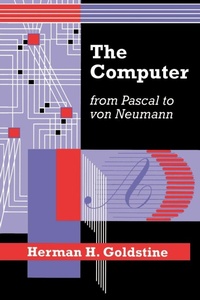
The Computer from Pascal to von Neumann
The Computer from Pascal to von Neumann
Published on 21. October 1980
Book
Paperback/Softback
365 pages
978-0-691-02367-0 (ISBN)
Description
In 1942, Lt. Herman H. Goldstine, a former mathematics professor, was stationed at the Moore School of Electrical Engineering at the University of Pennsylvania. It was there that he assisted in the creation of the ENIAC, the first electronic digital computer. The ENIAC was operational in 1945, but plans for a new computer were already underway. The principal source of ideas for the new computer was John von Neumann, who became Goldstine's chief collaborator. Together they developed EDVAC, successor to ENIAC. After World War II, at the Institute for Advanced Study, they built what was to become the prototype of the present-day computer. Herman Goldstine writes as both historian and scientist in this first examination of the development of computing machinery, from the seventeenth century through the early 1950s. His personal involvement lends a special authenticity to his narrative, as he sprinkles anecdotes and stories liberally through his text.
Reviews / Votes
Winner of the Award in Science, Phi Beta Kappa "The book is first-rate: it is written in a style that all can understand."--Nature "Herman Goldstine is himself a pioneer of the computer... [He] writes with disarming candor and good humor."--Scientific AmericanMore details
Language
English
Place of publication
New Jersey
United States
Target group
Professional and scholarly
College/higher education
Product notice
Paperback (trade)
Dimensions
Height: 229 mm
Width: 152 mm
Thickness: 24 mm
Weight
647 gr
ISBN-13
978-0-691-02367-0 (9780691023670)
Copyright in bibliographic data and cover images is held by Nielsen Book Services Limited or by the publishers or by their respective licensors: all rights reserved.
Schweitzer Classification
Other editions
Additional editions
E-Book
09/2008
1st Edition
Princeton University Press
€304.95
Available for download
Person
Herman H. Goldstine is currently Executive Officer of the American Philosophical Society.
Content
*FrontMatter, pg. i*Contents, pg. v*Illustrations, pg. vii*Preface (1893), pg. ix*Preface, pg. xi*I. Beginnings, pg. 3*2. Cllarles Babhage and His Analytical Engine, pg. 10*3. The Astronolnical Ephemeris, pg. 27*4. The Universities: Maxwell and Boole, pg. 31*5, Integrators and Planin~c.ters, pg. 39*6. Michelsori, Fourier Coc~ffic~ientasn, d the Gibbs Phenomenon, pg. 52*7. Boolean Algebra: x2 = xx = x, pg. 60*8. Billings, IIollerith, and the. Census, pg. 65*9. Rallistics ancl the Rise of the Great Mathematicians, pg. 72*10. Blish's Differential Analyzer and Other Analog IJcvices, pg. 84*11. Adaptation to Scientific Needs, pg. 106*12. Renascenrbe and Triumph of Digital Means of Computation, pg. 115*1. Electronic, EAi~rtsp rior to the EN1AC, pg. 123*2. The Ballistic Research Laboratory, pg. 127*3. Differences between Analog and Digital Machines, pg. 140*4. Beginnings of the ENIA(:, pg. 148*5. The ENIAC as a Matl~errratical Instrument, pg. 157*6. Jolln von Nel~mann ant1 the Computer, pg. 167*7. Beyond the ENIAC, pg. 184*8. Tlte Structure of the EDVAC, pg. 204*9. The Spread of Ideas, pg. 211*10. First Calculations on the ENIAC, pg. 225*1. Post-EIIVAC Days, pg. 239*2. The Institute for Advanced Study Computer, pg. 252*3. Automata Theory and Logic Machines, pg. 271*4. Numerical Mathematics, pg. 286*5. Nun~ericalM eteorology, pg. 300*6. Engineering Activities and Achievements, pg. 306*7. The Computer and UNESCO, pg. 321*8. The Early Industrial Scene, pg. 325*9. Programming Languages, pg. 333*10. Conclusions, pg. 342*APPENDIX: World-Wide Developments, pg. 349*Index, pg. 363