

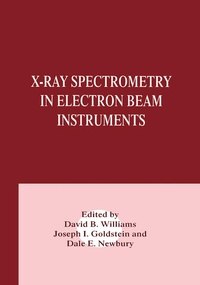
X-Ray Spectrometry in Electron Beam Instruments
Published on 21. October 2012
Book
Paperback/Softback
XVIII, 372 pages
978-1-4613-5738-4 (ISBN)
Description
From its early days in the 1950s, the electron microanalyzer has offered two principal ways of obtaining x-ray spectra: wavelength dispersive spectrometry (WDS), which utilizes crystal diffraction, and energy dispersive spectrometry (EDS), in which the x-ray quantum energy is measured directly. In general, WDS offers much better peak separation for complex line spectra, whereas EDS gives a higher collection efficiency and is easier and cheaper to use. Both techniques have undergone major transformations since those early days, from the simple focusing spectrometerand gas proportional counter of the 1950s to the advanced semiconductor detectors and programmable spectrometersoftoday. Becauseofthesedevelopments, thecapabilities and relative merits of EDS and WDS techniques have been a recurring feature of microprobeconferences for nearly40 years, and this volume bringstogetherthepapers presented at the Chuck Fiori Memorial Symposium, held at the Microbeam Analysis Society Meeting of 1993. Several themes are apparent in this rich and authoritative collection of papers, which have both a historical and an up-to-the-minute dimension. Light element analysis has long been a goal of microprobe analysts since Ray Dolby first detected K radiation with a gas proportional counter in 1960. WDS techniques (using carbon lead stearate films) were not used for this purpose until four years later. Now synthetic multilayers provide the best dispersive elements for quantitative light element analy sis-still used in conjunction with a gas counter.
Reviews / Votes
` [A] rich and authoritative collection of papers, which have both a historical and an up-to-the-minute dimension. 'from the Foreword by Peter Duncumb, University of Cambridge, England
` Contains a vast amount of detailed information and will surely be heavily used. '
Ultramicroscopy
More details
Edition
Softcover reprint of the original 1st ed. 1995
Language
English
Place of publication
New York
United States
Target group
Professional and scholarly
Research
Illustrations
XVIII, 372 p.
Dimensions
Height: 254 mm
Width: 178 mm
Thickness: 22 mm
Weight
742 gr
ISBN-13
978-1-4613-5738-4 (9781461357384)
DOI
10.1007/978-1-4615-1825-9
Schweitzer Classification
Other editions
Additional editions
Joseph Goldstein | Dale E. Newbury | David B. Williams
X-Ray Spectrometry in Electron Beam Instruments
E-Book
12/2012
Springer
€213.99
Available for download
Joseph Goldstein | Dale E. Newbury | David B. Williams
X-Ray Spectrometry in Electron Beam Instruments
Book
03/1995
Kluwer Academic/Plenum Publishers
€213.99
Shipment within 10-15 days
Content
The Development of Energy Dispersive Electron Probe Analysis; K.F.J. Heinrich. Problems and Trends in X-ray Detector Design for Microanalysis; B.G. Lowe. New Materials for Thin Windows; M.W. Lund. Intrinsic Ge Detectors; R. Sareen. Modeling the Energy-dispersive X-ray Detector; D.C. Joy. The Effect of Detector Dead Layers on Light Element Detection; J.J. McCarthy. Energy-dispersive X-ray Spectrometry in Ultra-high Vacuum Environments; J.R. Michael. Quantifying Benefits of Resolution and Count Rate in EDX Microanalysis; P.J. Statham. Improving EDS Performance with Digital Pulse Processing; R.B. Mott, J.J. Friel. A Study of Systematic Errors in Multiple Linear Regression Peak Fitting Using Generated Spectra; C.R. Swyt. Artifacts in Energy-dispersive X-ray Spectrometry in Electron Beam Instruments: Are Things Getting Any Better?; D.E. Newbury. Characterizing an Energy-dispersive Spectrometer on an Analytical Electron Microscope; S.M. Zemyan, D.B. Williams. Wavelength Dispersive Spectrometry - A Review; S.J.B. Reed. Synthetic Multilayer Crystals for EPMA of Ultralight Elements; G.F. Bastin, H.J.M. Heijligers. 4 additional articles. Index.