

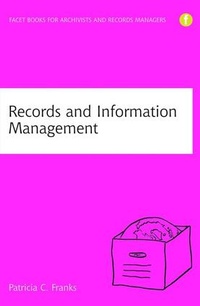
Records and Information Management
1st Edition
Published on 21. June 2013
Book
Paperback/Softback
448 pages
978-1-85604-836-1 (ISBN)
Description
This book provides a comprehensive, strategic approach to the creation, management, and disposition of information and records in organisations and is the first to analyse the impact that cloud computing and emerging technologies such as social networks and microblogging has on records management programmes.
The emergence of Web 2.0 and social media has fundamentally changed the way information is created, exchanged, and stored. Information is a valuable asset to be employed by the organisation to help meet its goals, but it can also pose a risk to the organisation if not effectively managed. The increasingly complex regulatory and legal environment, along with the growing volume and changing nature of records and information created through emerging technologies, has brought records and information management to the attention of executives who are ultimately responsible for the success or failure of their organisations. This book provides readers either an introduction to or a review of records management principles and practices, but with a consideration of the impact on those principles and practices made by records created through the use of emerging technologies and stored in the clouds.
Readership: This book will be of interest to students of archives and records management, experienced archives and records professionals who want a new perspective on their chosen field, supervisors and managers with the responsibility for records and information management and upper-level managers, executives, and other decision makers who are responsible for effectively managing their organisation's information assets.
The emergence of Web 2.0 and social media has fundamentally changed the way information is created, exchanged, and stored. Information is a valuable asset to be employed by the organisation to help meet its goals, but it can also pose a risk to the organisation if not effectively managed. The increasingly complex regulatory and legal environment, along with the growing volume and changing nature of records and information created through emerging technologies, has brought records and information management to the attention of executives who are ultimately responsible for the success or failure of their organisations. This book provides readers either an introduction to or a review of records management principles and practices, but with a consideration of the impact on those principles and practices made by records created through the use of emerging technologies and stored in the clouds.
Readership: This book will be of interest to students of archives and records management, experienced archives and records professionals who want a new perspective on their chosen field, supervisors and managers with the responsibility for records and information management and upper-level managers, executives, and other decision makers who are responsible for effectively managing their organisation's information assets.
Reviews / Votes
This book contains an encyclopaedic wealth of detail on the status of records and information management in our evolving digital world. The amount of research, the attention to detail, and the effort that has gone into the presentation of each chapter with sidebars, down to the italicised font drawing attention to key terms, has to be viewed to be fully appreciated...The previously held view that librarianship and records management were two separate disciplines needs to be discarded. In this day and age the boundaries are interchangeable and in some cases non-existent. This book bridges the gap for librarians, allowing them to cross the boundary into information and records management. -- Australian Library Journal ...the book is an excellent introduction to the field of records and information management. It achieves its goals of appealing to the new student as well as the more experienced practitioner. It is Franks' willingness and ability to share her knowledge of new systems and systems technology for records and information management that sets this work apart as an invaluable textbook and reference work. So much so, Franks also succeeds in producing a work that would appeal to the non-specialist reader wanting to understand how relevant records and information management is to the fabric of a working organization. This work is a valuable up to date combined textbook and reference book which will enhance its readers' knowledge irrespective of their place on the career ladder. It is worthy of inclusion on the reading list of an archives and records postgraduate course as well as the bookshelves of a seasoned practitioner. -- Archives and Records ...a valuable addition to the literature, particularly for undergraduate and postgraduate students and others moving into, or needing to understand, the discipline its principles and practice. It is readily accessible and easy to read although the use of first, second and third person is odd. The overall structure is logical, since it follows the records lifecycle, and there is a standard chapter structure...There are many useful 'end notes' in each chapter, a glossary, a bibliography and an index. -- Journal of Librarianship and Information Science I encourage anyone participating in the archives and records management field today or considering entering an Archives & Records Administration program to acquire this volume. I am sure many library and information science programs will quickly be adopting Records and Information Management as a core text. -- Technicalities Franks describes records and information management for library and information science students and records management professionals. Covering paper, electronic, and new media records, as well as records residing in the "cloud," she addresses both business operations and how records professionals can contribute to the mission of the enterprise beyond the lifecycle management of records. She discusses the origins and development of records and information management; building an information governance program; records and information creation/capture, classification, and file plan development; retention strategies; information access, storage, and retrieval; electronic management systems; emerging technologies, especially social media; vital records, disaster preparedness and recovery, and business continuity; monitoring, auditing, and risk management; inactive records management, archives, and long-term preservation; records management education and training; and how to develop a management program and information governance strategy. Case studies from professionals at archives, government and private organizations, law firms, and other organizations from the US, UK, and the Netherlands are included in each chapter. -- Reference and Research Book News The handbook is well constructed and organised with a good balance of theory and practical examples. It is highly readable and not at all dry or uninteresting. In addition to the written descriptions, there are illustrations of forms and schedules as well as photographs and charts. -- Australian Academic & Research Libraries Records and Information Management is a comprehensive introductory textbook for students considering a career in the records and information management (RIM) field ... the focus of the writing is on the introduction of terms, concepts, and processes, and the need for breadth trumps depth in almost every chapter. * Serials Review *More details
Language
English
Place of publication
London
United Kingdom
Target group
Professional and scholarly
Professional Practice & Development
Dimensions
Height: 229 mm
Width: 152 mm
Thickness: 22 mm
Weight
280 gr
ISBN-13
978-1-85604-836-1 (9781856048361)
Copyright in bibliographic data and cover images is held by Nielsen Book Services Limited or by the publishers or by their respective licensors: all rights reserved.
Schweitzer Classification
Other editions
New editions
Stephane Goldstein
Records and Information Management
Book
09/2018
2nd Edition
Facet Publishing
€106.60
Shipment within 3-4 weeks
Person
Patricia C. Franks is an associate Professor in the School of Library and Information Science (SLIS) at San Jose State University in California, where she serves as the Master of Archives and Records Administration (MARA) Program Coordinator and the SLIS Internship Program Coordinator. Dr. Franks supervises virtual interns and teaches courses related to information organizations and management, archival studies, and records management. Her professional activities include working with ARMA International, most recently as Consensus Group Leader for both ANSI/ARMA 1-2011 Implications of Web-Based, Collaborative Technologies in Records Management and ARMA TR 21-2012 Using Social Media in Organizations.
Content
1. The origins and development of records and information management
Introduction Records and Recordkeeping in Society Recordkeeping in the United States in the Twentieth Century Information Technology, Records, and the Information Age Web 2.0, Social Media, and Society Summary Perspective: Realigning the Records Management Covenant - Steve Bailey
2. Records and information management: the foundation for information governance
Introduction
Information Governance
Records Management as a Professional Management Discipline
Records and Information Management Lifecycle
Records Management Program Elements, Functions, and Activities
Standards, Laws, Regulations, and the Legal Environment
Summary
Paradigm: The US Nuclear Power Industry Mitigates Risk in the Use of Electronic Formats to Meet Quality Assurance Record Retention Requirements - Eugene Yang
3. Records and information creation/capture, classification, and file plan development
Introduction
Records and Information Creation and Capture
Controlled Language and Records Classification
Business Classification Schemes
Indexing, Content Analysis, and File Plan Development
Records Management Metadata
Summary
Paradigm: The Vermont Functional Classification System (VCLAS) - Tanya Marshall
4. Records retention strategies: inventory, appraisal, retention, and disposition
Introduction
Records Inventory
Records Appraisal
Legal and Regulatory Compliance
Developing a Records Retention and Disposition Schedule
Summary
Paradigm: Implementing Records Retention in an ERP System: Records Retention, Appraisal, and Disposition - Nancy Kunde
5. Records and information access, storage, and retrieval
Introduction
Business Process Mapping and Workflow Processes
Access Controls
Active Storage Systems
Search and Retrieval Process
Metadata and Metadata Standards
Summary
Paradigm: New Business Intake-Law Firm Environment - Deborah Rifenbark
6. Electronic records and electronic records management systems
Introduction
Electronic Records
Enterprise Information Systems
Content Management Systems
Enterprise Content Management Systems
Electronic Records Management
Electronic Records Management Systems
Electronic Records Management Systems Guidance
Data and System Migration
Records Management in the Clouds
Planning and Managing an Electronic Records Management Program
Summary
Paradigm: Records Management in the Cloud - Mary Beth Herkert
7. Emerging technologies and records management
Introduction
Diffusion of Innovation and Trend Spotting
Identifying, Capturing, and Scheduling Web Records
Social Media and Records Management
Managing Mobile Devices
Integration into the Electronic Records Management System
Summary
Paradigm: Discovering the South Land-Employing Emerging Technologies, Motivating Staff, and Measuring Success - Christian van der Ven
8. Vital records, disaster preparedness and recovery, and business continuity
Introduction
Business Resumption Strategies
Vital Records Program
Disaster Preparedness and Recovery Planning
Business Continuity Planning
Summary
Paradigm: Archdiocese of New Orleans Rebuilds Archives after Hurricane Katrina - Emilie Gagnet Leumas
9. Monitoring, auditing, and risk management
Introduction
Monitoring the Management of Records
Auditing the Records Management Program
Risk Management
Summary
Paradigm: Creating Defensible Records Retention Programs - Fred V. Diers
10. Inactive records management, archives, and long-term preservation
Introduction
Inactive Records and Records Centers
Archives Management
Long-Term Preservation
Digital Curation and Preservation
Summary
Paradigm: Chaos to Control-A Continuing Journey - Barb Ricci and Jeffrey W. Cox
11. Records management education and training
Introduction
Preparation for Records Management Professionals
Records Management Training Programs
Summary
Paradigm: Digital Education for a Digital World-The Digital Curriculum Laboratory at Simmons College - Ross Harvey
12. From records management to information governance, an evolution
Introduction
Developing a Records Management Program
Implementing an Information Governance Strategy
Summary
Perspective: Information Governance Program Development - Diane K. Carlisle
Introduction Records and Recordkeeping in Society Recordkeeping in the United States in the Twentieth Century Information Technology, Records, and the Information Age Web 2.0, Social Media, and Society Summary Perspective: Realigning the Records Management Covenant - Steve Bailey
2. Records and information management: the foundation for information governance
Introduction
Information Governance
Records Management as a Professional Management Discipline
Records and Information Management Lifecycle
Records Management Program Elements, Functions, and Activities
Standards, Laws, Regulations, and the Legal Environment
Summary
Paradigm: The US Nuclear Power Industry Mitigates Risk in the Use of Electronic Formats to Meet Quality Assurance Record Retention Requirements - Eugene Yang
3. Records and information creation/capture, classification, and file plan development
Introduction
Records and Information Creation and Capture
Controlled Language and Records Classification
Business Classification Schemes
Indexing, Content Analysis, and File Plan Development
Records Management Metadata
Summary
Paradigm: The Vermont Functional Classification System (VCLAS) - Tanya Marshall
4. Records retention strategies: inventory, appraisal, retention, and disposition
Introduction
Records Inventory
Records Appraisal
Legal and Regulatory Compliance
Developing a Records Retention and Disposition Schedule
Summary
Paradigm: Implementing Records Retention in an ERP System: Records Retention, Appraisal, and Disposition - Nancy Kunde
5. Records and information access, storage, and retrieval
Introduction
Business Process Mapping and Workflow Processes
Access Controls
Active Storage Systems
Search and Retrieval Process
Metadata and Metadata Standards
Summary
Paradigm: New Business Intake-Law Firm Environment - Deborah Rifenbark
6. Electronic records and electronic records management systems
Introduction
Electronic Records
Enterprise Information Systems
Content Management Systems
Enterprise Content Management Systems
Electronic Records Management
Electronic Records Management Systems
Electronic Records Management Systems Guidance
Data and System Migration
Records Management in the Clouds
Planning and Managing an Electronic Records Management Program
Summary
Paradigm: Records Management in the Cloud - Mary Beth Herkert
7. Emerging technologies and records management
Introduction
Diffusion of Innovation and Trend Spotting
Identifying, Capturing, and Scheduling Web Records
Social Media and Records Management
Managing Mobile Devices
Integration into the Electronic Records Management System
Summary
Paradigm: Discovering the South Land-Employing Emerging Technologies, Motivating Staff, and Measuring Success - Christian van der Ven
8. Vital records, disaster preparedness and recovery, and business continuity
Introduction
Business Resumption Strategies
Vital Records Program
Disaster Preparedness and Recovery Planning
Business Continuity Planning
Summary
Paradigm: Archdiocese of New Orleans Rebuilds Archives after Hurricane Katrina - Emilie Gagnet Leumas
9. Monitoring, auditing, and risk management
Introduction
Monitoring the Management of Records
Auditing the Records Management Program
Risk Management
Summary
Paradigm: Creating Defensible Records Retention Programs - Fred V. Diers
10. Inactive records management, archives, and long-term preservation
Introduction
Inactive Records and Records Centers
Archives Management
Long-Term Preservation
Digital Curation and Preservation
Summary
Paradigm: Chaos to Control-A Continuing Journey - Barb Ricci and Jeffrey W. Cox
11. Records management education and training
Introduction
Preparation for Records Management Professionals
Records Management Training Programs
Summary
Paradigm: Digital Education for a Digital World-The Digital Curriculum Laboratory at Simmons College - Ross Harvey
12. From records management to information governance, an evolution
Introduction
Developing a Records Management Program
Implementing an Information Governance Strategy
Summary
Perspective: Information Governance Program Development - Diane K. Carlisle