

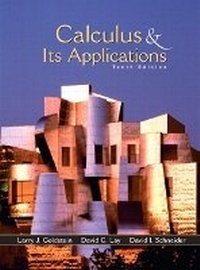
Calculus and Its Applications
International Edition
10th Edition
Published on 17. April 2003
Book
Paperback/Softback
736 pages
978-0-13-121731-7 (ISBN)
Description
For Applied Calculus courses.
These extremely readable, highly regarded, and widely adopted texts present innovative ways for applying calculus to real-world situations in the business, economics, life science, and social science disciplines. The texts' straightforward, engaging approach fosters the growth of both the student's mathematical maturity and his/her appreciation for the usefulness of mathematics. The authors' tried and true formula-pairing substantial amounts of graphical analysis and informal geometric proofs with an abundance of hands-on exercises-has proven to be tremendously successful with both students and instructors.
These extremely readable, highly regarded, and widely adopted texts present innovative ways for applying calculus to real-world situations in the business, economics, life science, and social science disciplines. The texts' straightforward, engaging approach fosters the growth of both the student's mathematical maturity and his/her appreciation for the usefulness of mathematics. The authors' tried and true formula-pairing substantial amounts of graphical analysis and informal geometric proofs with an abundance of hands-on exercises-has proven to be tremendously successful with both students and instructors.
More details
Edition
10th edition
Language
English
Place of publication
United States
Publishing group
Pearson Education (US)
Target group
Professional and scholarly
Dimensions
Height: 253 mm
Width: 201 mm
Thickness: 26 mm
Weight
1292 gr
ISBN-13
978-0-13-121731-7 (9780131217317)
Copyright in bibliographic data and cover images is held by Nielsen Book Services Limited or by the publishers or by their respective licensors: all rights reserved.
Schweitzer Classification
Other editions
New editions
Larry J. Goldstein | David I. Schneider | David C. Lay
Calculus and its Applications
International Edition
Book
03/2006
11th Edition
Pearson
€68.08
Article exhausted; check for reprint
Content
(NOTE: Calculus and Its Applications, 10/E consists of Chs. 0-12. Brief Calculus and Its Applications, 10/E consists of Chs. 0-8.)
Index of Applications.
Preface.
Introduction.
0. Functions.
Functions and Their Graphs. Some Important Functions. The Algebra of Functions. Zeros of Functions - The Quadratic Formula and Factoring. Exponents and Power Functions. Functions and Graphs in Applications. Appendix: Graphing Functions Using Technology.
1. The Derivative.
The Slope of a Straight Line. The Slope of a Curve at a Point. The Derivative. Limits and the Derivative. Differentiability and Continuity. Some Rules for Differentiation. More About Derivatives. The Derivative as a Rate of Change.
2. Applications of the Derivative.
Describing Graphs of Functions. The First and Second Derivative Rules. Curve Sketching (Introduction.) Curve Sketching (Conclusion.) Optimization Problems. Further Optimization Problems. Applications of Derivatives to Business and Economics.
3. Techniques of Differentiation.
The Product and Quotient Rules. The Chain Rule and the General Power Rule. Implicit Differentiation and Related Rates.
4. The Exponential and Natural Logarithm Functions.
Exponential Functions. The Exponential Function e x. Differentiation of Exponential Functions. The Natural Logarithm Function. The Derivative of ln x. Properties of the Natural Logarithm Function.
5. Applications of the Exponential and Natural Logarithm Functions.
Exponential Growth and Decay. Compound Interest. Applications of the Natural Logarithm Function to Economics. Further Exponential Models.
6. The Definite Integral.
Antidifferentiation. Areas and Reimann Sums. Definite Integrals and the Fundamental Theorem. Areas in the xy-Plane. Applications of the Definite Integral.
7. Functions of Several Variables.
Examples of Functions of Several Variables. Partial Derivatives. Maxima and Minima of Functions of Several Variables. Lagrange Multipliers and Constrained Optimization. The Method of Least Squares. Nonlinear Regression. Double Integrals.
8. The Trigonometric Functions.
Radian Measure of Angles. The Sine and the Cosine. Differentiation of sin t and cos t. The Tangent and Other Trigonometric Functions.
9. Techniques of Integration.
Integration by Substitution. Integration by Parts. Evaluation of Definite Integrals. Approximation of Definite Integrals. Some Applications of the Integral. Improper Integrals.
10. Differential Equations.
Solutions of Differential Equations. Separation of Variables. Numerical Solution of Differential Equations. Qualitative Theory of Differential Equations. Applications of Differential Equations.
11. Taylor Polynomials and Infinite Series.
Taylor Polynomials. The Newton-Raphson Algorithm. Infinite Series. Series with Positive Terms. Taylor Series.
12. Probability and Calculus.
Discrete Random Variables. Continuous Random Variables. Expected Value and Variance. Exponential and Normal Random Variables. Poisson and Geometric Random Variables.
Appendices.
A. Calculus and the TI-82 Calculator.
B. Calculus and the TI-83 Calculator.
C. Calculus and the TI-85 Calculator.
D. Calculus and the TI-86 Calculator.
E. Areas Under the Standard Normal Curve.
Index of Applications.
Preface.
Introduction.
0. Functions.
Functions and Their Graphs. Some Important Functions. The Algebra of Functions. Zeros of Functions - The Quadratic Formula and Factoring. Exponents and Power Functions. Functions and Graphs in Applications. Appendix: Graphing Functions Using Technology.
1. The Derivative.
The Slope of a Straight Line. The Slope of a Curve at a Point. The Derivative. Limits and the Derivative. Differentiability and Continuity. Some Rules for Differentiation. More About Derivatives. The Derivative as a Rate of Change.
2. Applications of the Derivative.
Describing Graphs of Functions. The First and Second Derivative Rules. Curve Sketching (Introduction.) Curve Sketching (Conclusion.) Optimization Problems. Further Optimization Problems. Applications of Derivatives to Business and Economics.
3. Techniques of Differentiation.
The Product and Quotient Rules. The Chain Rule and the General Power Rule. Implicit Differentiation and Related Rates.
4. The Exponential and Natural Logarithm Functions.
Exponential Functions. The Exponential Function e x. Differentiation of Exponential Functions. The Natural Logarithm Function. The Derivative of ln x. Properties of the Natural Logarithm Function.
5. Applications of the Exponential and Natural Logarithm Functions.
Exponential Growth and Decay. Compound Interest. Applications of the Natural Logarithm Function to Economics. Further Exponential Models.
6. The Definite Integral.
Antidifferentiation. Areas and Reimann Sums. Definite Integrals and the Fundamental Theorem. Areas in the xy-Plane. Applications of the Definite Integral.
7. Functions of Several Variables.
Examples of Functions of Several Variables. Partial Derivatives. Maxima and Minima of Functions of Several Variables. Lagrange Multipliers and Constrained Optimization. The Method of Least Squares. Nonlinear Regression. Double Integrals.
8. The Trigonometric Functions.
Radian Measure of Angles. The Sine and the Cosine. Differentiation of sin t and cos t. The Tangent and Other Trigonometric Functions.
9. Techniques of Integration.
Integration by Substitution. Integration by Parts. Evaluation of Definite Integrals. Approximation of Definite Integrals. Some Applications of the Integral. Improper Integrals.
10. Differential Equations.
Solutions of Differential Equations. Separation of Variables. Numerical Solution of Differential Equations. Qualitative Theory of Differential Equations. Applications of Differential Equations.
11. Taylor Polynomials and Infinite Series.
Taylor Polynomials. The Newton-Raphson Algorithm. Infinite Series. Series with Positive Terms. Taylor Series.
12. Probability and Calculus.
Discrete Random Variables. Continuous Random Variables. Expected Value and Variance. Exponential and Normal Random Variables. Poisson and Geometric Random Variables.
Appendices.
A. Calculus and the TI-82 Calculator.
B. Calculus and the TI-83 Calculator.
C. Calculus and the TI-85 Calculator.
D. Calculus and the TI-86 Calculator.
E. Areas Under the Standard Normal Curve.