

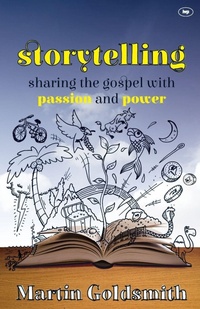
Storytelling
Sharing The Gospel With Passion And Power
Published on 19. September 2014
Book
Paperback/Softback
160 pages
978-1-78359-155-8 (ISBN)
Description
Biblical Stories are powerful stories and are easy to tell.
In a world that is often hostile to the good news, telling stories is an ideal way to communicate the gospel warmly and winningly. How can we, like Jesus, use the power of stories to get gospel truths across in a memorable and life-changing way? Learning to share the gospel with the winning and persuasive power of stories.
Martin Goldsmith discovered early in his career as a missionary that stories were the most effective way of sharing the gospel - especially in places where evangelism was illegal. But, since then, he's discovered that they are also often the best way of sharing it with our neighbours in the West, who are suspicious of religious truth and hate being preached at.
Full of colourful stories from a lifetime of sharing the gospel, this book shows us how to do the same. The author demonstrates how the Bible teaches its theology through story, and how other faiths are shaped by their storytelling - giving us a deeper understanding of how we can reach others and teach real and significant truths in an enthralling way.
If we want to win hearers for the gospel in today's world, it is vital to become compelling and persuasive tellers of the gospel story once again.
In a world that is often hostile to the good news, telling stories is an ideal way to communicate the gospel warmly and winningly. How can we, like Jesus, use the power of stories to get gospel truths across in a memorable and life-changing way? Learning to share the gospel with the winning and persuasive power of stories.
Martin Goldsmith discovered early in his career as a missionary that stories were the most effective way of sharing the gospel - especially in places where evangelism was illegal. But, since then, he's discovered that they are also often the best way of sharing it with our neighbours in the West, who are suspicious of religious truth and hate being preached at.
Full of colourful stories from a lifetime of sharing the gospel, this book shows us how to do the same. The author demonstrates how the Bible teaches its theology through story, and how other faiths are shaped by their storytelling - giving us a deeper understanding of how we can reach others and teach real and significant truths in an enthralling way.
If we want to win hearers for the gospel in today's world, it is vital to become compelling and persuasive tellers of the gospel story once again.
More details
Language
English
Place of publication
Nottingham
United Kingdom
Product notice
Paperback (UK-trade)
Dimensions
Height: 216 mm
Width: 140 mm
Thickness: 11 mm
Weight
252 gr
ISBN-13
978-1-78359-155-8 (9781783591558)
Copyright in bibliographic data and cover images is held by Nielsen Book Services Limited or by the publishers or by their respective licensors: all rights reserved.
Schweitzer Classification
Other editions
Additional editions
E-Book
09/2014
1st Edition
Inter-Varsity Press
€11.49
Available for download
Person
Martin Goldsmith is a Jewish Christian who trained as a Russian interpreter. He and his wife Elizabeth spent ten years as missionaries in South East Asia, and were involved from the start with All Nations Christian College, where they were both lecturers for over twenty years. Today they travel the world, lecturing and speaking at conferences.
Content
Introduction
1 The first challenge
2 Telling stories and influencing minds
3 Stories in other faiths
4 Biblical patterns of teaching
5 Using Bible stories in evangelism
6 Adapting other people's stories
7 Teaching by parables
8 Different cultures tell stories in different ways
Conclusion
Notes
1 The first challenge
2 Telling stories and influencing minds
3 Stories in other faiths
4 Biblical patterns of teaching
5 Using Bible stories in evangelism
6 Adapting other people's stories
7 Teaching by parables
8 Different cultures tell stories in different ways
Conclusion
Notes