

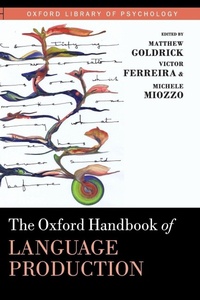
The Oxford Handbook of Language Production
Published on 22. May 2014
Book
Hardback
512 pages
978-0-19-973547-1 (ISBN)
Description
The Oxford Handbook of Language Production provides a comprehensive, multidisciplinary review of the complex mechanisms involved in language production. It describes what we know of the computational, linguistic, cognitive, and brain basis of human language production - from how we conceive the messages we aim to convey, to how we retrieve the right (and sometimes wrong) words, how we form grammatical sentences, and how we assemble and articulate individual sounds. Contributions from leading psycholinguists, cognitive linguists, and neuroscientists offer readers a broad perspective on the latest research, highlighting key investigations into core aspects of human language processing.
The Handbook is organized into three sections: speaking, written and sign languages, and how language production interfaces with the wider cognitive system, including control processes, memory, non-linguistic gestures, and the perceptual system. These chapters discuss a wide array of levels of representation, from sentences to individual words, speech sounds and articulatory gestures, extending to discourse and the broader social context of speaking. Detailed supporting chapters provide an overview of key issues in linguistic structure at each level of representation. Authoritative yet concisely written, the volume will be of interest to scholars and students working in cognitive psychology, psycholinguistics, cognitive neuroscience, computer science, audiology, and education, and related fields.
The Handbook is organized into three sections: speaking, written and sign languages, and how language production interfaces with the wider cognitive system, including control processes, memory, non-linguistic gestures, and the perceptual system. These chapters discuss a wide array of levels of representation, from sentences to individual words, speech sounds and articulatory gestures, extending to discourse and the broader social context of speaking. Detailed supporting chapters provide an overview of key issues in linguistic structure at each level of representation. Authoritative yet concisely written, the volume will be of interest to scholars and students working in cognitive psychology, psycholinguistics, cognitive neuroscience, computer science, audiology, and education, and related fields.
Reviews / Votes
"Numerous tables and figures help clarify the concepts. This is not an easy read without a background in speech and language, but the target audience will not be disappointed." -Gary B Kaniuk, Doody's Health Sciences Book ReviewMore details
Series
Language
English
Place of publication
New York
United States
Target group
College/higher education
Dimensions
Height: 260 mm
Width: 183 mm
Thickness: 32 mm
Weight
1148 gr
ISBN-13
978-0-19-973547-1 (9780199735471)
Copyright in bibliographic data and cover images is held by Nielsen Book Services Limited or by the publishers or by their respective licensors: all rights reserved.
Schweitzer Classification
Other editions
Additional editions
Matthew Goldrick | Victor Ferreira | Michele Miozzo
The Oxford Handbook of Language Production
E-Book
04/2014
1st Edition
OUP eBook
€178.99
Available for download
Matthew Goldrick | Victor Ferreira | Michele Miozzo
The Oxford Handbook of Language Production
E-Book
04/2014
OUP eBook
€178.99
Available for download
Persons
Matthew Goldrick is Associate Professor of Linguistics at Northwestern University, where he is affiliated with the Northwestern Cognitive Science Program and the Northwestern University Interdisciplinary Neuroscience Program. His research draws on behavioral experiments as well as computational and mathematical modeling to develop theories of the cognitive and neural mechanisms underlying the production, perception, and acquisition of sound structure.
Victor Ferreira is Professor of Psychology and Associate Director of the Center for Research in Language at the University of California, San Diego. Dr. Ferreira's research focuses on language production and communication. Specific research questions center on how speakers form sentences, how speakers retrieve and produce individual words, and how the knowledge that speakers and listeners have of one another affects language production behavior.
Michele Miozzo is Assistant Research Professor at Johns Hopkins and has held positions at Columbia University and the University of Cambridge. His research focuses on the organization of the brain mechanisms supporting word production in speaking, a topic he investigates with individuals with acquired language impairments and neuroimaging techniques.
Victor Ferreira is Professor of Psychology and Associate Director of the Center for Research in Language at the University of California, San Diego. Dr. Ferreira's research focuses on language production and communication. Specific research questions center on how speakers form sentences, how speakers retrieve and produce individual words, and how the knowledge that speakers and listeners have of one another affects language production behavior.
Michele Miozzo is Assistant Research Professor at Johns Hopkins and has held positions at Columbia University and the University of Cambridge. His research focuses on the organization of the brain mechanisms supporting word production in speaking, a topic he investigates with individuals with acquired language impairments and neuroimaging techniques.
Author
Associate Professor of LinguisticsAssociate Professor of Linguistics, Northwestern University, Evanston, United States of American
Professor of PsychologyProfessor of Psychology, University of California, San Diego, San Diego, United States of America
Assistant Research ProfessorAssistant Research Professor, Johns Hopkins University, New York, United States of America
Content
The Oxford Handbook of Language Production ; Part One: Speaking ; 1. Message encoding (Agnieszka Konopka & Sarah Brown-Schmidt) ; 2. Syntactically Speaking ; Kathryn Bock and Victor Ferreira ; 3. Neural Bases of Sentence Processing: Evidence from Neurolinguistic and Neuroimaging Studies ; Cynthia Thompson and Aneta Kielar ; 4. Computational Models Of Sentence Production: A Dual-path Approach ; Franklin Chang and Hartmut Fitz ; 5. Word Production: Behavioral and Computational Considerations ; Gary S. Dell, Nazbanou Nozari, and Gary M. Oppenheim ; 6. Neural Bases of Word Representations for Naming ; David S. Race and Argye E. Hillis ; 7. Organization and Structure of Conceptual Representations ; Anna Leshinskaya and Alfonso Caramazza ; 8. Giving Words Meaning: Why Better Models of Semantics Are Needed in Language Production Research ; David Vinson, Mark Andrews, Gabriella Vigliocco ; 9. The Morphology of Words ; James P. Blevins ; 10. Speech Planning in Two Languages: What Bilinguals Tell Us about Language Production ; Judith F. Kroll and Tamar H. Gollan ; 11. Bilingual word access (Elin Runnqvist, Kristof Strijkers & Albert Costa) ; 12. Phonology and Phonological Theory ; Eric Bakovi? ; 13. The Temporal Organization of Speech ; Louis Goldstein and Marianne Pouplier ; 14. Phonological Processing: The Retrieval and Encoding of Word Form Information in Speech Production ; Matthew Goldrick ; 15. Phonetic Processing ; Adam Buchwald ; 16. Phrase-level Phonological and Phonetic Phenomena ; Stefanie Shattuck-Hufnagel ; 17. Neural Bases of Phonological and Articulatory Processing ; Wolfram Ziegler and Hermann Ackermann ; 18. Spontaneous discourse ; Herbert H. Clark ; 19. Producing Socially Meaningful Linguistic Variation ; Molly Babel and Benjamin Munson ; Part Two: Beyond Speaking ; 20. Writing Systems, Language Production, and Modes of Rationality ; David R. Olson ; 21. Representation of Orthographic Knowledge ; Brenda Rapp and Simon Fischer-Baum ; 22. The Role of Lexical and Sublexical Orthography in Writing: Autonomy, Interactions, and Neurofunctional Correlates ; Gabriele Miceli and Vanessa Costa ; 23. The Structure of Sign Languages ; Gaurav Mathur and Christian Rathmann ; 24. Sign Language Production: An Overview ; David P. Corina, Eva Gutierrez, and Michael Grosvald ; Part Three: The Interface of Production with Other Cognitive Systems ; 25. Monitoring and control of the production system ; Robert J. Hartsuiker ; 26. Language Production and Working Memory ; Randi C. Martin and L. Robert Slevc ; 27. Production of Speech-accompanying Gesture ; Sotaro Kita ; 28. Perception-production Interactions and their Neural Bases ; Jason A. Tourville, Maya G. Peeva, and Frank H. Guenther