

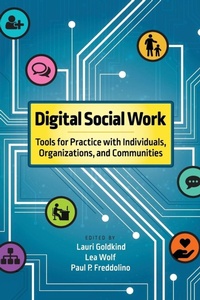
Digital Social Work
Tools for Practice with Individuals, Organizations, and Communities
Published on 10. January 2019
Book
Paperback/Softback
320 pages
978-0-19-087111-6 (ISBN)
Description
In a rapidly advancing technological culture, social work practitioners are frequently challenged to invent new strategies to meet client needs and foster social change. Despite the Council on Social Work Education's new standards for technology in social work practice, few schools of social work teach the use of technology for practice, and many instructors struggle with the integration this increasingly necessary dimension into education. Digital Social Work is designed to offer engaging, meaningful, and easy-to-use technology content that can be incorporated into generalist and advanced social work practice courses. The chapters in this volume offer instructors and students insight into the knowledge, skills, and values required of those who practice social work 2.0; by providing concrete examples of technology tools, they complement traditional social work curricula dealing with micro, mezzo, and macro systems. Chapters can be used singly--to augment Practice, Research, or Policy courses--or can provide a format to discuss technology in courses addressing practice with individuals, youth, and families. Virtual worlds, social media, GIS, blogs, and many other technology tools are represented in this collection.
Reviews / Votes
In what is certainly the study's most striking aspect, Scaglia claims that 'in the 1920s and 1930s, concerns about what people felt came to drive virtually every aspect of international life, from politics to leisure, from education to health'. In using inter war Alpine internationalism as a laboratory, she seeks to explain how emotions 'became a fundamental feature of internationalism, long shaped its development, and constitute an essential dimension of international history to this day'. * Talbot Imlay, French History * The volume enlarges our understanding of the spirit of an age in terms of one of its most significant creations: a whole spectrum of internationalisms. * Daniela Rossini, H-Diplo Review Essay * The book delicately balances between demonstrating, through numerous case studies, what are wonderful novel opportunities of technology and envisioning what could be possible in the future and which paths should be explored. * Innar Liiv, European Journal of Social Work *More details
Language
English
Place of publication
New York
United States
Target group
Professional and scholarly
Dimensions
Height: 234 mm
Width: 156 mm
Thickness: 17 mm
Weight
483 gr
ISBN-13
978-0-19-087111-6 (9780190871116)
Copyright in bibliographic data and cover images is held by Nielsen Book Services Limited or by the publishers or by their respective licensors: all rights reserved.
Schweitzer Classification
Other editions
Additional editions
Lauri Goldkind | Lea Wolf | Paul P. Freddolino
Digital Social Work
Tools for Practice with Individuals, Organizations, and Communities
E-Book
10/2018
1st Edition
OUP eBook
€29.99
Available for download
Lauri Goldkind | Lea Wolf | Paul P. Freddolino
Digital Social Work
Tools for Practice with Individuals, Organizations, and Communities
E-Book
10/2018
1st Edition
OUP eBook
€29.99
Available for download
Persons
Lauri Goldkind, PhD, MSW, is Associate Professor in the Graduate School of Social Service at Fordham University. As a social worker who has focused on macro practice, she is also interested in organizational development and evaluating organizational effectiveness across all areas (including use of technology, defining notions of accountability, and leadership development). Her current research has two strands: technology implementation, information, and communication technologies (ICT) tools in human services; and nonprofits, social justice, and civic engagement in organizational life.
Lea Wolf, MSW, is a social worker who lives and works in New York City. Wolf's published work addresses arts-based interventions across sectors, social activism, and the nexus of social work and technology.
Paul P. Freddolino, MDiv, PhD, is Professor of Social Work at Michigan State University. He has led development of hybrid/blended social work education programs and online courses. He is also actively
engaged in research related to the use of technology tools in social work practice. Current projects focus on technology for stroke victims, for people with dementia, and for caregivers of both.
Lea Wolf, MSW, is a social worker who lives and works in New York City. Wolf's published work addresses arts-based interventions across sectors, social activism, and the nexus of social work and technology.
Paul P. Freddolino, MDiv, PhD, is Professor of Social Work at Michigan State University. He has led development of hybrid/blended social work education programs and online courses. He is also actively
engaged in research related to the use of technology tools in social work practice. Current projects focus on technology for stroke victims, for people with dementia, and for caregivers of both.
Content
1. Introduction Part I: INDIVIDUAL2. Promoting Real Abilities in a Virtual World 3. Where I Was and Where I Want to Go: Digital Music and Therapeutic Songwriting 4. mDad: Helping Dads Be Better Parents with Mobile Phones 5. Online Social Support for Foster Care Youths Transitioning to College and Adulthood 6. Digital Storytelling: Tools, Techniques, and Traditions 7. Using Data to Improve Client Services Part II. ORGANIZATION8. Getting Big Data to the Good Guys: The Promises and Challenges of San Francisco's Shared Youth Database 9. The Use of Geographic Information Systems for Social Work Education, Research, and Practice 10. Social Media in Agency Settings Part III. COMMUNITY11. Blogging: A Tool for Social Justice 12. The Safety Net Gets Much Closer: m-Government and Mobile Benefits 13. #MacroSW: A Twitter Community of Personal Learning and Practice 14. Going Forward