

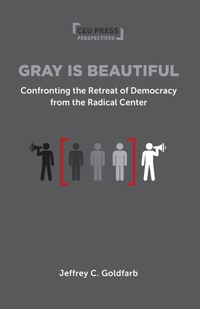
Gray is Beautiful
Confronting the Retreat of Democracy from the Radical Center
Will be published approx. on 19. January 2026
Book
Paperback/Softback
250 pages
978-963-386-861-4 (ISBN)
Description
With "the age of democracy" apparently coming to an end, Jeffrey C. Goldfarb offers hope against hopelessness, turning away from the canned political perspectives of the left, right, and center to recognize the beauty of the less than perfect and to emphasize the centrality of free public life. In Gray is Beautiful, he reflects on a lifetime of political engagement and scholarship, drawing upon experiences as a radical New Leftist, participant observer of the democratic opposition "behind the iron curtain," teacher in Afghanistan, and publisher of online public forums. Offering original insights, this book considers the promise rather than the problems of political uncertainty, uses Tocqueville's mistakes to understand the present state of democracy in America, and considers the ironies of collaboration. Goldfarb helps readers confront today's central challenges in fresh ways, demonstrating that the political gray is indeed beautiful and how this sensibility provides a way to confront the global retreat of democracy.
More details
Series
Language
English
Place of publication
Amsterdam
Hungary
Target group
Professional and scholarly
Academic
Dimensions
Height: 216 mm
Width: 140 mm
Thickness: 12 mm
Weight
286 gr
ISBN-13
978-963-386-861-4 (9789633868614)
Copyright in bibliographic data and cover images is held by Nielsen Book Services Limited or by the publishers or by their respective licensors: all rights reserved.
Schweitzer Classification
Person
Jeffrey C. Goldfarb is the Michael E. Gellert Professor of Sociology Emeritus at The New School for Social Research. He is the author of dozens of articles and eight previous books, including Reinventing Political Culture: The Power of Culture versus the Culture of Power (2013).
Content
Introduction: 1. The Sensibility, the Commitment, the Context, and the Approach
Inquiries:
2. Uncertainty in Times of Pandemic: Confronting the Social Condition
3. Intellectuals in Dark Times: Reflections on Lived Experience
4. Hannah Arendt and the Radical Center
5. Art After Auschwitz
6. Teaching in Afghanistan: Acting as if we live in a free society
7. Tocqueville's Democracy in America and Making America Great Again.
8. A Collaborator: To be or Not to Be?
Conclusions
9. The Cynical Society (Revisited) and the Retreat of Democracy.
10. Confronting the Enemy: Hope Against Hopelessness
References
Inquiries:
2. Uncertainty in Times of Pandemic: Confronting the Social Condition
3. Intellectuals in Dark Times: Reflections on Lived Experience
4. Hannah Arendt and the Radical Center
5. Art After Auschwitz
6. Teaching in Afghanistan: Acting as if we live in a free society
7. Tocqueville's Democracy in America and Making America Great Again.
8. A Collaborator: To be or Not to Be?
Conclusions
9. The Cynical Society (Revisited) and the Retreat of Democracy.
10. Confronting the Enemy: Hope Against Hopelessness
References