

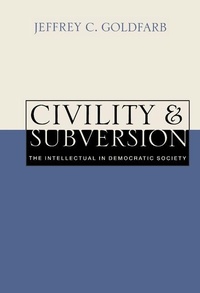
Civility and Subversion
The Intellectual in Democratic Society
Published on 12. November 1998
Book
Hardback
264 pages
978-0-521-62220-2 (ISBN)
Description
This 1998 book provides a sophisticated alternative to existing accounts of the role of the intellectual in modern democracy. Arguing that society suffers from a systemic deliberation deficit, Jeffrey Goldfarb explores the potential of the intellectual as democratic agent, at once civilizing political contestation and subverting complacent consensus. The sentimental Leftist view of the intellectual as guardian of democracy and the demonising Rightist view of the intellectual as obstructor of progress, are both shown to be flawed. Instead, intellectuals are portrayed as special kinds of 'strangers' who pay careful attention to their critical faculties, equipping them uniquely to address the most pressing issues of today. Professor Goldfarb deploys classical and contemporary social theory to analyse a diverse set of intellectuals in action, from Socrates in fifth-century Athens to Malcolm X and Toni Morrison in twentieth-century America, and, drawing on personal acquaintance, the political dissidents in Communist and post-Communist Central Europe.
Reviews / Votes
"This is a serious book by an exceptionally thoughtful, learned scholar." Canadian Journal of Sociology Online "This is a fine book. It is also an honest book. It avoids easy rhetoric and facile posturing. It will, no doubt, annoy some of its readers. It contributes to an important debate, the significance of which extendds beyond the confines of the American academy." Jeremy Jennings, Social ForcesMore details
Language
English
Place of publication
Cambridge
United Kingdom
Target group
Professional and scholarly
Dimensions
Height: 235 mm
Width: 157 mm
Thickness: 20 mm
Weight
584 gr
ISBN-13
978-0-521-62220-2 (9780521622202)
Copyright in bibliographic data and cover images is held by Nielsen Book Services Limited or by the publishers or by their respective licensors: all rights reserved.
Schweitzer Classification
Person
Content
1. Introduction; 2. Who are the intellectuals?; 3. The civil intellectual and the public; 4. The subversive intellectual and the public; 5. The civil society ideal; 6. The intellectuals and the politics of culture after Communism; 7. The university; 8. Race and discursive disruption; 9. Race and sustained deliberation; 10. Why is there no feminism after Communism?; 11. Civility and subversion in cynical times.