

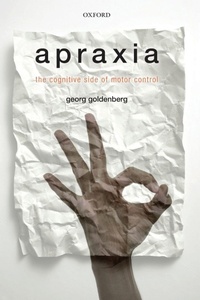
Apraxia
The Cognitive side of motor control
Published on 4. July 2013
Book
Hardback
282 pages
978-0-19-959151-0 (ISBN)
Description
Apraxia is a symptom of cerebral lesions that has puzzled clinicians and researchers for some 100 years. It has engendered many fascinating descriptions and a wide diversity of conflicting theoretical accounts.
This book is the first one that gives a comprehensive account of clinical and experimental findings on all manifestations of apraxia as well as of the history and the philosophical underpinning of theories on apraxia. The review of contemporary evidence is illustrated with vivid descriptions of clinical examples. The historical part reveals early precursors of the concept of apraxia in the last third of 19th century and resuscitates contributions made in the "holistic" era in the mid-20th century that have now largely fallen in oblivion. They show that the richness of ideas on apraxia is much greater than some modern authors would acknowledge.
Over and beyond giving an overview of history and clinical appearance of apraxia the book explores the philosophical fundaments that underlie definitions, classifications, and theories of apraxia. Goldenberg argues that they are ultimately grounded in a mind versus body dichotomy that appears as opposition between high and low or, respectively, cognitive and motor levels of action control. By relating history and modern evidence to perennial philosophical problems the book transgresses the topic of apraxia and touches the fundaments of cognitive neuroscience.
This book will make fascinating reading for those in the fields of neuroscience, neurology, neuropsychology, and developmental psychology
This book is the first one that gives a comprehensive account of clinical and experimental findings on all manifestations of apraxia as well as of the history and the philosophical underpinning of theories on apraxia. The review of contemporary evidence is illustrated with vivid descriptions of clinical examples. The historical part reveals early precursors of the concept of apraxia in the last third of 19th century and resuscitates contributions made in the "holistic" era in the mid-20th century that have now largely fallen in oblivion. They show that the richness of ideas on apraxia is much greater than some modern authors would acknowledge.
Over and beyond giving an overview of history and clinical appearance of apraxia the book explores the philosophical fundaments that underlie definitions, classifications, and theories of apraxia. Goldenberg argues that they are ultimately grounded in a mind versus body dichotomy that appears as opposition between high and low or, respectively, cognitive and motor levels of action control. By relating history and modern evidence to perennial philosophical problems the book transgresses the topic of apraxia and touches the fundaments of cognitive neuroscience.
This book will make fascinating reading for those in the fields of neuroscience, neurology, neuropsychology, and developmental psychology
Reviews / Votes
In this book, Professor Goldenberg has made an impressive case for placing apraxia at the centre of neuropsychological research ... this book not only represents not only a summary of his own seminal work in the area but the mose erudite and comprehensive review of the condition we are likely to encounter for some time * Andrew Worthington, consultant in neuropsychology and rehabilitation, Perception. * A pleasing combination of clinical storytelling in the vein of Oliver Sacks and scholarly review, this book is sure to appeal to students and early career clinicians interested in apraxia. * Doody's Notes * The book by Goldenberg on apraxia contains a comprehensive description of different manifestations of apraxia and addresses the different classifications... I found the historical part particularly interesting, both as relates to apraxia but also ideas as to how the brain works. * Brain * Apraxia - The Cognitive Side of Motor Control authored by one of the foremost authorities in the field of apraxia, Professor Georg Goldenberg, is a highly interesting and well-written addition to medical literature. The book offers a comprehensive and informative exploration into the historical basis of apraxia from the 19th century theoretical models to current interpretations. Only when this historical travel is dissected in its entirety as well presented by Goldenberg, does the true impetus and interest for present and future research emerge... I highly recommend Goldberg's impressive oeuvre on apraxia to those who dedicate their studies to the mysteries and complexities of the human brain. * European Neurology *More details
Language
English
Place of publication
Oxford
United Kingdom
Target group
College/higher education
Professional and scholarly
Dimensions
Height: 260 mm
Width: 183 mm
Thickness: 20 mm
Weight
745 gr
ISBN-13
978-0-19-959151-0 (9780199591510)
Copyright in bibliographic data and cover images is held by Nielsen Book Services Limited or by the publishers or by their respective licensors: all rights reserved.
Schweitzer Classification
Other editions
Person
Professor Goldenberg studied medicine and was trained as a neurologist in Vienna. After stages in Aachen and Paris he was habilitated with a thesis on the neurological basis of mental visual images in 1986. Since 1995 he has been Director of the Department of Neuropsychology at Bogenhausen Hospital and Professor at the Technical University of Munich. Goldenberg also served as Chairman of the German Society for Aphasia Research and Treatment and is associate editor of core journals in neuropsychology and neurological rehabilitation. He has published more than 200 scientific papers in international journals and about 50 book chapters. He is author of a popular German textbook on clinical neuropsychology and co-editor of German and English books on Clinical Neuropsychology.
Content
1. Apraxia before Liepmann: Mind-Palsy, Asymbolia, and Apraxia ; 2. Hugo Karl Liepmann ; 3. The decline of diagrams ; 4. Return of the ostracised ; 5. High and Low Levels of Action Control ; 6. Imitation: A direct route from vision to action? ; 7. Body part specificity ; 8. Use of single tools ; 9. Naturalistic action ; 10. Communicative Gestures - Pantomime of Tool Use ; 11. Communicating with Gestures ; 12. Apraxia in left handers ; 13. Approaching apraxia from the motor side ; 14. Callosal apraxia and intermanual conflict ; 15. The cognitive side of motor control ; 16. Levels of therapy