

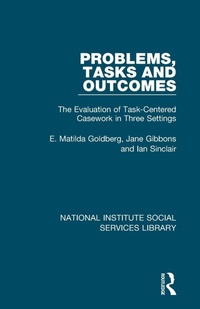
Problems, Tasks and Outcomes
The Evaluation of Task-Centered Casework in Three Settings
1st Edition
Published on 5. November 2023
Book
Paperback/Softback
282 pages
978-1-032-05193-2 (ISBN)
Description
In the 1980s, although most social workers organised their time and described their work in terms of cases, research studies had cast serious doubts on the efficacy of working in this way. As a result, there had been growing anxiety about what social workers do, what they ought to do, and the training they needed.
Task-centred casework was an approach to social work which proposed a solution to some aspects of this dilemma. Growing out of the surprising results of an American research study, it broke free from the traditional psycho-analytic approach to casework. It aimed at clarity of purpose, a concentration on the clients' perceptions of the problems, openness about clients' and helpers' intentions and agreement about what is to be done and achieved within a specified time.
Originally published in 1985, this book brings together three British studies that accompanied, and in some respects pioneered, the introduction of task-centred casework into the United Kingdom. The studies describe and evaluate task-centred casework with social services department clients, with young people on probation, and with men and women referred to hospital after poisoning themselves. The research suggests what task-centred casework can and cannot achieve, describes how clients experience it and seeks to define the skills it requires. The studies also provide some reasons why many previous studies of social work have failed to find evidence for social work effectiveness.
The book uses much case material to illustrate methods of task-centred casework and its outcomes as seen by clients, social workers, and an independent outsider. It should still be of interest to social workers, teachers of social work, and social work students. More generally, it will be welcomed by all those who are interested in building social work on a surer basis than anecdote and fashion.
Task-centred casework was an approach to social work which proposed a solution to some aspects of this dilemma. Growing out of the surprising results of an American research study, it broke free from the traditional psycho-analytic approach to casework. It aimed at clarity of purpose, a concentration on the clients' perceptions of the problems, openness about clients' and helpers' intentions and agreement about what is to be done and achieved within a specified time.
Originally published in 1985, this book brings together three British studies that accompanied, and in some respects pioneered, the introduction of task-centred casework into the United Kingdom. The studies describe and evaluate task-centred casework with social services department clients, with young people on probation, and with men and women referred to hospital after poisoning themselves. The research suggests what task-centred casework can and cannot achieve, describes how clients experience it and seeks to define the skills it requires. The studies also provide some reasons why many previous studies of social work have failed to find evidence for social work effectiveness.
The book uses much case material to illustrate methods of task-centred casework and its outcomes as seen by clients, social workers, and an independent outsider. It should still be of interest to social workers, teachers of social work, and social work students. More generally, it will be welcomed by all those who are interested in building social work on a surer basis than anecdote and fashion.
More details
Series
Language
English
Place of publication
London
United Kingdom
Publishing group
Taylor & Francis Ltd
Target group
College/higher education
Professional and scholarly
Postgraduate, Professional, and Undergraduate
Dimensions
Height: 216 mm
Width: 140 mm
Thickness: 15 mm
Weight
361 gr
ISBN-13
978-1-032-05193-2 (9781032051932)
Copyright in bibliographic data and cover images is held by Nielsen Book Services Limited or by the publishers or by their respective licensors: all rights reserved.
Schweitzer Classification
Other editions
Additional editions
E. Matilda Goldberg | Jane Gibbons | Ian Sinclair
Problems, Tasks and Outcomes
The Evaluation of Task-Centered Casework in Three Settings
Book
11/2021
1st Edition
Routledge
€165.80
Shipment within 10-20 days
E. Matilda Goldberg | Jane Gibbons | Ian Sinclair
Problems, Tasks and Outcomes
The Evaluation of Task-Centered Casework in Three Settings
E-Book
11/2021
1st Edition
Routledge
€44.99
Available for download
E. Matilda Goldberg | Jane Gibbons | Ian Sinclair
Problems, Tasks and Outcomes
The Evaluation of Task-Centered Casework in Three Settings
E-Book
11/2021
1st Edition
Routledge
€44.99
Available for download
Persons
E. Matilda Goldberg, Jane Gibbons, Ian Sinclair
Content
Introduction. Part I: Task-Centred Casework in Two Intake Teams by Ian Sinclair and David Waller 1. Introduction to Part One 2. Clients and Outcomes 3. Process and Outcome 4. What Determines Outcome? 5. Summary of Part One: Implications and Conclusion Part II: Task-Centred Casework in a Probation Setting by E. Matilda Goldberg and Stephen J. Stanley with the assistance of Jenny Kenrick 6. Evaluating the Effectiveness of Probation 7. Setting and Aims of the Project 8. Sample and Flow of Referrals 9. Throughput and Analysis of 100 Short-Term Probation Orders 10. Task-Centred Casework in a Probation Setting 11. Problems and Tasks 12. Outstanding Features of Task-Centred Intervention 13. Task Achievement and Problem Outcome 14. Factors Associated with Successful Outcome 15. Summary of Part Two 16. Conclusions of Part Two Part III: Task-Centred Social Work After Parasuicide by Jane Gibbons, Irene Bow and Janet Butler 17. Parasuicide: Trends and Characteristics 18. Social Work Methods and Parasuicide 19. The Experiment 20. The Results of the Trial 21. Task-Centred Work with Clients who Repeated Overdose 22. Making Contracts in Task-Centred Work 23. Implications of Research. Conclusion. Appendix to Part II. Appendix to Part III. Index.