

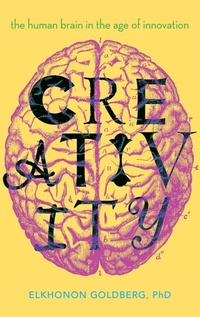
Creativity
The Human Brain in the Age of Innovation
Published on 31. January 2019
Book
Hardback
296 pages
978-0-19-046649-7 (ISBN)
Description
What is the nature of human creativity? What are the brain processes behind its mystique? What are the evolutionary roots of creativity? How does culture help shape individual creativity? Creativity: The Human Brain in the Age of Innovation by Elkhonon Goldberg is arguably the first ever book to address these and other questions in a way that is both rigorous and engaging, demystifying human creativity for the general public. The synthesis of neuroscience and the humanities is a unique feature of the book, making it of interest to an unusually broad range of readership. Drawing on a number of cutting-edge discoveries from brain research as well as on his own insights as a neuroscientist and neuropsychologist, Goldberg integrates them with a wide-ranging discussion of history, culture, and evolution to arrive at an original, compelling, and at times provocative understanding of the nature of human creativity. To make his argument, Goldberg discusses the origins of language, the nature of several neurological disorders, animal cognition, virtual reality, and even artificial intelligence. In the process, he takes the reader to different times and places, from antiquity to the future, and from Western Europe to South-East Asia. He makes bold predictions about the future directions of creativity and innovation in society, their multiple biological and cultural roots and expressions, about how they will shape society for generations to come, and even how they will change the ways the human brain develops and ages.
Reviews / Votes
well written and wide-ranging ... Throughout the book, Goldberg embraces a strongly first-person presentation, which adds to the interest and memorability of his account. * Aaron Kozbelt, Evolutionary Studies in Imaginative Culture * Countless contributions have dealt with the psychological, socio-cultural, cognitive, evolutionary aspects of creativity. The neuroanatomical and physiological aspects have been explored to a limited extent: which is odd, as creativity is the product of brain's activity. Elkhonon Goldberg's book has the brain as its undisputed main character; this makes it uniquely important. The role of the brain's physiology and anatomy in the generation of creativity, with the frontal lobe and the prefrontal cortex in the privileged position, are discussed exhaustively and masterfully. Goldberg is a first rate neuroscientist and a born writer. * Ernesto Carafoli, MD, Venetian Institute of Molecular Medicine, University of Padova, Italy * In Creativity, Elkhonon Goldberg is subtle, judicious, relentlessly curious, fun and brutally honest about what neuroscience knows, and doesn't know, about the subject. He guides us through decades of research, to show that perhaps the most striking thing about our plastic organ of creativity, is that, while there are certain basic patterns in the creative brain, they are only starting points; the brainas circuitry, being so plastic, likely has just as many different ways of helping to produce creative states, as there are human ways of being creative. No one interested in the neuroscience of creativity can afford to miss this book. * Norman Doidge, MD, author of 'The Brain That Changes Itself', and 'The Brain's Way of Healing', Toronto, Canada * Dr. Goldberg has obviously travelled extensively and his observations and experiences seem like a beautifully written journey in themselves until he leads one to the point where he reveals even more involving aspects of creativity in other cultures and even species. As far as this book is concerned, Dr. Goldberg clearly knows what he's doing when it comes to Creativity. * John Fawcett, Creative Director, Balucate, Sydney, Australia * What an inspired marriage of Creativity and Neuroscience (big C, big N), officiated by a brave scientist and original thinker. This book will spark new research, new toolkits, new conversations * and much creativity.Alvaro Fernandez, MBA, MA, CEO & Editor-in-Chief of SharpBrains, Washington, DC * Elkhonon Goldberg's new book, Creativity: The Human Brain in the Age of Innovation is a very insightful study of our brains in a time of accelerating and multi-dimensional change. It is the fruit of both scholarly research and many decades of experience. Creativity is a wonderful addition to Dr. Goldberg's body of work. * Bienvenido F. Nebres, Professor of Mathematics, Past-President of Ateneo de Manila University, Manila, Philippines * Elkhonon Goldberg, PhD, a leading-edge neuropsychologist and broad-ranging thinker, has provided a brilliant, synthetic account of human creativity. A sophisticated understanding of brain function is combined with insights from contemporary psychology, evolutionary biology, and cross-cultural studies to elucidate the key processes underlying innovation in the arts, sciences and all areas of human endeavor. * David Silbersweig, MD, Co-Director, Neuroscience Center and Professor of Psychiatry, Brigham and Women's Hospital, Harvard Medical School, Boston, MA *More details
Language
English
Place of publication
New York
United States
Target group
Professional and scholarly
Dimensions
Height: 240 mm
Width: 161 mm
Thickness: 21 mm
Weight
611 gr
ISBN-13
978-0-19-046649-7 (9780190466497)
Copyright in bibliographic data and cover images is held by Nielsen Book Services Limited or by the publishers or by their respective licensors: all rights reserved.
Schweitzer Classification
Other editions
Additional editions
E-Book
01/2018
1st Edition
OUP eBook
€18.49
Available for download
E-Book
01/2018
1st Edition
OUP eBook
€18.49
Available for download
Person
Elkhonon Goldberg, PhD, ABPP, is a scientist, clinician, and educator. He is Director of Luria Neuroscience Institute and Clinical Professor in the Department of Neurology, NYU School of Medicine. Goldberg is internationally renowned for his research in cognitive neuroscience and clinical neuropsychology. He has authored several widely acclaimed books which have been translated into many languages. He lectures worldwide. Goldberg is also a clinician with an active practice in neuropsychology.
Content
TABLE OF CONTENTS
PREFACE
ACKNOWLEDGEMENTS
CHAPTER 1. THE AGE OF NOVELTY
CHAPTER 2. THE NEUROMYTHOLOGY OF CREATIVITY
From neuroorphans to neurofads
"Bad and useless"
Deconstructing innovation and creativity
Multiple creativities
CHAPTER 3. THE CONSERVATIVE BRAIN
How we know what we know
Mapping the world in the brain
How language found its home
"Isomorphic gradients"
Dementia with a silver lining?
CHAPTER 4. THE MERMAID AND THE LEGO MASTER (AND THE CAVE LION-MAN)
How is a new idea born?
Mechanics behind the metaphor - the macro view
The working memory conundrum
Phantoms in the brain - the micro view
CHAPTER 5. IT IS ALL ABOUT SALIENCE!
The salience circuit
Salient default
Salience, dopamine, and frontal arousal - or lack thereof
Salience diluted
Salience hijacked
CHAPTER 6. THE INNOVATING BRAIN
The novelty challenge
Hemispheres misunderstood
The novel and the routine
Wired for novelty
Driven by novelty
Novelty overdrive
CHAPTER 7. DIRECTED WANDERING AND THE INEFFABLE CREATIVE SPARK
No monkey business
The extreme frontal lobes
Dorsolateral bistability: Inspiration and perspiration
Lego master at work: creative perspiration
Lego master at rest: creative inspiration? Not yet
The brain's small world
Directed mental wondering: The creative spark
Iteration and selection
CHAPTER 8. IS THE BABOON CREATIVE?
Novelty in evolution
Human development and animal creativity
CHAPTER 9. THE CREATIVE MIND
A few worthy feats
Conform or not conform?
The theory of mind's mixed blessing
Creativity and intelligence
A few worthy tests
How bad is mad?
Creating minds
CHAPTER 10. THE CREATIVE BRAIN
A few worthy brains
Connectivity of creativity
Life in a small world
The advantages of having a coat
The advantages of not having a coat
Are "creativity genes" for real?
CHAPTER 11. EPILOGUE: WHAT'S NEXT?
Summing up and looking forward
Consuming innovation
Creating innovation
CHAPTER NOTES
INDEX
PREFACE
ACKNOWLEDGEMENTS
CHAPTER 1. THE AGE OF NOVELTY
CHAPTER 2. THE NEUROMYTHOLOGY OF CREATIVITY
From neuroorphans to neurofads
"Bad and useless"
Deconstructing innovation and creativity
Multiple creativities
CHAPTER 3. THE CONSERVATIVE BRAIN
How we know what we know
Mapping the world in the brain
How language found its home
"Isomorphic gradients"
Dementia with a silver lining?
CHAPTER 4. THE MERMAID AND THE LEGO MASTER (AND THE CAVE LION-MAN)
How is a new idea born?
Mechanics behind the metaphor - the macro view
The working memory conundrum
Phantoms in the brain - the micro view
CHAPTER 5. IT IS ALL ABOUT SALIENCE!
The salience circuit
Salient default
Salience, dopamine, and frontal arousal - or lack thereof
Salience diluted
Salience hijacked
CHAPTER 6. THE INNOVATING BRAIN
The novelty challenge
Hemispheres misunderstood
The novel and the routine
Wired for novelty
Driven by novelty
Novelty overdrive
CHAPTER 7. DIRECTED WANDERING AND THE INEFFABLE CREATIVE SPARK
No monkey business
The extreme frontal lobes
Dorsolateral bistability: Inspiration and perspiration
Lego master at work: creative perspiration
Lego master at rest: creative inspiration? Not yet
The brain's small world
Directed mental wondering: The creative spark
Iteration and selection
CHAPTER 8. IS THE BABOON CREATIVE?
Novelty in evolution
Human development and animal creativity
CHAPTER 9. THE CREATIVE MIND
A few worthy feats
Conform or not conform?
The theory of mind's mixed blessing
Creativity and intelligence
A few worthy tests
How bad is mad?
Creating minds
CHAPTER 10. THE CREATIVE BRAIN
A few worthy brains
Connectivity of creativity
Life in a small world
The advantages of having a coat
The advantages of not having a coat
Are "creativity genes" for real?
CHAPTER 11. EPILOGUE: WHAT'S NEXT?
Summing up and looking forward
Consuming innovation
Creating innovation
CHAPTER NOTES
INDEX